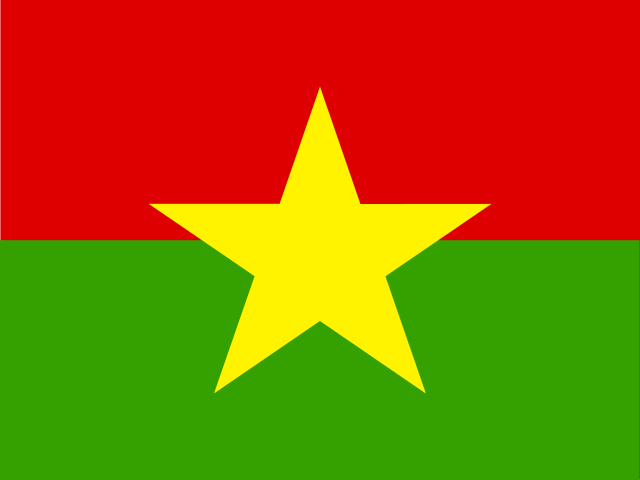
The Flag of Burkina Faso
Africa · Adopted 4 August 1984
Burkina Faso's flag dates to 4 August 1984, the first anniversary of the revolution led by Captain Thomas Sankara, the young army officer who seized power in 1983 and used the occasion to rename the country from Upper Volta — a name inherited from French colonial administration and referencing the Volta River — to Burkina Faso, meaning roughly 'Land of Upright/Honest People' in a blend of the Mòoré and Dioula languages.
The new flag replaced Upper Volta's previous black-white-red horizontal tricolor entirely, discarding a design that had represented the country's three main rivers (the Black, White, and Red Volta) in favor of a red-and-green horizontal bicolor with a five-pointed gold star centered across the middle, a design closely aligned with the pan-African and socialist symbolism Sankara's government embraced.
Red is officially described as representing the revolution and the struggle waged by the people, green stands for the country's agricultural and natural wealth, and the gold star is described as the guiding light of the revolution — an explicit echo of the red star used on numerous other socialist and Marxist-influenced African flags of the era, including Ghana's original 1957 flag which itself popularized the pan-African red-gold-green palette across the continent.
Sankara's government, often described as one of Africa's most radical post-independence experiments, pursued sweeping land reform, vaccination campaigns, and anti-corruption measures during its four years in power, and the flag adopted alongside the country's renaming was explicitly part of that project of breaking with the colonial and immediate post-colonial past.
Sankara was assassinated in a 1987 coup led by his former ally Blaise Compaoré, who went on to rule for 27 years, yet the flag and the country's new name survived that transition unchanged — a stability that has outlasted Compaoré's own 2014 ouster and the political instability, including several further coups, that Burkina Faso has experienced since 2022.
The flag's design has never been formally altered since 1984, remaining one of the more direct visual links back to Sankara's revolutionary government still in daily official use, even as his successors' governments have taken the country in sharply different political directions.
Sankara, who also renamed citizens 'Burkinabè' and pushed symbolic breaks with colonial-era customs such as ordering officials to travel economy class and swapping government Mercedes-Benz vehicles for cheaper cars, treated the flag and the country's renaming as part of one coordinated project of national self-definition — the symbolism was never meant to stand apart from the policy changes happening alongside it.
Burkina Faso's national emblem, distinct from the flag itself, likewise dates to the Sankara era and carries a similar red-green-gold palette featuring a shield, spears, and a scroll bearing the national motto 'Unité, Progrès, Justice' (Unity, Progress, Justice), reinforcing the same revolutionary-era symbolism across the country's other official insignia.
Following the military takeovers of 2022, Burkina Faso's transitional governments have invoked Sankara's legacy heavily in official rhetoric, and the unchanged flag has functioned as a continuous visual link between the current government and the 1983–1987 revolutionary period, regardless of how directly the current leadership's policies actually match Sankara's own.
Burkina Faso is one of three landlocked West African states, alongside Mali and Niger, that formed the Alliance of Sahel States in 2023–2024 after withdrawing from the regional bloc ECOWAS; officials from all three governments have invoked shared anti-colonial and revolutionary rhetoric reminiscent of Sankara's era in describing the new alliance, even though the flags of all three states were designed independently decades apart.
Burkina Faso's flag law requires the design to be flown at full staff on official buildings on both Independence Day (5 August) and the anniversary of the 1983 revolution (4 August), placing the country's two most significant national commemorations on consecutive days each year.
Before Sankara's revolution, Upper Volta's black-white-red flag, adopted at independence from France in 1960, had itself drawn on French tricolor conventions in its horizontal-band structure even while choosing its own colors, and its replacement in 1984 was as much a rejection of that colonial-adjacent design tradition as it was an embrace of pan-African socialist symbolism.
Because Sankara's government renamed the country rather than merely changing its flag, Burkina Faso is frequently cited alongside Ghana (from the Gold Coast) and Zimbabwe (from Rhodesia) as one of the clearest African examples of a post-independence government using both a new name and a new flag together to make a complete symbolic break from the colonial era.
The gold star at the center of the flag is drawn as a simple five-pointed shape without additional ornamentation, a plainer treatment than the elaborate stars used on some other African flags of the same period, consistent with the generally austere, function-first visual style Sankara's government favored across its official symbols.
Burkina Faso's population includes over 60 ethnic groups, with the Mossi forming the largest single group historically centered on Ouagadougou; the flag's plain, group-neutral red-green-gold design was chosen in part to avoid privileging any single ethnic community's traditional colors or symbols over another's.
A design that survives being shrunk
- Small hand-held flags — Two solid bands and one centred star, with the separate national emblem kept off the cloth entirely, is a design that still reads at postcard size where an emblem-bearing flag turns to mush.
As an Amazon Associate we earn from qualifying purchases made through these links, at no extra cost to you.
Often confused with
- Ghana — shares red, green, and a central gold/black star motif, the template Ghana itself established at independence in 1957, though Ghana's flag adds a horizontal yellow stripe rather than Burkina Faso's simple red-over-green split. Compare side by side →
- Guinea-Bissau — uses a black star on a similar pan-African palette, though arranged with a red vertical hoist band rather than Burkina Faso's horizontal red-green split. Compare side by side →
Burkina Faso at a glance
- Capital
- Ouagadougou
- Population
- 23.4 million (2024)
- Currency
- West African CFA Franc (XOF)
- Language(s)
- French (official); Mòoré, Dioula, and Fula widely spoken
Population figure as of 2024, source: UN World Population Prospects (2024 revision). See methodology for how facts are sourced and kept current.