Gitega — Capital of Burundi
Gitega became Burundi's official political capital on 18 January 2019, when the government relocated legislative and some executive functions there from Bujumbura, making it one of the most recent capital changes anywhere in the world; Bujumbura, the former capital, remains the country's largest city and its economic and diplomatic center, similar to the split seen between Porto-Novo and Cotonou in neighboring Benin.
The government's stated reasoning for the move centered on Gitega's more central geographic location within Burundi and on restoring the city's historical status: Gitega had been the capital of the pre-colonial Kingdom of Burundi and served as an important administrative center under both German and Belgian colonial rule before Bujumbura, a lakeside port, was designated capital instead in the 20th century.
Gitega's much smaller size and less developed infrastructure compared with Bujumbura have made the transition gradual rather than immediate; many embassies, international organizations, and much of the country's commercial activity have remained based in Bujumbura even after the official capital designation moved, leaving Burundi with a functional two-city arrangement in practice similar to several other African states with legal and de facto capitals in different places.
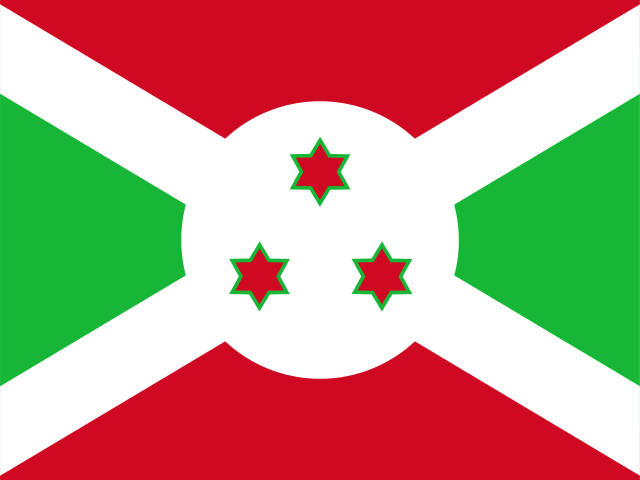
The city's National Museum of Gitega, one of Burundi's most significant cultural institutions, houses collections related to the pre-colonial monarchy, including royal regalia and historical artifacts connected to the karyenda drum tradition once central to Burundian kingship and formerly depicted on the country's flag before the 1967 redesign.
Belgian colonial administrators had used Gitega as an important regional center under their Ruanda-Urundi mandate, established after Germany lost the territory following the First World War, giving the city an administrative continuity that made it a natural candidate when the government later looked for a capital alternative to coastal Bujumbura.
Since the 2019 relocation, the Burundian government has invested in new government buildings and a stadium in Gitega intended to host national ceremonies previously held in Bujumbura, part of a longer-term plan to build out infrastructure to match the city's new formal status.
Gitega's cooler, higher-elevation climate compared with the lakeside heat of Bujumbura was cited by some officials as an additional practical reason for favoring the city as the seat of government, alongside the primary argument about central geographic location and historical royal significance.
Roads connecting Gitega to Bujumbura and to Burundi's other regional centers have required substantial upgrading since the 2019 capital move, part of a broader government infrastructure push aimed at making the new capital genuinely functional rather than symbolic only.
Burundi's coffee industry, the country's dominant export crop, is grown extensively in the hills surrounding Gitega, giving the new capital an economic hinterland distinct from Bujumbura's lakeside trade and fishing economy.
International reaction to the 2019 capital move was mixed, with some diplomatic missions and international organizations choosing to maintain their primary offices in Bujumbura for practical reasons even while formally recognizing Gitega's new status, a transitional arrangement that has persisted for several years since the change.
Gitega province, of which the city is the seat, is also one of Burundi's most densely populated and agriculturally productive regions, adding to the government's rationale that shifting political weight toward the country's center made both symbolic and practical sense.
The relocation echoed a pattern seen elsewhere on the continent, including Nigeria's move to Abuja and Tanzania's ongoing shift toward Dodoma, of governments relocating capitals away from a colonial-era coastal or lakeside commercial hub toward a more centrally located, historically or symbolically significant interior site.
Burundi's education and health infrastructure remain heavily concentrated in Bujumbura even after the 2019 political relocation, meaning Gitega's practical transformation into a fully self-sufficient capital city remains, by the government's own acknowledgment, a multi-decade undertaking rather than a completed process.
Quick facts
- Gitega's population is estimated at around 40,000 to 50,000, dramatically smaller than Bujumbura's metropolitan population of well over 1 million.
- The 2019 relocation was formalized through a constitutional revision under President Pierre Nkurunziza's government, which had floated moving the capital away from Bujumbura years earlier before finally pushing the change through.
- Gitega was previously the residence of the Burundian monarchy's royal court under the Ganwa ruling class before colonization.
- The city sits near the geographic center of Burundi, roughly 100 kilometers east of Lake Tanganyika and Bujumbura.