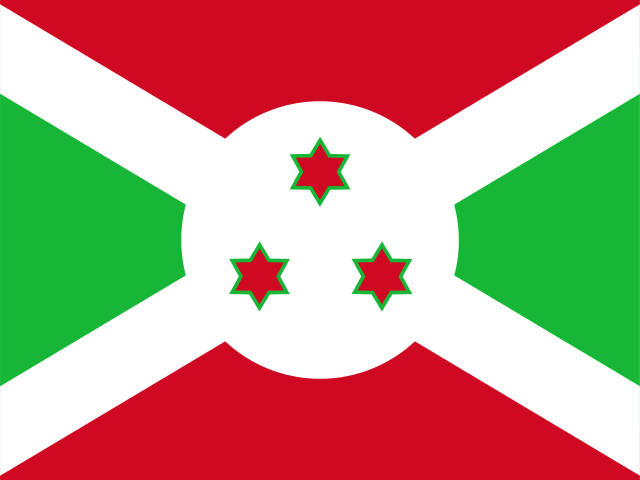
The Flag of Burundi
Africa · Adopted 28 June 1967
Burundi's flag reached its current form on 28 June 1967, a redesign of an earlier 1962 independence flag carried out after the monarchy was abolished and the country became a republic under Michel Micombero the previous year. The 1962 original had featured a drum, the karyenda, a royal symbol of the Burundian monarchy, at its center; the 1967 revision dropped the drum and replaced it with three six-pointed red stars, a change that stripped the flag of its explicit royalist imagery to fit the new republican government.
The design is built around a white diagonal cross (a saltire) that divides the flag into four triangular fields, alternating red at top and bottom with green at hoist and fly, with a white circular medallion at the center holding the three stars, each outlined in green.
The three stars are officially explained as representing Burundi's national motto, 'Unité, Travail, Progrès' (Unity, Work, Progress), though they are also very widely understood, and taught in some accounts, as a reference to Burundi's three officially recognized social groups — the Hutu, Tutsi, and Twa — whose relations have been central, and often violently contested, to the country's post-independence history.
White in the flag is described as representing peace, green as representing hope, and red as representing the struggle for independence, a fairly standard set of pan-national color meanings, though in Burundi's specific case the red also carries added weight given the extreme ethnic violence, including mass killings in 1972, 1988, and again during the 1993–2005 civil war, that the country experienced in the decades after independence.
The karyenda drum removed from the flag in 1967 remains an important cultural symbol even outside its former royal-political context; the Royal Drummers of Burundi tradition, which uses drums closely related to the karyenda, was recognized by UNESCO as part of the Intangible Cultural Heritage of Humanity in 2014, showing the imagery has outlived the monarchy that the flag itself once represented.
Burundi's 1966 republic, and the flag redesign that followed a year later, emerged from a rapid sequence of political upheaval: the country had only become independent from Belgium in 1962 as a constitutional monarchy, and within four years a military coup led by Micombero ended the monarchy entirely, making the flag's 1967 revision one of the fastest post-independence symbolic turnovers in the region.
Because the flag's design has remained legally unchanged since 1967 despite the extraordinary political volatility that followed — repeated coups, a long civil war, and a 2000s peace process culminating in the Arusha Accords — it stands as one of the few consistent official symbols spanning Burundi's entire post-monarchy history.
Burundi's government treats the three stars' ethnic-unity reading as central to national reconciliation messaging in the post-civil-war era, frequently invoking the flag's 'Unité, Travail, Progrès' motto in official communications aimed at reinforcing cross-ethnic national identity after the 1993–2005 conflict.
The flag is flown at full staff on Independence Day, 1 July, and on Unity Day, 5 February, which specifically commemorates the country's ongoing effort toward inter-ethnic reconciliation — a holiday whose themes map directly onto the unity symbolism officially attached to the flag's three stars.
Burundi's neighbor Rwanda shares a broadly similar Hutu-Tutsi-Twa demographic makeup and a parallel history of colonial-era ethnic favoritism under Belgian rule, yet the two countries' flags look nothing alike — Rwanda replaced its own post-independence flag entirely in 2001 specifically to remove ethnically loaded symbolism, while Burundi instead kept its three-star design and reinterpreted it toward unity rather than replacing it outright.
The white saltire cross dividing Burundi's flag into four colored triangles is a relatively unusual structural choice among African flags, more commonly associated with Nordic-style or historically maritime flag traditions elsewhere in the world, making Burundi's overall silhouette distinctive even before its specific colors and central stars are considered.
Government buildings, schools, and Burundian diplomatic missions abroad are required by national symbol law to fly the flag according to specified proportions and color standards, with the three-star emblem's exact size and placement within the central white disc fixed precisely rather than left to individual reproduction.
Burundi's 1993 elections, which brought Melchior Ndadaye to power as the country's first democratically elected Hutu president, were followed within months by his assassination and the outbreak of a civil war lasting over a decade, a trauma so central to national memory that the flag's unity-focused motto is frequently invoked specifically in reference to preventing a recurrence of that violence.
Landlocked and mountainous, Burundi is among the most densely populated countries in Africa, a demographic pressure that has repeatedly intersected with the same land and resource competition that fueled past ethnic violence, giving the flag's 'Travail' (work) and 'Progrès' (progress) mottoes a practical as well as symbolic resonance in national development messaging.
Burundi's currency, the Burundian franc, and its central bank both use imagery echoing the flag's stars and cross motif on some denominations, extending the same national symbolism from ceremonial and governmental contexts into everyday commercial life across the country.
Belgian colonial administration, which took over the former German territory of Ruanda-Urundi after the First World War and governed it jointly with neighboring Rwanda until 1962, entrenched ethnic identity cards and administrative favoritism that many historians trace as a direct root cause of the intercommunal violence Burundi's flag now explicitly tries to symbolically overcome through its unity-focused motto.
The three stars at the centre
- Embroidered-medallion flag — The white medallion holds three green-outlined stars against a saltire, so the accuracy of the piece turns on a small circle. Embroidery or a fine print keeps the outlines apart; coarse dye work merges them.
As an Amazon Associate we earn from qualifying purchases made through these links, at no extra cost to you.
Often confused with
- Central African Republic — no direct color overlap, but is sometimes mentally grouped with Burundi by unfamiliar viewers simply as another Central African flag with a distinctive central emblem on a multi-colored field. Compare side by side →
Burundi at a glance
- Capital
- Gitega
- Population
- 13.2 million (2024)
- Currency
- Burundian Franc (BIF)
- Language(s)
- Kirundi, French, and English (official)
Population figure as of 2024, source: UN World Population Prospects (2024 revision). See methodology for how facts are sourced and kept current.