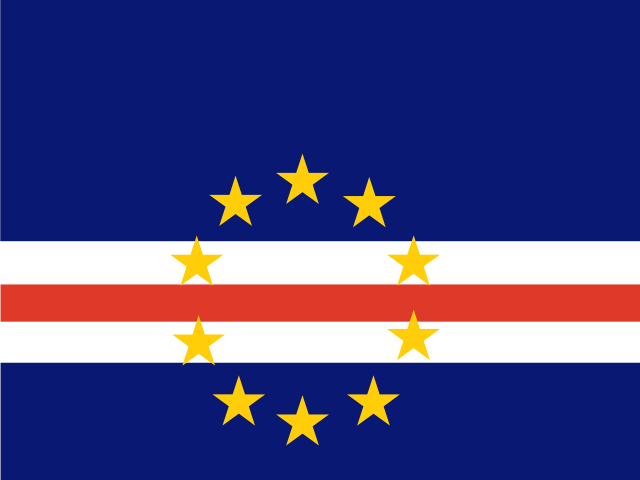
Praia — Capital of Cabo Verde
Praia has been Cabo Verde's capital since 1770, when Portuguese colonial authorities transferred the seat of government there from Ribeira Grande (now Cidade Velha), the archipelago's original settlement and one of the oldest European colonial towns in the tropics, founded in the 1460s shortly after Portuguese navigators first reached the previously uninhabited islands.
Cidade Velha's decline as a functioning capital was driven largely by repeated pirate attacks, including a devastating raid by Francis Drake in 1585, which pushed colonial administrators toward Praia's more defensible plateau location on the island of Santiago, a shift that gave the new capital its Portuguese name, meaning simply 'beach' or 'shore.'
As the administrative center of Portuguese Cabo Verde for over two centuries, Praia inherited the archipelago's role in the transatlantic slave trade; the islands' position roughly 570 kilometers off the West African coast made them a key staging and resupply point for slave ships crossing the Atlantic from the 15th through the 19th centuries.
Since independence in 1975, Praia has grown into the political, economic, and cultural hub of the entire ten-island nation, hosting the national assembly, the presidency, and the University of Cabo Verde, even as the outlying islands retain distinct local identities and, in several cases, their own significant tourism and fishing economies.
The Plateau district, the historic administrative core of Praia built on the flat-topped hill that gave the city its defensive advantage, still houses most of the country's key government buildings and forms the heart of the capital's colonial-era urban layout.
Praia's growth since independence has been fueled substantially by rural-to-urban migration from Cabo Verde's outer islands, many of which face chronic water scarcity and periodic drought, pushing residents toward the greater economic opportunity concentrated in the capital.
Cabo Verde's tourism industry, concentrated mainly on the islands of Sal and Boa Vista rather than Santiago, means Praia itself functions primarily as an administrative and transport hub rather than the country's main resort destination, a distinction from many other small-island nations where the capital and the main tourist center coincide.
Praia's harbor, the Porto da Praia, remains an important link connecting the capital to Cabo Verde's other islands, since inter-island transport still depends heavily on ferry services alongside domestic flights, given the archipelago's dispersed geography across roughly 4,000 square kilometers of Atlantic Ocean.
The city's Sucupira Market is one of West Africa's better-known informal cross-border trading hubs, drawing goods and traders from West Africa's mainland coast as well as from the Cabo Verdean diaspora, who often bring merchandise back to the islands on return visits.
Praia's Palácio do Governo and Assembleia Nacional buildings anchor the Plateau district's administrative core, and much of the city's colonial-era architecture has been preserved alongside newer government and commercial construction built since independence.
Cabo Verde's relatively strong governance record, including regular peaceful elections and comparatively low corruption by regional standards, has made Praia something of a diplomatic and development-cooperation hub for a small island nation, hosting a wider range of foreign missions and international organization offices than its modest population might otherwise suggest.
The Atlantic trade winds that shaped the islands' original strategic importance to Portuguese, and later international, shipping still influence Praia's climate today, giving the capital a semi-arid, generally mild environment distinct from the tropical humidity found in many mainland West African capitals at similar latitudes.
Music, particularly the morna genre popularized internationally by singer Cesária Évora, has close ties to Cabo Verdean identity, and Praia hosts regular festivals celebrating this musical heritage alongside the archipelago's broader Creole cultural traditions.
Quick facts
- Praia's population is estimated at roughly 170,000, making it by far Cabo Verde's largest city.
- UNESCO's 2009 listing for nearby Cidade Velha, the original 15th-century capital, honors its standing as the first European colonial settlement built anywhere in the tropics.
- Praia sits on the island of Santiago, the largest and most populous of Cabo Verde's ten main islands.
- The city's name, meaning 'beach' in Portuguese, refers to its original coastal settlement site below the plateau where the modern city center now stands.