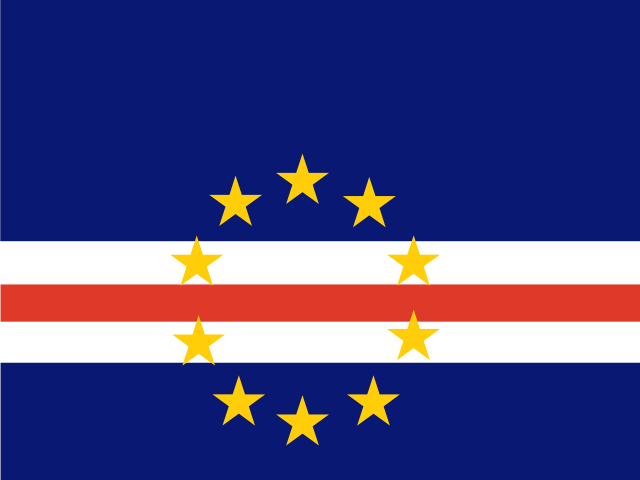
The Flag of Cabo Verde
Africa · Adopted 22 September 1992
Cabo Verde's current flag is younger than the country's independence itself: it was adopted on 22 September 1992, replacing the original 1975 independence flag after the ruling MPLA-aligned party, the PAICV, lost power in the archipelago's first multiparty elections in 1991 and the new government chose to break visually from the old single-party symbolism.
The original 1975 flag had been a red-yellow-green pan-African design closely coordinated with, and visually similar to, Guinea-Bissau's flag, reflecting that both countries had been liberated together by the same movement, the PAIGC, before splitting into separate states shortly after independence. The 1992 redesign deliberately abandoned that shared pan-African palette in favor of an entirely different design.
The new flag is built around a dark blue field representing the Atlantic Ocean surrounding the ten-island archipelago, crossed by a horizontal band of white-red-white stripes positioned slightly below center, with a circle of ten gold five-pointed stars — one for each of the archipelago's main islands — arranged in an ellipse over the point where the stripes meet the blue field.
Blue is officially described as representing the sea and sky, white as peace, and red as the effort and determination of the Cabo Verdean people, while the circle of ten stars is explicitly meant to represent the unity of the islands rather than any deeper political ideology, a marked shift in tone from the 1975 flag's explicitly liberation-movement symbolism.
The redesign reflected a broader political shift: Cabo Verde's 1991 elections, in which the PAICV lost power peacefully to the MpD (Movement for Democracy), are widely cited as one of the first peaceful transfers of power away from a former African liberation-movement ruling party, and the new flag was part of a deliberate effort to present the young multiparty democracy as distinct from its one-party socialist origins.
Cabo Verde's ten islands are conventionally divided into the windward (Barlavento) and leeward (Sotavento) groups, and while the flag does not distinguish between them visually, the ten-star circle is understood locally to represent both groups together as a single national whole rather than privileging either.
Unlike many African flags of the pan-African red-gold-green tradition, Cabo Verde's post-1992 design has more in common visually with European Union member state flags — a blue field with stars — a resemblance some observers have noted reflects the country's close economic and diplomatic ties to Portugal and the wider EU, its largest source of remittances and development aid.
The flag has remained unchanged since its 1992 adoption, and Cabo Verde has continued to hold regular, broadly accepted multiparty elections in the decades since, making the country one of the more consistently stable democracies in West Africa.
Cabo Verde marks its independence anniversary, 5 July, separately from the flag's own 22 September adoption date, giving the country two distinct annual occasions tied to different milestones in its transition from colony to single-party state to multiparty democracy.
The archipelago's Creole culture, blending Portuguese and West African influences over more than five centuries of settlement, is often cited as central to Cabo Verde's national identity in ways the current flag's relatively abstract blue-white-red-and-stars design does not directly depict, unlike the more locally specific emblems found on some neighboring West African flags.
Cabo Verde's large diaspora — commonly estimated to be at least as large as the resident population, with major communities in the United States, Portugal, and the Netherlands — means the flag is a familiar sight at Cabo Verdean cultural festivals and Creole-heritage events well beyond the islands themselves.
The ten-star design was the subject of public design consultations before its 1992 adoption, distinguishing it from flags imposed directly by a single leader or party, and its comparatively recent, consensus-built origin is sometimes cited by vexillologists as an example of a late-20th-century flag created through a genuinely participatory process rather than top-down decree.
Cabo Verde's islands were entirely uninhabited before Portuguese settlement in the 1460s, unlike most African nations whose flags must reckon with pre-colonial indigenous political history; this gives Cabo Verde's national symbolism a comparatively unusual starting point, built around a population and culture that formed only after, and specifically because of, transatlantic contact and the slave trade.
The archipelago's chronic vulnerability to drought and limited arable land pushed large-scale emigration for over a century before independence, and the current flag's themes of unity and shared determination are frequently read locally as addressing a nation whose population and identity are as much diasporic as they are resident on the islands themselves.
Amílcar Cabral, the PAIGC's founding leader who was assassinated in 1973 before either Guinea-Bissau or Cabo Verde achieved independence, remains a revered figure in both countries even though Cabo Verde's own flag no longer bears any direct visual reference to the movement he led, unlike Guinea-Bissau's, which retained the original shared design.
Cabo Verde consistently ranks among Africa's highest-performing nations on measures of governance, press freedom, and political stability, a reputation its post-1992 flag redesign helped visually cement at the very moment the country was establishing that democratic track record. The country graduated from the UN's Least Developed Country category in 2007, one of very few nations ever to do so, a milestone officials frequently link rhetorically to the same 'effort and determination' the flag's red band is said to represent.
Ten small stars in a ring
- Larger printed flag — The ring of ten stars is the element that goes first at small sizes, each one only a few millimetres across on a desk flag. Buying up a size is what keeps the circle countable rather than a gold smudge.
As an Amazon Associate we earn from qualifying purchases made through these links, at no extra cost to you.
Often confused with
- Guinea-Bissau — was visually near-identical to Cabo Verde's ORIGINAL 1975–1992 flag, since both were liberated by the same PAIGC movement — but Cabo Verde's current post-1992 flag looks nothing like Guinea-Bissau's, which retained the old shared design. Compare side by side →
Cabo Verde at a glance
- Capital
- Praia
- Population
- 0.6 million (2024)
- Currency
- Cabo Verdean Escudo (CVE)
- Language(s)
- Portuguese (official); Cabo Verdean Creole (Kriolu) widely spoken
Population figure as of 2024, source: UN World Population Prospects (2024 revision). See methodology for how facts are sourced and kept current.