Yaoundé — Capital of Cameroon
Yaoundé was founded in 1888 as a German colonial trading and military outpost, originally established among the Ewondo and Bane peoples on a group of hills in Cameroon's forested interior, and it took over as the capital of German Kamerun from the coastal city of Buea in 1909, largely because its inland, higher-elevation location was considered healthier for European administrators than the humid coast.
Following Germany's defeat in the First World War, Cameroon was divided between French and British administration under League of Nations mandates; Yaoundé remained the capital of the larger French-administered territory throughout this period, while the smaller British-administered Southern Cameroons was governed separately from Buea and, later, Lagos.
When French Cameroun became independent in 1960 and was joined a year later by the formerly British Southern Cameroons, Yaoundé was retained as the capital of the newly unified federation and later the unitary Republic of Cameroon, cementing its status as the political seat of a country formed from two different colonial administrative traditions.
The city's hilly terrain has earned it the nickname 'the city of seven hills,' and its status as the seat of Cameroon's presidency, parliament, and most federal ministries has made it the country's primary political center even though the coastal city of Douala remains substantially larger and serves as Cameroon's main commercial and industrial hub.
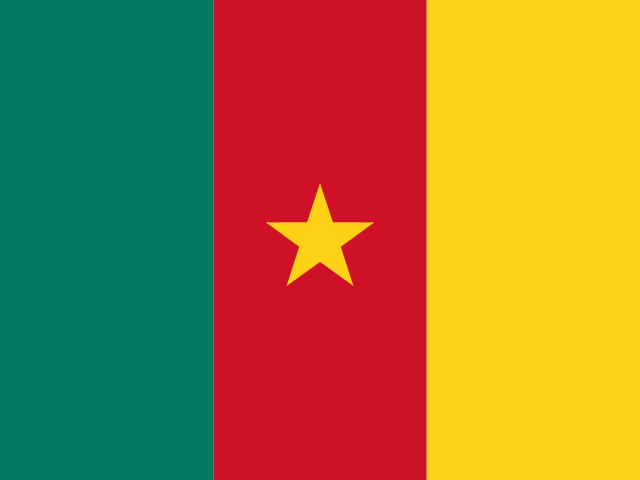
Yaoundé's role as capital of a bilingual, formerly dual-colonized country has shaped its institutions distinctly; the city hosts both French- and English-medium administrative structures, and government communications are formally issued in both languages, a practical daily expression of the same French-English unification the flag's single gold star is meant to symbolize.
The Basilica of Marie-Reine-des-Apôtres, Yaoundé's largest Catholic church, and the National Museum, housed in a former presidential palace building near the city center, are among the capital's most prominent public landmarks, reflecting both the strong Christian missionary influence on the region's colonial-era development and the state's efforts to preserve pre-colonial and independence-era history.
Mount Fébé and the surrounding hills give Yaoundé a green, terraced skyline distinct from many other African capitals, and the city's rapid population growth since the 1960s has expanded well beyond its original colonial-era footprint into a sprawling metropolitan area covering dozens of surrounding neighborhoods and villages.
Yaoundé has hosted several major international conferences over the decades, including gatherings related to Central African economic integration through CEMAC (the Central African Economic and Monetary Community), reflecting the city's role as a regional diplomatic center beyond Cameroon's own borders.
The city's growth has periodically strained its road and water infrastructure, and Yaoundé's often heavy rainfall and hilly terrain together create recurring flooding and landslide risks in some of its more densely built neighborhoods, a persistent municipal planning challenge for the capital.
The rivalry between Yaoundé, the political capital, and Douala, the economic capital, is a recurring theme in Cameroonian public life, with the two cities often compared much as political and commercial capitals are elsewhere — a dynamic reinforced by their roughly three-hour road or rail journey apart.
Yaoundé's Unity Palace, the seat of the presidency, was completed in the 1980s as a large modernist complex intended to project state authority, and it remains the ceremonial center for major national events tied to the same unity themes embodied in the flag's single gold star.
The city's diplomatic quarter hosts embassies and international organization offices reflecting Cameroon's role as a regional actor in Central African affairs, and Yaoundé periodically hosts African Union and CEMAC-related summits alongside its routine function as the national seat of government.
Quick facts
- Yaoundé's population passed 4 million as of 2024, according to UN estimates, narrowing the gap with Douala, Cameroon's larger and more populous commercial capital.
- The city sits at an elevation of roughly 750 meters, considerably cooler than Cameroon's humid Atlantic coast.
- Yaoundé became capital of German Kamerun in 1909, succeeding the coastal town of Buea.
- The University of Yaoundé, founded in 1962, was for decades the country's sole public university before later splitting into multiple institutions across the city.