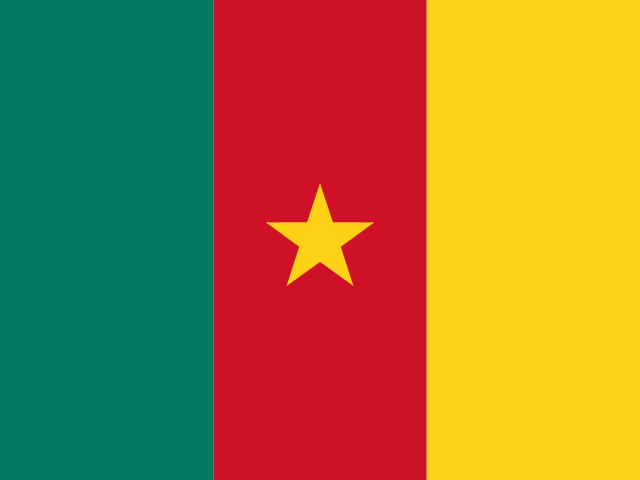
The Flag of Cameroon
Africa · Adopted 20 May 1975
Cameroon's current flag dates to 20 May 1975, though it is the third version of a design first adopted at independence in 1960, and the changes across those three versions trace the country's unusual path from two separate colonial territories into one unified state. The original 1957–1960 design, used by French Cameroun ahead of independence, was a plain green-red-yellow vertical tricolor without any central emblem.
In 1961, a British-administered territory called Southern Cameroons voted in a UN-supervised plebiscite to join the newly independent Republic of Cameroon rather than remain with Nigeria, forming a federation of two states; the flag was amended that year to add two gold stars in the green stripe, representing the two federated territories now joined under one flag.
When the federal system was abolished in 1972 in favor of a unitary state — a centralization that remains controversial in the country's English-speaking regions to this day — the flag was simplified again in 1975, replacing the two stars with a single large gold star centered in the middle red stripe, a design explicitly meant to represent national unity rather than a federation of parts.
Green, at the hoist, represents the country's southern forests and hope; red, in the center, represents unity and sovereignty; and yellow, at the fly, represents the sun and the savanna plains of the north — a fairly standard pan-African set of meanings, but one made more pointed in Cameroon's case by the country's genuine north-south ecological and cultural divide between forest and savanna zones.
The single gold star, officially called the 'star of unity,' is meant to symbolize the integration of the country's more than 250 ethnic groups and its former French- and English-administered territories into one nation, though the tension the 1972 unitary shift was meant to resolve resurfaced decades later: an armed separatist movement in Cameroon's Anglophone Northwest and Southwest regions, seeking to restore a federal or fully independent 'Ambazonia,' has fought Cameroonian government forces since 2017.
Ambazonian separatists have designed and flown their own blue-and-white striped flag with a single star at various points during the conflict, a direct rival symbol to Cameroon's own star-of-unity flag and one the Cameroonian government treats as an illegal separatist emblem.
Cameroon's pan-African red-yellow-green palette, chosen at independence, was itself an explicit homage to Ghana's pioneering 1957 flag and to Ethiopia's much older tricolor, part of the same wave of newly independent African states adopting variations on Ethiopia's colors as a shared anti-colonial statement in the late 1950s and 1960s.
Cameroon marks two separate national days connected to its unification history: 1 January commemorates the 1960 independence of French Cameroun, while 20 May, the date of the flag's final 1975 version, is celebrated as National Unity Day, the country's most significant public holiday.
The star's exact positioning — centered in the middle stripe rather than in a canton — is a design choice Cameroon shares with several other African republics that adopted centrally placed stars in the same era, though Cameroon's specific green-red-yellow palette and single star combination remains distinct enough that it is rarely mistaken for another country's flag.
Cameroon's Anglophone crisis has meant that flag symbolism itself has become politically contested territory: the government has at times prosecuted individuals for displaying the rival Ambazonian flag, treating it as a secessionist symbol under laws that criminalize acts undermining national unity, while separatist sympathizers view raising Cameroon's own star-of-unity flag in Anglophone regions as an assertion of the very centralized rule they are fighting against.
Cameroon is sometimes nicknamed 'Africa in miniature' for its unusually wide range of climates and ecosystems, from coastal rainforest to Sahelian semi-desert in the far north, a geographic diversity that maps loosely onto the flag's own green-to-yellow color transition from south to north.
The flag's construction standard specifies a 2:3 ratio and precise Pantone-equivalent shades for its three colors and the gold star, details codified in Cameroonian law governing the reproduction of national symbols on official documents, buildings, and military uniforms.
Cameroon's national football team, the Indomitable Lions, has done more than perhaps any other institution to make the flag's green-red-yellow palette internationally recognizable, with the team's World Cup appearances since 1982 — including a run to the 1990 quarterfinals — regularly broadcasting the flag's colors to a global audience far larger than most diplomatic or political contexts would reach.
The Bamileke, Fulani, Beti-Pahuin, and dozens of other ethnic groups across Cameroon each maintain distinct traditional dress, language, and local symbols; the flag's plain, pan-African palette sidesteps any single group's specific cultural imagery, an intentionally neutral choice echoed by the design logic of several other multi-ethnic African states. Cameroonian civics textbooks generally present that neutrality as a deliberate strength of the 1975 design rather than a limitation, arguing that a symbol tied to no single community is precisely what a country formed from two colonial territories and hundreds of ethnic groups needed.
Paul Biya, Cameroon's president since 1982, has governed under this same flag for over four decades, making his tenure one of the longest in Africa and giving the 1975 unity-star design an unusually long association with a single head of state's rule.
Matching the specified shades
- Solution-dyed flag — The page notes that the three colours and the gold star are pinned to named ink equivalents. Solution-dyed cloth carries the colour through the fibre instead of sitting on it, which is what holds those values in sun.
As an Amazon Associate we earn from qualifying purchases made through these links, at no extra cost to you.
Often confused with
- Senegal — uses the identical green-yellow-red pan-African palette with a central star, but Senegal's star sits in the yellow (center) stripe and is green, not gold, while its stripe order is reversed left to right. Compare side by side →
- Mali — shares the same three pan-African colors in vertical bands but has no star at all, making the two flags distinguishable at a glance despite the shared palette. Compare side by side →
Cameroon at a glance
- Capital
- Yaoundé
- Population
- 29.3 million (2024)
- Currency
- Central African CFA Franc (XAF)
- Language(s)
- French and English (official)
Population figure as of 2024, source: UN World Population Prospects (2024 revision). See methodology for how facts are sourced and kept current.