Bangui — Capital of Central African Republic
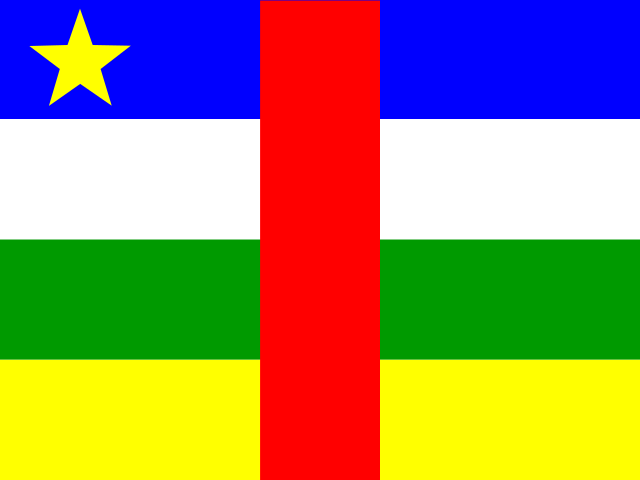
See the flag of Central African Republic →
Bangui was founded by French colonial forces in 1889 as a military and administrative post on the northern bank of the Ubangi River, chosen specifically because rapids just downstream made the site the practical head of river navigation from the Congo basin — the farthest point oceangoing river traffic could reasonably reach before rapids blocked further passage upstream.
That river-navigation geography made Bangui the natural administrative center for French Equatorial Africa's Ubangi-Shari territory throughout the colonial period, and the city retained its capital status through the territory's 1958 transition to autonomous republic status under Barthélemy Boganda and full independence in 1960.
The city has suffered repeated and severe disruption during the Central African Republic's post-independence instability, including widespread looting and violence during the 2012–2014 Séléka and anti-balaka conflict, when large numbers of residents were displaced into camps around the city, including one at Bangui's M'Poko Airport that at its peak housed tens of thousands of people.
Despite this instability, Bangui remains the country's overwhelming political, economic, and cultural center, hosting the presidency, national assembly, the country's main university, and the great majority of what limited industry and international organizational presence the country retains.
Pope Francis made a notably high-profile visit to Bangui in November 2015, at the height of the Séléka/anti-balaka conflict, personally opening a symbolic 'Holy Door' at the city's cathedral as part of the Catholic Church's Jubilee of Mercy — a visit widely covered internationally as a gesture of solidarity with a capital then still experiencing active violence.
The Boganda National Museum in Bangui, named for the country's founding father, holds ethnographic and historical collections documenting the Central African Republic's numerous ethnic groups, though the museum's operations have been periodically disrupted by the same instability that has affected much of the capital's public infrastructure since 2012.
The Ubangi River that runs alongside Bangui also forms part of the country's border with the Democratic Republic of Congo, and river trade and transport remain economically significant for the capital given the country's almost total lack of rail infrastructure and limited paved road networks.
Bangui's cathedral, Notre-Dame de Bangui, has functioned at various points during the recent conflict as a place of refuge for civilians fleeing violence, reflecting the church's broader role as one of the few consistently trusted institutions during the country's periods of weak state authority.
The city's Ubangi riverfront has historically supported a modest fishing and river-trade economy, and pirogue traffic across the river to and from Democratic Republic of Congo territory remains a routine part of daily life for many residents of Bangui's riverside districts.
Bangui's population swelled significantly during the worst periods of the 2012–2014 conflict as displaced people from the countryside sought safety within the relative security the capital's international peacekeeping presence provided, a pattern of conflict-driven urbanization that has reshaped several of the city's neighborhoods over the past decade.
The M'Poko displacement camp that formed around Bangui's airport during the height of the crisis became one of the largest informal settlements in the country's recent history before gradually closing as security conditions in parts of the capital improved in the later 2010s.
Bangui's Université de Bangui, the country's principal institution of higher education, has continued operating even through periods of severe unrest, functioning as one of the few consistent national institutions serving students from across the country's various regions.
The city's Bangui Marina, along the Ubangi River, remains a modest but functioning port facility, though decades of underinvestment and periodic insecurity have limited its capacity compared with river ports in more stable neighboring countries.
Quick facts
- Bangui's population is estimated at roughly 900,000 to 1 million, making it far larger than any other city in the Central African Republic.
- The city's name comes from the rapids on the Ubangi River, which historically marked the limit of navigable river traffic.
- Bangui has hosted UN peacekeeping forces (MINUSCA) since 2014 amid the country's ongoing conflict and instability.
- The Central African Republic ranks among the least developed nations by UN Human Development Index measures, a status closely tied to decades of instability centered on the capital.