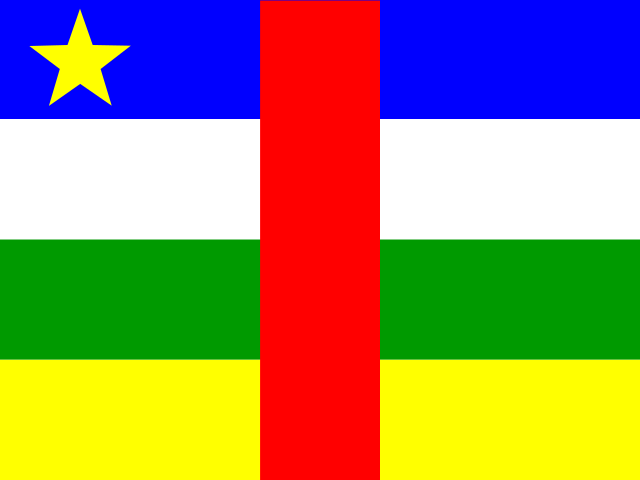
The Flag of Central African Republic
Africa · Adopted 1 December 1958
The Central African Republic's flag was adopted on 1 December 1958, while the territory was still an autonomous republic within the French Community rather than fully independent, and it was designed by Barthélemy Boganda, the founding father of the modern Central African Republic, who died in a plane crash in 1959 before he could see the full independence he had campaigned for realized in 1960.
Boganda's design is unusual among African flags for deliberately fusing, rather than choosing between, European and pan-African symbolism: it combines the blue-white-red of the French tricolor with the red-yellow-green pan-African palette in a single design, four horizontal stripes (blue, white, green, yellow) crossed by a vertical red stripe through the center, with a single gold star in the canton.
Boganda explained the combination explicitly as a statement of both Central African unity and continued partnership with France, at a moment when he was still hoping to build a broader federation of former French Equatorial African territories rather than a single small landlocked state — a wider federation project that ultimately failed to materialize before his death.
The vertical red stripe crossing all four horizontal bands is officially described as symbolizing the blood of humanity, uniting people of every color and background, while the yellow gold star in the canton represents the country's hoped-for place among the independent nations of the world.
The flag has remained legally unchanged since 1958 despite the Central African Republic's turbulent post-independence history, which has included the eccentric and brutal self-declared 'emperor' Jean-Bédel Bokassa in the 1970s, multiple coups, and a civil war beginning in 2012 between mostly Muslim Séléka rebels and mostly Christian anti-balaka militias that left large parts of the country outside effective government control for years.
Bokassa, who ruled from 1966 and briefly declared the Central African Empire in 1976 in a lavish, self-financed coronation modeled loosely on Napoleon's, retained Boganda's flag design throughout his rule, adding only a new imperial crest and additional decorations for state occasions rather than replacing the national flag itself.
Despite the deep instability of recent decades, Boganda's blue-white-green-yellow-red combination has functioned as one of the country's few consistently recognized state symbols, used even by transitional and internationally backed governments during periods when the state's actual territorial control was severely limited.
The flag's fusion of French tricolor and pan-African colors is sometimes cited by vexillologists as a rare, genuinely original mid-20th-century flag design rather than a variation on an existing template, since Boganda's specific five-color combination and cross-hatch layout has no direct precedent among earlier African or European flags.
Independence Day, 13 August, and the anniversary of the flag's 1958 adoption are both marked with national ceremonies, though large-scale public celebrations have been periodically curtailed in the capital, Bangui, during periods of active conflict since 2012.
Boganda himself never used the flag as a national symbol in his lifetime, since he died in a plane crash in March 1959, months after the flag's adoption and more than a year before the full independence he had spent his political career pursuing was finally achieved in August 1960 under his successor, David Dacko.
The gold star in the flag's canton is sometimes described in official explanations as representing the country's aspiration toward the ideals of the wider African unity movement Boganda championed, since he was also a prominent early advocate of pan-African federation among France's Central African territories, an ambition never realized in his lifetime.
Despite decades of severe instability, the Central African Republic's government, backed at various points by French, UN, and Russian Wagner Group forces, has continued to fly Boganda's original design over whatever portion of the national territory it effectively controls, making the flag one of the few threads of institutional continuity across a genuinely fractured post-independence history.
The country's vast mineral wealth, including diamonds and gold, has been central to funding the various armed factions that have fought for control of different regions since 2012, an irony given that the flag's yellow star was originally meant to symbolize hopeful national aspiration rather than the resource-driven conflict that has instead dominated much of the country's recent history.
The Central African Republic remains landlocked and among the least developed countries in the world by UN Human Development Index rankings, a status connected both to its difficult colonial-era extraction economy under Free French and earlier concessionary company rule, and to the repeated instability that has followed independence.
The flag's five colors are specified in official documentation with exact proportional widths for each horizontal band and the central vertical stripe, a level of technical precision that has survived even the periods when the government issuing such specifications controlled only a fraction of the country's actual territory.
A 2020–2023 constitutional process under President Faustin-Archange Touadéra reaffirmed Boganda's flag without modification even while making other significant changes to presidential term limits and the structure of government, underscoring how comparatively uncontested the flag's core design has remained even amid deep disagreement over other aspects of the constitution. Boganda's own vision for a wider Central African federation, which the flag's French-tricolor-plus-pan-African-palette fusion was meant partly to symbolize, never materialized beyond the single, comparatively small state that exists today.
The country's name itself, chosen simply for its geographic position rather than any ethnic or historical reference, mirrors the flag's own studied neutrality — both were deliberately built to avoid favoring any one of the territory's many ethnic communities over another.
Six bands and a corner star
- Desk flag with base — Four horizontals crossed by one vertical and a single star in the canton is bold geometry with no fine emblem, so it stays readable at the few inches a table flag gives you.
As an Amazon Associate we earn from qualifying purchases made through these links, at no extra cost to you.
Central African Republic at a glance
- Capital
- Bangui
- Population
- 5.7 million (2024)
- Currency
- Central African CFA Franc (XAF)
- Language(s)
- French and Sango (official)
Population figure as of 2024, source: UN World Population Prospects (2024 revision). See methodology for how facts are sourced and kept current.