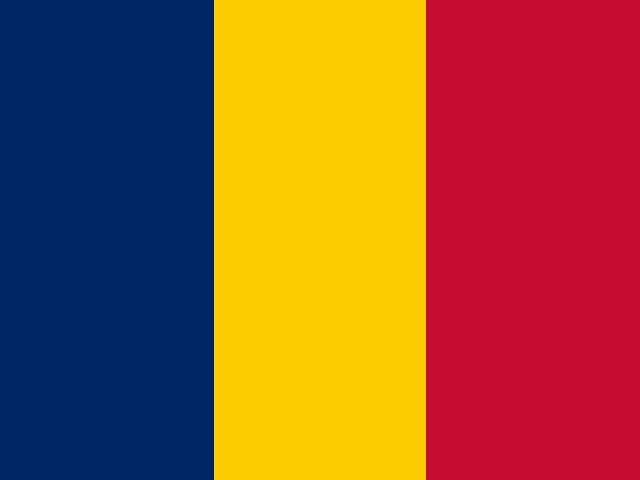
N'Djamena — Capital of Chad
N'Djamena was founded by French military officer Émile Gentil in 1900 as Fort-Lamy, named after French commander François Lamy, who was killed that year in a decisive battle against the forces of the regional warlord Rabih az-Zubayr near the confluence of the Chari and Logone rivers, the site chosen for the new fort.
That river confluence gave Fort-Lamy strategic and administrative importance from its founding, and it became the capital first of the French colonial territory of Chad and then, after independence in 1960, of the sovereign Republic of Chad, retaining the colonial name Fort-Lamy for its first 13 years as an independent nation's capital.
In 1973, President François Tombalbaye renamed the city N'Djamena as part of a broader 'Chadization' campaign encouraging citizens to abandon French names in favor of African ones, drawing the new name from Nijamena, an Arabic-influenced term referring to a nearby village and meaning roughly 'place of rest.'
N'Djamena sits directly on Chad's border with Cameroon, with the Chari River separating the two countries at that point, giving the capital an unusually exposed frontier location that has repeatedly mattered militarily, including during Libyan-backed incursions in the 1980s and attacks by the Nigeria-based militant group Boko Haram in the 2010s.
The city has been besieged or fought over more than once since independence, including a major rebel assault in February 2008 that reached the presidential palace before being repelled, and it has periodically served as a base for French military operations across the wider Sahel region under successive counter-terrorism missions.
N'Djamena's Grand Marché and riverside districts along the Chari remain central to the city's daily commercial life, while its position at Chad's southern edge, just across the river from Cameroon's far north, has also made it an important node for regional trade and, at times, cross-border refugee movements during periods of conflict in neighboring countries.
The city has absorbed large numbers of refugees fleeing violence in neighboring Sudan, the Central African Republic, and Nigeria over the past two decades, straining municipal services in a capital that already ranks among the least developed in the world by UN infrastructure indices.
N'Djamena's international airport and its role as the base for regional counter-terrorism operations have made it strategically significant well beyond Chad's own borders, hosting French and other allied forces engaged in operations across the wider Sahel.
The city's mix of modern government buildings alongside traditional mudbrick neighborhoods reflects its rapid, sometimes uneven growth since the mid-20th century, when it expanded from a modest colonial fort town into the political center of one of Africa's largest countries by land area.
N'Djamena hosts Chad's National Assembly, presidency, and the bulk of its limited industrial base, including food-processing and light manufacturing plants that supply much of the surrounding region, giving the capital an outsized share of the country's formal economic activity.
The city's Avenue Charles de Gaulle and other central boulevards still bear names reflecting the strong and continuing French political and military relationship that has shaped Chad since well before independence in 1960.
N'Djamena's University of N'Djamena, founded in 1971, remains the country's oldest and largest public university, drawing students from across Chad's diverse regions to the capital for higher education not widely available elsewhere in the country.
The city's Grande Mosquée and its central cathedral both serve as landmarks reflecting Chad's religious diversity, standing not far apart in the capital much as the country's Muslim-majority north and Christian-influenced south meet in the political life of N'Djamena itself.
N'Djamena's markets and informal cross-border trade with Cameroon remain economically vital for many residents, particularly given the disruption that repeated regional conflicts and, at times, border closures have caused to more formal channels of commerce over the past two decades.
Quick facts
- N'Djamena's population is estimated at around 1.6 million, making it by far Chad's largest city.
- The city was known as Fort-Lamy from its 1900 founding until its 1973 renaming.
- N'Djamena's National Museum displays finds tied to Sahelanthropus tchadensis, a roughly seven-million-year-old hominin fossil discovered in northern Chad's desert in 2001, one of the oldest human-lineage fossils ever found.
- The city hosts a French military base that has operated continuously since Chad's independence in 1960.