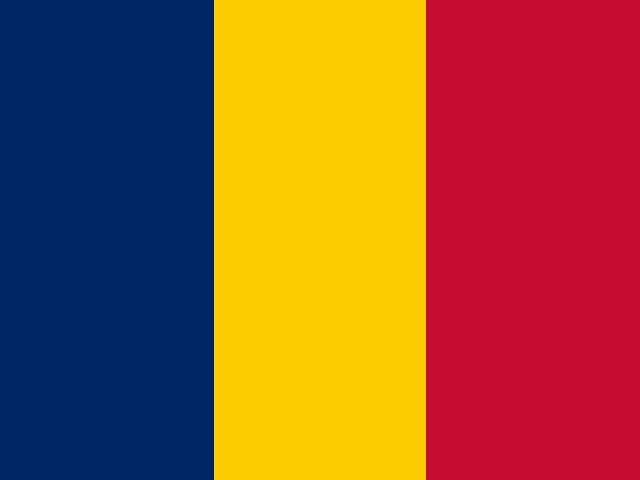
The Flag of Chad
Africa · Adopted 6 November 1959
Chad adopted its flag on 6 November 1959, roughly a year before formal independence from France in 1960, in a design process notably shaped by a specific problem: initial proposals for a green-yellow-red pan-African tricolor, similar to those chosen by many other francophone states at the time, were rejected in part because that combination was already in use, or under consideration, by too many other newly independent African states.
The solution Chad's pre-independence government settled on was to keep the same vertical tricolor structure, but swap the green stripe for blue, producing a blue-yellow-red design that borrowed the middle and fly stripes' colors from pan-African symbolism while adopting a hoist stripe closer to the blue of the French tricolor, a deliberate hybrid intended to signal both African identity and continued ties to France.
Blue is officially described as representing the sky and hope, as well as the water sources of southern Chad's rivers and Lake Chad; yellow represents the sun and the northern Saharan desert regions; and red represents unity, national sovereignty, and the blood shed in the struggle for progress and independence.
The resulting design is strikingly, almost exactly, similar to Romania's flag, a resemblance that has caused genuine diplomatic friction: Chad formally protested to the United Nations in 2004 when Romania adopted a new, brighter-toned version of its own blue-yellow-red tricolor, arguing the two flags had become close to indistinguishable, though no design change ultimately resulted from the complaint.
Chad's north-south divide echoed in the flag's blue-and-yellow color symbolism — water and Sahel in the south, desert in the north — has also mapped onto the country's real political geography: decades of tension and periodic civil war between a more Arab-Muslim north and a more Christian and animist south have run through Chadian politics since shortly after independence.
Since the flag's adoption, Chad has experienced numerous coups, an extended civil war through the 1980s, and Libyan military intervention in its north during the Aouzou Strip border dispute, yet the blue-yellow-red tricolor itself has never been redesigned, remaining one of the more stable elements of the country's official symbolism despite the surrounding turbulence.
France's continued military presence in Chad, including a air base near the capital N'Djamena that has hosted French forces continuously since independence, reflects the same close postcolonial relationship the flag's hybrid blue-toned design was originally meant to signal in 1959.
Because of the near-identical Chad–Romania color match, vexillological references frequently cite the pair as the textbook example of unintentional national flag duplication, a case regularly used to illustrate how limited the practical palette of horizontal and vertical tricolors really is once dozens of countries have each made their own independent color choices.
Chad marks its independence anniversary on 11 August, distinct from the 6 November flag-adoption date, and official flag ceremonies are held at both occasions, though independence day remains by far the larger public holiday.
Lake Chad itself, once one of Africa's largest freshwater lakes and the namesake of the country, has shrunk dramatically since the 1960s due to climate change, upstream irrigation demands, and drought, a slow-motion environmental crisis that has displaced communities across Chad, Nigeria, Niger, and Cameroon and indirectly fueled the water-scarcity tensions the flag's blue stripe was originally meant to celebrate rather than mourn.
Chad's oil reserves, developed from the early 2000s with a World Bank-backed pipeline to the Cameroonian coast, transformed government revenue but have been widely criticized for failing to translate into broad-based development, with much of the country, particularly in the more arid north, remaining among the least developed regions in the world by UN measures.
The country's flag features prominently in Chad's military uniforms and vehicles, a practical necessity given the Chadian army's frequent deployments both within its own borders against rebel and jihadist groups and, at various points, in neighboring Mali, the Central African Republic, and the Lake Chad Basin as part of regional counter-insurgency coalitions.
Chad's long-serving president Idriss Déby, who ruled from 1990 until his death on the battlefield fighting rebel forces in 2021, presided over the flag through three decades of relative political continuity compared with the country's more volatile earlier post-independence decades, before power passed to his son in a transition many observers criticized as unconstitutional.
The country's population is roughly evenly split between a mostly Muslim north and a mostly Christian and animist south, a demographic balance that has shaped decades of political competition even as the flag's own blue-yellow-red design was deliberately built to avoid religious symbolism of any kind.
Chad is one of the largest countries in Africa by land area yet one of the least densely populated, and its flag is correspondingly a rare visible constant across an otherwise geographically and ethnically fragmented territory stretching from Sahara sands in the north to Sahel savanna in the south.
Chad's transitional government under Mahamat Déby, who took power after his father's 2021 death, organized a new constitutional referendum and elections in 2023–2024 while retaining the same blue-yellow-red flag throughout the transition, another instance of the design outlasting yet another abrupt change of leadership. Chad's flag construction standard, like several other former French territories, fixes the ratio at 2:3, a measurement carried over administratively from French colonial practice even as the color choice itself was a deliberate departure from France's own palette.
Telling it apart from Romania's
- Labelled desk flag — A plain blue-yellow-red vertical tricolour carries nothing on the cloth to identify it, which is exactly why a table flag with the country named on the base is worth more here than on a flag with an emblem.
As an Amazon Associate we earn from qualifying purchases made through these links, at no extra cost to you.
Often confused with
- Romania — is Chad's single most famous flag look-alike worldwide — both use an identical blue-yellow-red vertical tricolor, a resemblance close enough that Chad formally protested to the UN in 2004 over Romania's redesigned, brighter shade. Compare side by side →
Chad at a glance
- Capital
- N'Djamena
- Population
- 19.3 million (2024)
- Currency
- Central African CFA Franc (XAF)
- Language(s)
- French and Arabic (official)
Population figure as of 2024, source: UN World Population Prospects (2024 revision). See methodology for how facts are sourced and kept current.