Beijing — Capital of China
Beijing has served as a capital city, under one dynasty or another, for roughly eight centuries in total, though not continuously — it first became a major imperial capital under the Mongol-led Yuan dynasty in the 13th century, when Kublai Khan established his capital Khanbaliq (later visited and described by Marco Polo) roughly on the site of modern Beijing, and it was later developed into its most recognizable historic form under the Ming dynasty, which moved the capital there from Nanjing in 1421 and built the Forbidden City as the imperial palace complex.
The Forbidden City, completed in 1420 and home to 24 emperors across the Ming and Qing dynasties until the last emperor, Puyi, was expelled in 1924, remains the best-preserved and most complete ancient palace complex in China and one of the largest palace complexes in the world, a scale that reflects centuries of continuous imperial building and rebuilding on the same central site rather than a single construction project.
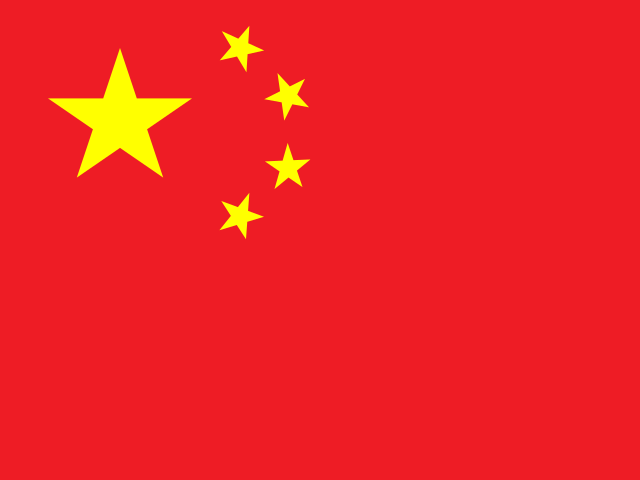
Beijing lost its capital status twice in the 20th century before regaining it for good: the Republic of China moved the capital to Nanjing in 1928, and Beijing (then called Beiping, 'northern peace,' to reflect its non-capital status) only regained the name Beijing ('northern capital') and its status as capital again on 1 October 1949, when Mao Zedong proclaimed the People's Republic of China from Tiananmen Gate at the southern edge of the Forbidden City — the same ceremony that introduced the current national flag.
The Great Wall sections nearest Beijing, particularly at Badaling and Mutianyu, were built or substantially rebuilt during the Ming dynasty specifically to defend the capital region from northern incursions, tying the wall's most-visited stretches directly to Beijing's historic role as a frontier-facing imperial seat rather than to the wall's much longer and older overall history across northern China.
Modern Beijing hosted the Summer Olympics in 2008 and the Winter Olympics in 2022, making it the first city in the world to host both the Summer and Winter Games, a distinction that reflects the scale of infrastructure investment the Chinese government has directed at the capital over the past two decades.
The Temple of Heaven, built in 1420 alongside the Forbidden City and used by Ming and Qing emperors for annual ceremonies asking Heaven for good harvests, is laid out according to strict cosmological principles reflected in its circular halls (representing heaven) set within a square outer wall (representing earth), and remains one of Beijing's best-preserved examples of imperial ritual architecture separate from the palace complex itself.
Much of old Beijing's residential fabric survives, where it still exists, in hutongs — narrow lanes lined with traditional courtyard homes (siheyuan) that once made up most of the city's housing stock; large sections were demolished during rapid modernization from the 1990s onward, particularly ahead of the 2008 Olympics, and the remaining hutong districts near the city center are now protected to varying degrees as heritage areas even as most of Beijing has been rebuilt as high-rise apartment blocks.
Standard Mandarin, the official spoken language of mainland China, is based primarily on the Beijing dialect's phonology, a status that dates to language-standardization efforts under the late Qing and early Republican governments and that was formalized further after 1949 — meaning the national spoken standard is more directly tied to the capital's own speech patterns than is the case in many other large countries.
Beijing has struggled for decades with severe air pollution driven by industrial activity, vehicle emissions, and coal heating in the surrounding region, and the municipal and national government have run large-scale anti-pollution campaigns since the early 2010s, including relocating some heavy industry away from the city and restricting vehicle registrations, measures credited with measurable air-quality improvement in the capital by the late 2010s and 2020s even as pollution remains a recurring seasonal concern.
Quick facts
- Beijing's municipal population reached roughly 22 million by 2024, putting it among the handful of national capitals with more residents than many entire countries.
- Beijing means 'Northern Capital' in Chinese; the city was called Beiping ('Northern Peace') during the periods it was not serving as national capital.
- Twenty-four Ming and Qing emperors ruled from Beijing's palace complex before the last, Puyi, was expelled in 1924, and it remains one of the largest and best-preserved palace complexes on Earth.
- Beijing is the first city to have hosted both the Summer Olympics (2008) and Winter Olympics (2022).
- Beijing's status as capital dates most recently to 1 October 1949, when the People's Republic of China was proclaimed there.