The Flag of China
Asia · Adopted 1 October 1949
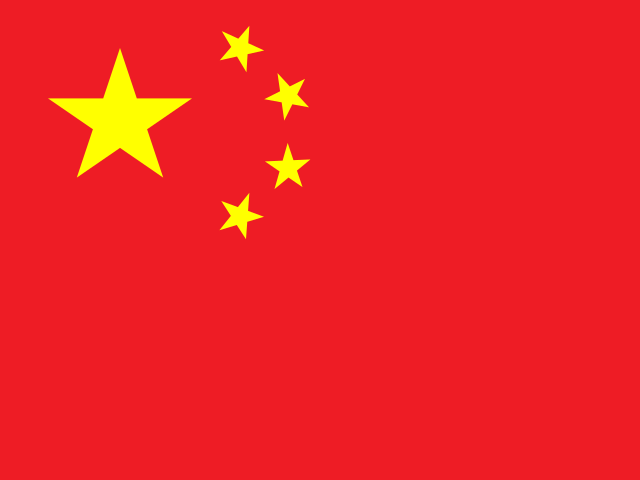
China's flag — red with one large gold five-pointed star and four smaller gold stars arranged in an arc beside it — was adopted on 1 October 1949, the same day Mao Zedong formally proclaimed the People's Republic of China from Tiananmen Gate in Beijing, marking the end of the Chinese Civil War against the Nationalist (Kuomintang) government, which retreated to Taiwan and continues to use an entirely different flag there. The design was selected through a national public competition run by the new government in mid-1949, which drew nearly 3,000 submitted designs before a committee chose the entry submitted by Zeng Liansong, an economist and amateur designer from Shanghai, with some modifications made to his original concept before final adoption.
Red is explained as representing the Communist revolution and, more broadly, the historical color associated with Han Chinese culture and celebration going back centuries before communism, giving the flag's background color a dual layer of meaning — one modern-political, one older-cultural — that Chinese state explanations of the flag generally present together rather than choosing between them.
The large star represents the leadership of the Communist Party of China, and the four smaller stars, arranged in a semicircle around the large star's upper-right side so that each smaller star has one point directed toward the center of the large star, represent the four social classes the party's founding ideology identified as the base of the revolutionary alliance: the working class, the peasantry, the urban petty bourgeoisie, and the national (patriotic) bourgeoisie. Zeng Liansong's original submission reportedly included a hammer-and-sickle emblem inside the large star as well, similar to Soviet iconography, but that detail was removed by the selection committee before the final design was adopted, distinguishing China's flag from more directly Soviet-imitative designs used by some other communist states.
The specific arrangement — small stars each angled to point at the large star — was a deliberate design choice meant to visually represent unity and orientation around the party's central leadership, rather than the smaller stars being scattered or oriented independently, and that geometric detail is precisely specified in China's national flag law to ensure it is rendered identically on every official flag produced.
China's flag has not been redesigned since 1949, a stability of 75-plus years that stands in sharp contrast to the flags used by China's various pre-1949 governments — the Qing dynasty's yellow dragon flag (adopted 1889), the Republic of China's five-color striped flag (1912–1928), and the Republic of China's 'Blue Sky, White Sun, and a Wholly Red Earth' flag adopted in 1928, the last of which is still flown today, unchanged, by the government on Taiwan, which considers itself the continuation of the pre-1949 Republic of China.
China's flag is occasionally confused only in the loosest sense with Vietnam's flag, which is also red with a single gold star, but Vietnam's design has just one large centered star and no smaller stars at all, making the two flags straightforward to tell apart once compared directly rather than recalled from memory alone.
The 1949 design competition specified from the outset that the new flag should avoid overt hammer-and-sickle imagery in favor of a design better suited to represent all of China's people rather than only industrial workers, which is part of why Zeng Liansong's submission — built around stars rather than tools — was competitive against entries that leaned more directly on Soviet visual conventions; committee records from the selection process describe extended debate over whether to include a yellow horizontal bar representing the Yellow River, an element present in Zeng's earliest sketches but dropped before the final design, since some committee members felt it implied China was divided by the river rather than unified across it.
China's National Flag Law, enacted in 1990 and amended several times since, most recently in 2020, specifies the flag's exact 2:3 ratio, the precise radius and position of each star, and detailed rules for its display, including a requirement that flags be raised at sunrise and lowered at sunset in coordination with Beijing's own solar timing at Tiananmen Square, where a flag-raising ceremony performed by a People's Liberation Army honor guard has been conducted daily since 1949 and draws large public crowds, particularly around National Day on 1 October.
Hong Kong and Macau, returned to Chinese sovereignty by Britain in 1997 and by Portugal in 1999 respectively, fly China's national flag alongside their own distinct regional flags under the 'one country, two systems' framework, a two-flag display arrangement that has no exact equivalent elsewhere in China, where provinces and other administrative regions do not otherwise maintain flags of their own separate from the national design.
The four smaller stars' arrangement was fixed with enough geometric precision that Chinese textbooks and official reference materials specify the exact angle at which each small star's uppermost point aims toward the center of the large star, a level of specified detail uncommon even among other nations' legally codified flags, reflecting the political weight placed on the stars' unity symbolism since the flag's earliest adoption.
Zeng Liansong reportedly did not learn with certainty that his design had won until after the 1949 founding ceremony had already taken place, and he received only a modest prize and no lasting public recognition for decades afterward; his role as the flag's designer was not widely publicized in China until well after his death in 1999, a detail that has since become a well-known footnote in accounts of the flag's origin and a point of some retrospective public interest in giving credit to the individual behind a symbol otherwise closely associated with the collective founding of the state.
Star radii and positions
- Geometry-accurate flag — Each star's radius and position in the canton is fixed rather than drawn by eye, and the usual fault in a loose copy is four small stars set at even spacing instead of angled toward the large one.
As an Amazon Associate we earn from qualifying purchases made through these links, at no extra cost to you.
Often confused with
- Vietnam — shares a red field and gold star motif, but Vietnam's flag has a single large centered star with no smaller accompanying stars, unlike China's one large star plus four smaller stars. Compare side by side →
China at a glance
- Capital
- Beijing
- Population
- 1.41 billion (2024)
- Currency
- Renminbi / Chinese Yuan (CNY)
- Language(s)
- Standard Chinese / Mandarin (official)
Population figure as of 2024, source: UN World Population Prospects (2024 revision). See methodology for how facts are sourced and kept current.