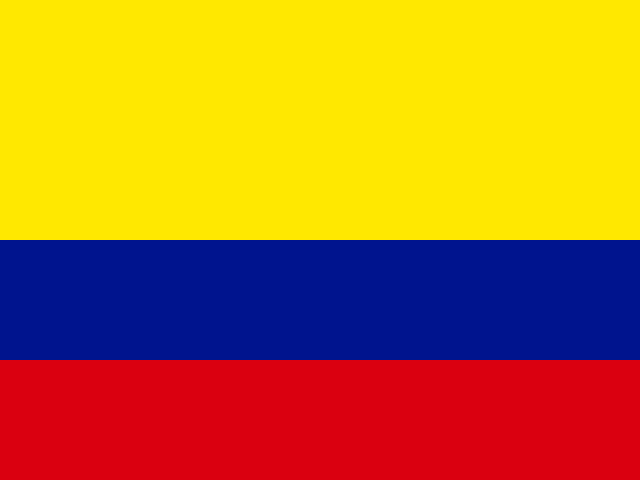
Bogotá — Capital of Colombia
Bogotá was founded in August 1538 by the Spanish conquistador Gonzalo Jiménez de Quesada on the site of Bacatá, the principal settlement of the Muisca people, whose confederation had controlled the high Andean plateau known as the Sabana de Bogotá for centuries before Spanish arrival. Quesada named the new city Santa Fe de Bogotá, and it grew into the administrative seat of the Viceroyalty of New Granada, a Spanish colonial territory that at its largest extent covered present-day Colombia, Venezuela, Ecuador, and Panama.
The city's status as a capital predates Colombian independence by well over a century — Santa Fe de Bogotá became the viceregal capital in 1739, when Spain elevated New Granada to a full viceroyalty, and the city kept that administrative primacy straight through independence in the 1810s–1820s and into the Gran Colombia era, before becoming capital of the standalone Republic of Colombia (then still called New Granada) after 1830.
Sitting at roughly 2,640 meters (about 8,660 feet) above sea level on a high plateau in the Eastern Andes, Bogotá is one of the highest-elevation capital cities in the world, an altitude that shapes everything from its notably cool, spring-like climate year-round — despite lying close to the equator — to the way the city's thin air affects newcomers and athletes alike.
La Candelaria, Bogotá's historic center, preserves narrow colonial-era streets and Spanish Baroque churches dating to the 16th and 17th centuries, standing in contrast to the dense high-rise districts that expanded rapidly during the city's 20th-century population boom, when rural migration and, later, displacement from Colombia's internal armed conflict drove explosive urban growth.
The Museo del Oro (Gold Museum), located in the city center, holds the world's largest collection of pre-Hispanic gold artifacts, more than 34,000 pieces drawn from cultures across Colombia including the Muisca themselves — whose legendary ritual of covering a chief in gold dust and submerging him in a sacred lake gave rise to the El Dorado myth that drove Spanish exploration across much of northern South America.
Bogotá has also become known internationally for its urban transit and cycling infrastructure, including the TransMilenio bus rapid transit system launched in 2000 and one of the most extensive networks of permanent bicycle paths (ciclorutas) of any Latin American capital, both pursued as deliberate alternatives to road-building after decades of unplanned expansion had already outgrown the street network.
The city's Plaza de Bolívar, the historic central square, has been the site of some of Colombia's most consequential political moments, including the 1985 siege of the nearby Palace of Justice by the M-19 guerrilla group and the subsequent military retaking of the building, an event that killed dozens, including several Supreme Court justices, and remains a deeply contested episode in Colombia's modern history of armed conflict.
Every Sunday and public holiday, a stretch of Bogotá's major roadways closes to motor traffic entirely for Ciclovía, a car-free cycling and pedestrian program that began in 1974 and has since been studied and copied by cities worldwide, making it one of the longest continuously running programs of its kind anywhere.
Quick facts
- Bogotá's metropolitan population is roughly 11.3 million as of 2024 estimates, making it South America's third-largest urban area after São Paulo and Buenos Aires.
- The city's original name, Santa Fe de Bogotá, was only shortened to plain 'Bogotá' in the 20th century, though 'Santa Fe' survives as the name of one of the city's central districts.
- Bogotá sits within the Sabana de Bogotá, a large flat plateau that was formerly the bed of a Pleistocene-era lake, which is part of why the surrounding terrain is so unusually level for a city set deep in the Andes.
- The city is home to more than 60 universities, including the Universidad Nacional de Colombia (founded 1867), making it the country's principal center of higher education.
- Bogotá's Monserrate mountain, rising above the eastern edge of the city to about 3,150 meters, is topped by a 17th-century church and is reachable by cable car or funicular, offering a panoramic view of the entire capital below.