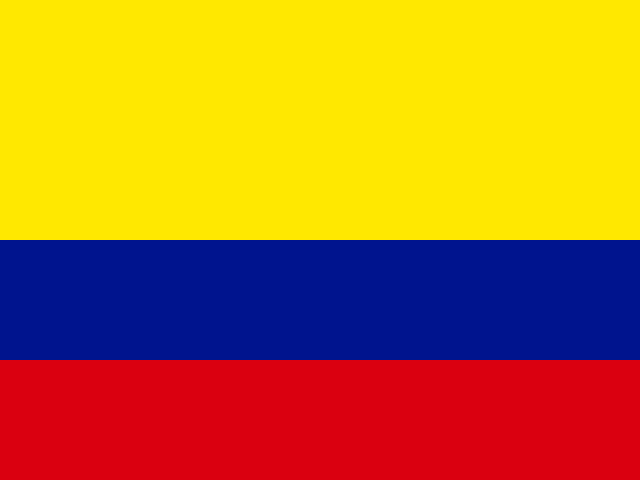
The Flag of Colombia
South America · Adopted 26 November 1861 (proportions fixed; tricolor itself older)
Colombia's yellow-blue-red horizontal tricolor did not begin life as a Colombian flag at all. It descends from a banner first raised in 1806 by Francisco de Miranda, the Venezuelan-born revolutionary who tried to launch an independence expedition against Spanish rule along South America's Caribbean coast years before independence actually arrived. Miranda's original design used three equal horizontal bands, and when Simón Bolívar's armies eventually broke Spanish control of the region, the same three colors became the flag of Gran Colombia, the short-lived republic (1819–1830) that briefly united what are now Colombia, Venezuela, Ecuador, and Panama under one government.
When Gran Colombia collapsed in 1830 amid regional rivalries, each successor state kept the tricolor but began adjusting it to tell its own version apart from the others. Colombia (then called New Granada) went through several variations over the following three decades before President Tomás Cipriano de Mosquera fixed the version still flown today: an 1861 decree that widened the yellow band to take up half the flag's height, leaving blue and red to split the remaining half equally. That single proportional change is the main thing that visually separates Colombia's flag from Ecuador's and Venezuela's, both of which kept closer to Miranda's original equal-thirds layout.
There is no single government-decreed meaning for the three colors, and Colombians themselves will tell you the popular readings evolved after the fact rather than being handed down with the 1861 decree. The most commonly taught interpretation ties yellow to the country's gold and mineral wealth and to the sovereignty of its land, blue to the two oceans that border Colombia — the Caribbean to the north and the Pacific to the west, a coastline on both seas that few South American countries share — and red to the lives lost in the wars for independence from Spain. Schoolbooks repeat this reading, but historians note it was assembled well after 1861 rather than specified in the original decree itself.
Colombia's plain civil tricolor, the version private citizens are legally entitled to fly, carries no emblem. The state and war ensigns are a separate matter: they add the national coat of arms — a condor perched above a Phrygian cap, flanked by cornucopias spilling coins and fruit, with the Isthmus of Panama depicted between two oceans, a detail retained even though Panama separated from Colombia in 1903 — centered on the same tricolor field. Confusing the plain civil flag for the full state flag, or vice versa, is a common mistake even within Colombia.
The 1861 proportions were reaffirmed by later governments, including a 1934 decree under President Enrique Olaya Herrera that restated the exact specifications without altering them, and Colombia's current constitution (1991) treats the flag's description as settled national law rather than something open to revision.
Because Colombia, Ecuador, and Venezuela all trace their flags to the same 1806 Miranda banner, they are the classic case of confusable South American flags, and each government has, at different points, had to explain to its own citizens why a neighbor's flag looks so similar. The distinguishing details are precise but easy to miss at a glance — Colombia's doubled yellow band, Ecuador's mandatory coat of arms on every flag flown (not just state ones), and Venezuela's row of stars across the blue band — which is why all three are frequently mislabeled online and in stock-photo captions.
Colombia's flag is flown daily above government buildings and is especially prominent around Independence Day, 20 July, marking the 1810 declaration against Spanish colonial administration in Bogotá, and Battle of Boyacá Day, 7 August, which commemorates the 1819 victory that effectively secured independence for the territory that became Gran Colombia.
The events of 20 July 1810 that the flag's main holiday commemorates began, according to the traditional account, with a minor dispute over a borrowed flower vase — the so-called Florero de Llorente — staged deliberately by Creole leaders to provoke a public confrontation with a Spanish shopkeeper and rally crowds in Bogotá's main square against colonial authority. Historians treat the vase incident as at least partly stage-managed rather than a spontaneous quarrel, but it is taught in Colombian schools as the spark that led to the formation of a local governing junta the same day, the first concrete step toward independence even though a formal break from Spain took another decade of fighting to secure.
Because Colombia, Ecuador, and Venezuela's flags are so visually close, international broadcasters and news graphics have mixed them up on-air more than once — Colombian sports fans and diplomats have publicly called out foreign outlets for displaying Venezuela's starred blue band or Ecuador's coat of arms under a Colombian team or delegation's name, an error common enough that Colombian media outlets periodically run explainer pieces reminding viewers exactly which proportions and details belong to which country.
Colombia also maintains a distinct naval war ensign, separate again from both the plain civil flag and the government state flag: it adds the coat of arms at the center exactly as the state flag does, but is flown specifically aboard Colombian naval vessels and at maritime installations, a three-tier civil/state/naval distinction that mirrors practices in several other Latin American republics whose flag laws trace to similar 19th-century legal codification efforts.
The everyday version carries nothing
- Civil flag without the emblem — The page says the version ordinary citizens fly has no emblem at all, while other official versions add one, so a listing showing a centred shield is selling a different flag.
As an Amazon Associate we earn from qualifying purchases made through these links, at no extra cost to you.
Often confused with
- Ecuador — shares the exact same yellow-blue-red family from the 1806 Miranda banner, but Ecuador's law requires the national coat of arms on every flag flown, civilian included, while Colombia's everyday civil flag is plain. Compare side by side →
- Venezuela — uses the same three colors in roughly equal horizontal thirds rather than Colombia's doubled yellow band, and adds a row of stars across the blue stripe that Colombia's flag has never carried. Compare side by side →
Colombia at a glance
- Capital
- Bogotá
- Population
- 52.2 million (2024)
- Currency
- Colombian Peso (COP)
- Language(s)
- Spanish (official); more than 65 indigenous languages hold co-official status in their respective territories
Population figure as of 2024, source: UN World Population Prospects (2024 revision). See methodology for how facts are sourced and kept current.