Kinshasa — Capital of Congo, Democratic Republic of the
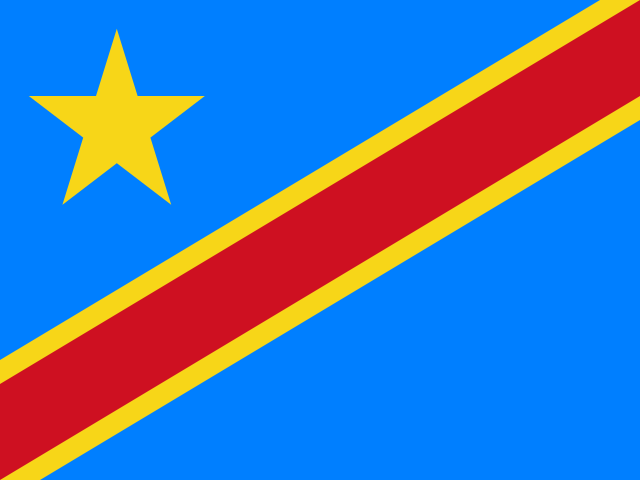
See the flag of Congo, Democratic Republic of the →
Kinshasa began as Léopoldville, founded in 1881 by the explorer Henry Morton Stanley on behalf of King Leopold II of Belgium, chosen for its position at the widening of the Congo River known as Pool Malebo — the furthest point upriver oceangoing traffic could reach before the river's lower rapids made further navigation impossible, making it a natural transshipment point for the entire colonial trade route inland. The city's original name honored the Belgian king directly, a colonial naming choice that stood for over eight decades.
The name Kinshasa was restored in 1966 as part of Mobutu Sese Seko's authenticité campaign, which sought to erase colonial-era names across the country (Stanleyville became Kisangani, Elisabethville became Lubumbashi) in favor of pre-colonial local names — Kinshasa itself derives from a fishing village of that name that had existed on the site before Stanley's arrival.
Kinshasa is now widely cited as the largest officially Francophone city in the world by population, larger than Paris itself, despite French being a colonial-era import rather than an indigenous language — a striking demographic fact that reflects both the country's enormous population growth since independence and Kinshasa's role as the overwhelming magnet for internal migration within DR Congo.
The city hosted one of the most famous events in 20th-century sports history: the 'Rumble in the Jungle,' the 1974 heavyweight boxing match between Muhammad Ali and reigning champion George Foreman, held at the Stade Tata Raphaël and watched by an enormous global television audience — a Mobutu-era prestige event intended to showcase Zaire on the world stage during a period of relative economic strength driven by high copper prices.
Kinshasa's growth has been staggering and largely unplanned: from a colonial population in the low hundreds of thousands at independence in 1960, the city has grown into one of the largest urban agglomerations in Africa, driven by decades of rural-to-urban migration during periods of conflict and economic collapse in the country's interior, straining infrastructure that has struggled to keep pace.
Sitting directly across the Congo River from Brazzaville, capital of the neighboring Republic of the Congo, Kinshasa and its riverside counterpart sit closer together than any other pair of national capitals divided by an international border — a geographic curiosity that also reflects the two countries' shared colonial-era river-trade history under different European powers, Belgium on the south bank and France on the north.
The city's La Kinoise music and dance scene, particularly the rumba-derived genre known as soukous that developed in Kinshasa's dance halls from the 1930s through the 1960s, spread across Central and East Africa and remains one of the region's most influential popular music exports, with Kinshasa-based artists and bands shaping dance music trends across the continent for decades.
Kinshasa's Limete neighborhood houses the Congolese People's Palace and the Lumumba Monument, honoring Patrice Lumumba, the country's first democratically elected prime minister, whose assassination in January 1961 — carried out with Belgian and American involvement documented decades later by official inquiries — remains one of the most consequential political killings in postcolonial African history and a defining trauma referenced repeatedly in the city's public monuments and street naming.
Kinshasa's Cinquantenaire (Fiftieth Anniversary) stadium, built for the country's 2010 golden jubilee of independence, and the sprawling Boulevard du 30 Juin running through the city center are among the most visible pieces of state-sponsored infrastructure built in the capital in the decades following the fall of Mobutu, reflecting successive governments' efforts to modernize a city whose population growth has consistently outpaced its infrastructure investment.
Quick facts
- By some counts Kinshasa's metropolitan area now exceeds 17 million residents, placing it among the largest urban agglomerations on Earth.
- The city was named Léopoldville until 1966, when Mobutu's authenticité campaign restored the pre-colonial village name Kinshasa.
- Kinshasa hosted the 1974 'Rumble in the Jungle' boxing match between Muhammad Ali and George Foreman.
- It sits at Pool Malebo, the point where the navigable lower Congo River meets a stretch of rapids that blocks further oceangoing river traffic inland.
- The University of Kinshasa, founded in 1954 as Lovanium University under Belgian Catholic sponsorship before being nationalized and renamed after independence, remains the country's oldest and largest institution of higher education, sited on a campus overlooking the Congo River south of the city center.