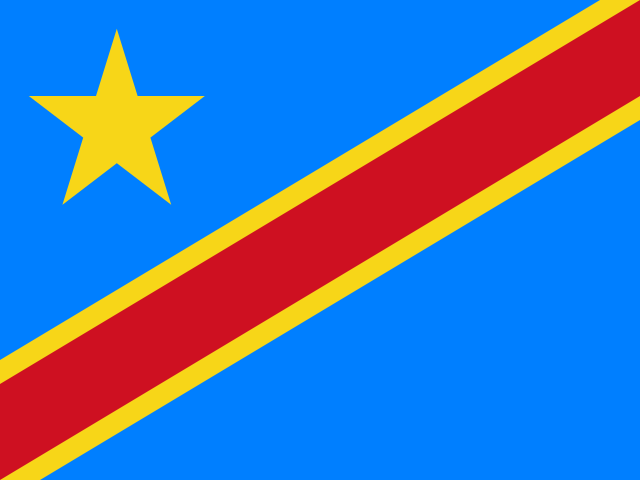
The Flag of Congo, Democratic Republic of the
Africa · Adopted 20 February 2006 (restoring a 1963–1971 design with amended blue shade)
The Democratic Republic of the Congo's current flag — sky blue field, a diagonal red band edged in yellow running from lower hoist to upper fly, and a single yellow star in the upper hoist — was formally readopted on 20 February 2006, but the design is a deliberate revival of a flag first used from 1963 to 1971, itself a modification of the flag flown at the country's 1960 independence from Belgium. Very few African flags have as tangled a lineage: this same basic blue-red-yellow-star scheme has flown, in slightly different arrangements, under at least four different national names and political systems since 1960.
At independence in 1960 the flag was a plain blue field with a single large yellow star in the canton and a row of six smaller stars along the hoist, representing the six provinces of the newly independent Congo. The 1963 revision (adopted after political turmoil including the Congo Crisis and Katanga's attempted secession) added the diagonal red-and-yellow band and dropped to a single central star, the version now echoed in the 2006 flag.
Mobutu Sese Seko's 1965 seizure of power and his subsequent Africanization campaign eventually swept the flag away too: in 1971, as part of renaming the country Zaire, Mobutu replaced it with a plain green flag bearing a yellow circle and a hand holding a torch — a design that lasted until his fall from power in 1997. The country's name reverted to the Democratic Republic of the Congo in 1997 under Laurent-Désiré Kabila, and the blue-red-yellow-star flag was restored, though with a darker navy-blue field than today's version.
The 2006 constitution, adopted after the country's first multiparty elections since independence, lightened the shade of blue to the current sky-blue and made minor proportional adjustments, cementing the current version as the one in force today. The blue is generally explained in Congolese government material as representing peace and hope, the red as the blood of the nation's martyrs (a reference reaching back to the anti-colonial struggle and the political violence of the Mobutu and post-Mobutu decades alike), the yellow trim as the country's mineral wealth, and the single star as unity for the country's vast and ethnically diverse population.
DR Congo's flag is easily and frequently confused with that of its smaller neighbor across the river, the Republic of the Congo, purely because of the shared name — but the resemblance stops there: the Republic of the Congo's flag is green-and-red on a diagonal with no star at all, a completely different color scheme from DR Congo's blue-red-yellow.
Because the country has changed its name four times since 1960 (Congo, Zaire, Democratic Republic of the Congo, and back), and its flag along with it more than once, DR Congo is sometimes cited by vexillologists as a case study in how closely national flags track political rupture — each of Mobutu's rise, the Congo Crisis, and the 1997 fall of Zaire produced a genuinely new flag rather than a minor tweak.
The flag today flies over a country still recovering from decades of conflict, including the First and Second Congo Wars of the late 1990s and early 2000s and ongoing instability in the eastern provinces, and it remains a fairly recent and still-consolidating symbol relative to flags with a single unbroken lineage since independence.
DR Congo's single yellow star sits deliberately off-center, placed in the upper hoist corner of the blue field rather than in the middle of the flag, a positioning inherited directly from the 1960 independence-era flag's row-of-stars arrangement and preserved through every subsequent redesign — one of the few visual through-lines connecting the 1960, 1963, and 2006 versions despite their otherwise different color schemes.
The country's immense size — DR Congo is Africa's second-largest country by area, spanning multiple time zones' worth of longitude and covering most of the Congo River basin — has made a single unifying national symbol especially important to successive governments given the country's more than 200 distinct ethnic groups and its history of regional secessionist pressure, most notably Katanga's attempted 1960–1963 secession under Moise Tshombe, which the central government fought specifically to prevent from fracturing the newly independent state the flag represented.
Independence Day, 30 June, marking the 1960 transfer of power from Belgium, remains the flag's principal annual occasion, and government buildings across the country's vast territory — from Kinshasa in the west to Lubumbashi and Goma in the east — display the flag prominently despite the practical difficulty of projecting consistent central authority across a landmass roughly the size of Western Europe.
Ongoing conflict in the country's eastern provinces, particularly North Kivu and South Kivu, where armed groups including the M23 rebel movement have repeatedly clashed with government forces and neighboring Rwanda has been repeatedly accused of backing rebel factions, has meant the blue-red-yellow flag flies over territory the central government does not always fully control — a persistent gap between the flag's formal claim to national unity and the country's fragmented on-the-ground reality in its eastern regions.
DR Congo's official flag specifications set the construction ratio at 3:4, a comparatively squarer proportion than the 2:3 ratio common among many other African states, and government usage places the diagonal red-and-yellow band running consistently from the lower hoist corner to the upper fly corner, with the star always positioned in the upper hoist portion of the blue field above the band.
The country's mineral wealth — vast cobalt, copper, and coltan reserves concentrated in the southeastern Katanga and Lualaba regions, critical to global battery and electronics manufacturing — has repeatedly fueled the same cycles of external interference and internal conflict that produced the flag's various redesigns in the first place, from Belgian and Western involvement in Katanga's 1960s secession to more recent accusations of foreign-backed militia activity tied to mineral extraction in the east.
Buying it at 3:4, not 3:5
- Flag cut to a 3:4 ratio — Stock flags are cut to 3:5 or 2:3, which stretches this one and shifts the diagonal band off the corners it is meant to run between. A maker who states the ratio is the distinction worth paying for.
As an Amazon Associate we earn from qualifying purchases made through these links, at no extra cost to you.
Often confused with
- Republic of the Congo — shares the diagonal-band layout and the pan-African palette family, but uses green and red with no star, a distinctly different color combination from DR Congo's blue, red, and yellow. Compare side by side →
Congo, Democratic Republic of the at a glance
- Capital
- Kinshasa
- Population
- 109.3 million (2024)
- Currency
- Congolese Franc (CDF)
- Language(s)
- French (official); Lingala, Kikongo, Tshiluba, and Swahili as national languages
Population figure as of 2024, source: UN World Population Prospects (2024 revision). See methodology for how facts are sourced and kept current.