Brazzaville — Capital of Congo, Republic of the
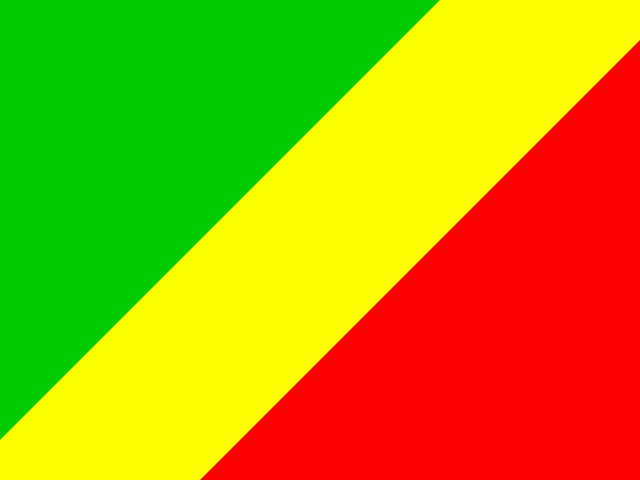
See the flag of Congo, Republic of the →
Brazzaville takes its name directly from Pierre Savorgnan de Brazza, the Italian-born French explorer who negotiated a treaty with local Bateke ruler Makoko in 1880 that opened the northern bank of the Congo River to French colonization, founding the settlement that bears his name the following year. That naming choice is unusually literal among African capitals — most colonial-era capitals were renamed after independence, but Brazzaville kept the name of the colonizer who founded it even after 1960.
The city sits directly across the Congo River from Kinshasa, capital of the Democratic Republic of the Congo, making the two the closest pair of national capitals in the world after Rome and Vatican City that are separated by an international border — a roughly 4-kilometer stretch of river separates the two downtowns, and the pairing is often cited in geography trivia as the only place two national capitals face each other across a river.
Brazzaville served as the capital of French Equatorial Africa, the federation covering modern Gabon, Chad, the Central African Republic, and the Republic of the Congo, from 1910 until that federation dissolved in 1958 — giving the city an administrative importance well beyond its own eventual national borders. It also briefly held outsized global significance during the Second World War: from 1940 to 1943, Brazzaville served as the symbolic capital of Free France under Charles de Gaulle after mainland France fell to Germany, since French Equatorial Africa was among the first colonial territories to side with the Free French rather than the Vichy government.
The Basilique Sainte-Anne du Congo, with its distinctive green-tiled roof completed in the 1940s, remains one of the city's most recognizable landmarks and a legacy of that French colonial and wartime period, while the nearby Poto-Poto neighborhood is known for a school of naive-style painting that developed there from the 1950s onward and gained international recognition.
The Republic of the Congo's own civil conflicts, particularly the 1997 war between forces loyal to Denis Sassou Nguesso and then-president Pascal Lissouba, caused significant destruction in parts of Brazzaville, and reconstruction of some districts continued well into the 2000s.
Brazzaville remains the country's political capital and one of its two major urban centers, though it is not the country's largest port on the Congo River system — that role, along with much of the country's rail-linked export trade, is shared with the coastal city of Pointe-Noire, which handles the bulk of oil exports that dominate the national economy.
The Congo-Ocean Railway, built between 1921 and 1934 under forced-labor conditions that killed an estimated 14,000 to 20,000 African laborers, links Brazzaville to Pointe-Noire on the coast and remains, nearly a century later, the primary rail corridor moving goods between the landlocked capital and the sea — a piece of infrastructure whose brutal construction history is now openly acknowledged in Congolese and French historical accounts as one of the deadliest colonial engineering projects in Central Africa.
Brazzaville's Poto-Poto painting school, founded formally in 1951 by French artist Pierre Lods working with local Congolese artists, helped establish the city as an early center of modern African art distinct from the folkloric or purely commercial output often expected of African artists under colonial rule, and works from the school's founding generation are now held in museums internationally.
Quick facts
- Brazzaville's metropolitan area, put at roughly 2.4 million people in 2024 estimates, holds well over a third of the entire Republic of the Congo's national population.
- Kinshasa, directly across the river, is more than five times larger than Brazzaville, making this river-facing capital pair among the most population-lopsided anywhere in the world.
- The green-tiled roof of the Basilique Sainte-Anne du Congo, completed in the 1940s, is visible from across the river in Kinshasa, one of the few Brazzaville landmarks recognizable from the opposite bank.
- Brazzaville was founded in 1880 by Pierre Savorgnan de Brazza and named for him rather than renamed after independence.
- The Congo-Ocean Railway remains the country's only rail line to the coast, running roughly 510 kilometers from Brazzaville to the Atlantic port of Pointe-Noire.