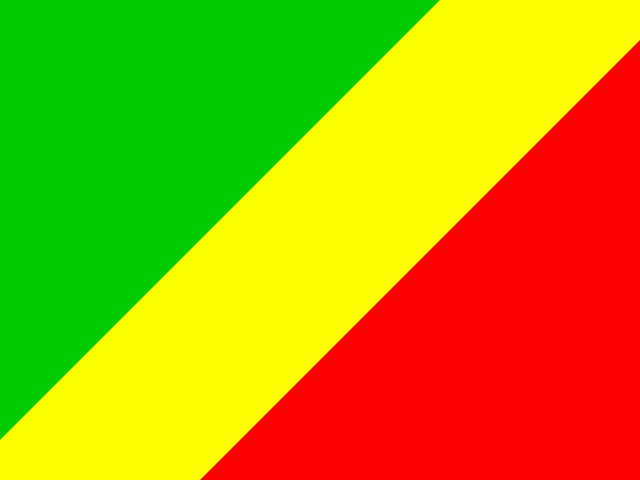
The Flag of Congo, Republic of the
Africa · Adopted 10 June 1991 (readopted, originally used 1959–1970)
The Republic of the Congo's flag has a strange, two-act history: it was first adopted in 1959, a year before independence from France, then abolished entirely in 1970 when the country declared itself the Marxist-Leninist People's Republic of the Congo and switched to a red flag bearing a hammer, hoe, and star in the Soviet-bloc style. That red flag flew for two decades until the country abandoned single-party Marxist rule in 1991, at which point the original 1959 diagonal tricolor was formally reinstated rather than a new design being created — an unusual move that made the post-Marxist flag older than the regime it replaced.
The design itself is a green, yellow, and red field split by a single diagonal band running from the lower hoist to the upper fly, with green filling the upper-hoist triangle and red the lower-fly triangle. Congo-Brazzaville is often cited as the flag that made this exact diagonal-tricolor layout famous within the pan-African design tradition, since it predates most other diagonal African flags and was adopted the year before the 1960 wave of African independence.
The three colors follow the pan-African palette that traces back to Ethiopia's flag, but Congo-Brazzaville's own government literature ties them to more specific local meanings: green for the country's forests and agriculture (the Republic of the Congo is heavily forested, with dense equatorial rainforest covering much of its territory), yellow for the friendship and dignity of its people, and red for the sacrifice made in the struggle for independence and unity.
The diagonal band itself has no single settled explanation in Congolese sources beyond serving as a distinctive way to combine the three pan-African colors without resorting to the horizontal or vertical stripe layouts already used by neighboring states — a practical design choice as much as a symbolic one, since by the late 1950s several nearby territories were already moving toward vertical or horizontal pan-African tricolors and Brazzaville's diagonal cut a visually distinct silhouette.
Because the Republic of the Congo (capital Brazzaville) and the Democratic Republic of the Congo (capital Kinshasa) sit directly across the Congo River from one another and share a name, a language of administration (French), and a broad regional history, the two are frequently confused in casual conversation — but their flags look nothing alike: DR Congo's is diagonally split blue and red with a single yellow star, while the Republic of the Congo's is diagonally split green and red with a solid yellow band, no star at all.
Marien Ngouabi's 1969 coup and the subsequent declaration of the People's Republic of the Congo in 1970 replaced this flag with an entirely different Soviet-style red banner, and Congo-Brazzaville remained one of Africa's few explicitly Marxist-Leninist one-party states for over two decades, aligned closely with the USSR and Cuba, until the National Conference of 1991 abolished the one-party constitution and restored both multiparty politics and the pre-1970 flag in the same reform wave.
Since 1991 the flag has not been altered again, surviving the return to power of former Marxist president Denis Sassou Nguesso in the 1997 civil war and his continued rule since — a rare case of a flag outlasting the very ideological system under which it was first suppressed.
The 1997 civil war that returned Sassou Nguesso to power was fought largely in and around Brazzaville itself, between his own Cobra militia (backed by Angolan troops) and forces loyal to elected president Pascal Lissouba, and the fighting caused extensive damage to the capital even as the pre-1970, pre-Marxist flag flew as the country's uncontested official symbol on both sides of that conflict — none of the warring factions sought to replace it with a rival design of their own.
The green-yellow-red palette Congo-Brazzaville draws on, while rooted historically in Ethiopia's example, is applied here with a distinctly regional Central African emphasis on forest cover: the Republic of the Congo's northern regions sit within the wider Congo Basin rainforest, the second-largest contiguous tropical rainforest on Earth after the Amazon, and government explanations of the flag's green consistently foreground that specific ecological identity rather than treating green as a generic pan-African reference.
Congolese law designates 15 August, the 1960 independence date from France, as the principal day for official flag ceremonies nationwide, distinct from the 1991 date on which the current flag's post-Marxist status was formally restored — meaning the flag itself is publicly commemorated on the anniversary of its original 1959 creation and 1960 first use rather than the date of its 1991 reinstatement.
Congolese official reproductions call for a bright, saturated yellow on the diagonal band rather than a duller gold tone, a detail that helps distinguish the flag visually at a distance from Cameroon's, which pairs similar green and red with a comparatively muted gold star arranged in vertical rather than diagonal bands, on a field built to a standard 2:3 proportion.
Denis Sassou Nguesso, who first seized power in 1979 under the Marxist one-party system and then returned in the 1997 civil war after the multiparty era had already restored this same tricolor flag, has now governed the Republic of the Congo for a combined total exceeding three decades under two entirely different flags — the Marxist red banner during his first period in power, and the pre-1970 tricolor throughout his second, longer tenure since 1997.
The Republic of the Congo's population remains concentrated overwhelmingly along the Brazzaville-Pointe Noire railway corridor and the country's two main cities, leaving vast stretches of the northern rainforest interior sparsely populated — a settlement pattern the flag's green band, representing that same forest expanse, only partially reflects, since most Congolese citizens living under the flag today experience it as an urban rather than a forest symbol in daily life.
The yellow the page asks for
- Bright-dye outdoor flag — The page draws a distinction between a bright saturated yellow and a duller gold, and that is a real buying decision: the duller tone is what you get from a coarse print, and it is also what makes this flag look like Cameroon's.
As an Amazon Associate we earn from qualifying purchases made through these links, at no extra cost to you.
Often confused with
- Democratic Republic of the Congo — shares a name, a border along the Congo River, and a diagonal band layout, but uses blue and red rather than green and red, and adds a single yellow star that Congo-Brazzaville's flag lacks entirely. Compare side by side →
- Senegal — uses the same green-yellow-red pan-African palette but in vertical stripes with a central star, a completely different layout from Congo-Brazzaville's diagonal split. Compare side by side →
Congo, Republic of the at a glance
- Capital
- Brazzaville
- Population
- 6.3 million (2024)
- Currency
- Central African CFA Franc (XAF)
- Language(s)
- French (official); Lingala and Kituba widely spoken as national languages
Population figure as of 2024, source: UN World Population Prospects (2024 revision). See methodology for how facts are sourced and kept current.