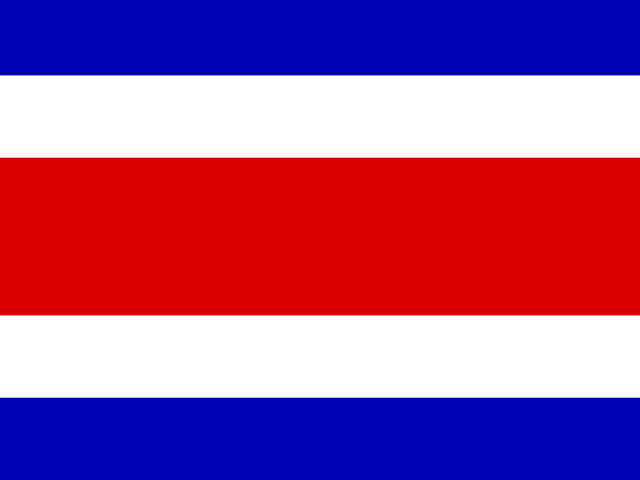
San José — Capital of Costa Rica
San José was not Costa Rica's original colonial capital — that distinction belonged to Cartago, founded in 1563 as the seat of Spanish colonial administration for the province. San José itself was only founded in 1737, as a small tobacco-growing settlement in the fertile Central Valley, and it did not become Costa Rica's capital until 1823, when a brief civil conflict, the Ochomogo War, was fought specifically over whether the capital should move from royalist-leaning Cartago to the more liberal, republican-minded San José. San José's side won, and the capital has remained there ever since.
The city grew rapidly through the 19th century on the strength of coffee exports, which became Costa Rica's dominant cash crop and principal source of national wealth from the 1830s onward, funding much of San José's civic architecture, including the ornate National Theatre, completed in 1897 and financed partly through a special tax on coffee exports after touring opera companies had reportedly skipped Costa Rica for lacking a suitable venue.
San José sits in the Central Valley at an elevation of roughly 1,170 meters, giving it a notably mild, spring-like climate year-round compared with Costa Rica's hotter coastal regions — a factor that contributed to the valley's appeal for both indigenous settlement before the Spanish arrived and for the coffee cultivation that later built the city's wealth, since Arabica coffee grows especially well at that elevation.
As the seat of Costa Rica's unicameral Legislative Assembly, the Supreme Court, and the presidency, San José has functioned as the country's uncontested political center since the 1823 Ochomogo War settled the question, and it has never faced a serious rival bid to relocate the capital in the two centuries since, unlike some neighboring Central American countries whose capitals shifted more than once after independence.
The city's National Museum is housed in the former Bellavista Fortress, a military barracks still pockmarked with bullet holes from the 1948 Costa Rican Civil War, the conflict that led directly to the abolition of Costa Rica's military that same year — a building whose transformation from army barracks to museum mirrors the country's own shift away from a standing military entirely.
San José's rapid, largely unplanned 20th-century growth left the city with a reputation, even among many Costa Ricans, as architecturally less charming than smaller colonial towns like Cartago or the coffee-growing towns of the surrounding Central Valley, since much of its 19th-century coffee-boom architecture was demolished during mid-20th-century modernization drives in favor of concrete commercial buildings — a contrast the National Theatre's preserved 1897 grandeur stands out against all the more sharply today.
The Metropolitan Cathedral of San José, rebuilt several times after earthquake damage with the current structure dating largely from a 1928 reconstruction, sits facing the Parque Central at the historic heart of the city, and the surrounding downtown grid still roughly follows the original 18th-century tobacco-farming settlement's layout even as high-rise development has spread outward through the wider Central Valley in the decades since.
San José hosts the headquarters of several regional and international organizations, including the Inter-American Court of Human Rights, established in the capital in 1979 as part of the Organization of American States' human rights system — a role Costa Rican officials frequently connect to the country's demilitarized, judicially oriented national identity following the 1948 abolition of its armed forces.
Quick facts
- More than a third of all Costa Ricans, around 2.2 million people, live within greater San José's metropolitan footprint, a share of national population unusually concentrated for a country of Costa Rica's size.
- Costa Ricans commonly call the capital 'Chepe,' a folk diminutive of the name José, in everyday conversation even on official radio and television.
- San José's Jade Museum holds one of the largest collections of pre-Columbian American jade in the world, most of it excavated from sites within Costa Rica.
- Much of downtown San José still follows the rectangular street grid laid out under the Spanish colonial Law of the Indies, visible in the historic center around Parque Central.
- La Sabana, now San José's largest urban park, was the country's international airport until 1955, when air traffic moved to a new site outside the city.