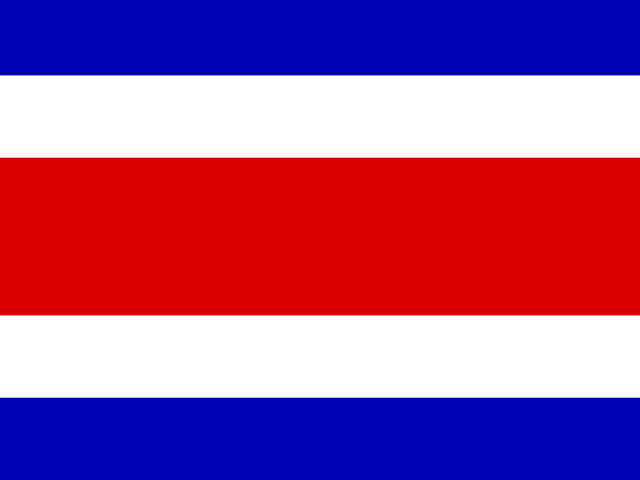
The Flag of Costa Rica
North America · Adopted 27 November 1906 (current civil flag proportions); core five-stripe design dates to 1848
Costa Rica's flag traces its immediate design lineage to 1848, when President José María Castro Madriz's wife, Pacífica Fernández, is credited with proposing the addition of a central red stripe to the existing blue-white-blue flag Costa Rica had used since breaking from the short-lived Federal Republic of Central America in the early 1820s. The change was explicitly inspired by the French Tricolour and by the 1848 revolutions sweeping Europe that year, with red added specifically to align Costa Rica visually with republican and revolutionary movements of the period, giving the country a five-stripe blue-white-red-white-blue design that has remained its core layout ever since.
That blue-white-blue starting point was never unique to Costa Rica: it descends from the flag of the United Provinces of Central America, the federation that briefly united Costa Rica with Guatemala, Honduras, El Salvador, and Nicaragua after independence from Spain in 1821 and Mexican rule ended in 1823. When the federation collapsed in the late 1830s and each state went its own way, most of the five successor nations kept some version of the original blue-white-blue banner as a shared visual inheritance — Costa Rica's 1848 red stripe is what set it apart from that family, since Guatemala, Honduras, El Salvador, and Nicaragua largely preserved the plain blue-white-blue pattern for far longer, or returned to variations of it, without adding a comparable central color.
The current state flag carries a coat of arms on the central red stripe (used on government and diplomatic flags, distinct from the plainer civil flag flown by ordinary citizens, which carries no emblem at all) depicting three volcanoes representing Costa Rica's three mountain ranges, a valley between two oceans referencing the country's position between the Pacific and Caribbean, and seven stars for the seven provinces, with a golden sun rising to represent a new day for the nation — the sun's exact number of rays and the coat of arms's overall design were most recently formalized by law in 1998, refining earlier 20th-century versions.
The flag's civil-versus-state distinction matters practically: private citizens and most everyday uses fly the plain five-stripe flag without the coat of arms, while government buildings, the president, and diplomatic missions use the version bearing the emblem — a two-tier system shared with several other Central American nations but formalized with particular legal precision in Costa Rica.
Costa Rica's decision to abolish its military in 1948, following a brief civil war, is sometimes cited by Costa Ricans as giving the flag added symbolic weight relative to its neighbors — the red stripe representing not the blood of an ongoing military struggle, as red is interpreted on some other national flags, but the warmth and generosity of the Costa Rican people, according to standard official readings, a peaceful framing consistent with the country's post-1948 identity as a demilitarized state within a historically conflict-prone region.
Because the blue-white-red-white-blue five-stripe pattern is genuinely close to Thailand's flag in raw stripe sequence, the two are sometimes confused in unlabeled images despite belonging to countries on opposite sides of the world with entirely unconnected design histories — Costa Rica's blue stripes are proportionally different and its state version carries the volcano-and-star coat of arms that Thailand's flag entirely lacks.
Costa Rica's flag law, most recently updated in the late 1990s, governs the exact width ratios of the five stripes (the central red band is wider than the others) and the coat of arms artwork, and the flag is flown with particular civic emphasis around Independence Day on 15 September, commemorating the shared 1821 Central American declaration of independence from Spain that also marks Guatemala, Honduras, El Salvador, and Nicaragua's independence days on the same date.
Pacífica Fernández's role in proposing the 1848 red stripe is one of the few instances in Latin American flag history where a first lady is directly credited with a specific design change adopted into law, and Costa Rican civic materials continue to name her specifically rather than attributing the change to President Castro Madriz's government in the abstract — a detail Costa Rican schoolchildren learn alongside the more commonly told story of the French Tricolour's influence on the choice.
The coat of arms's three volcanoes are usually identified as representing the Cordillera de Guanacaste, Cordillera Central, and Cordillera de Talamanca, Costa Rica's three principal mountain ranges, and the emblem's small merchant ships sailing on the two flanking bodies of water are a specific reference to the country's dual Pacific and Caribbean coastlines — a detail meant to distinguish Costa Rica visually from inland neighbors like Guatemala, whose own coat of arms has no comparable maritime imagery.
Costa Rica's 1948 civil war, brief but intense, was fought principally over a disputed presidential election, and the country's subsequent decision to formally abolish its military under the 1949 constitution is frequently cited by Costa Ricans as central to the country's modern self-image as a peaceful exception within a historically conflict-prone Central American region — an identity the flag's red stripe, reinterpreted as warmth rather than bloodshed, is often said to reflect, even though the stripe's original 1848 meaning had nothing to do with that later 20th-century political development.
The version with the arms
- State flag with the emblem — Two versions are in use and the plain one is much commoner in listings, so if the oval emblem on the red band is what you want, the listing has to show it explicitly.
As an Amazon Associate we earn from qualifying purchases made through these links, at no extra cost to you.
Often confused with
- Thailand — shares a similar blue-white-red-white-blue horizontal stripe sequence, but Thailand's flag has no coat of arms and different stripe proportions, and the two countries' flag traditions developed with no historical connection to one another. Compare side by side →
Costa Rica at a glance
- Capital
- San José
- Population
- 5.2 million (2024)
- Currency
- Costa Rican Colón (CRC)
- Language(s)
- Spanish (official)
Population figure as of 2024, source: UN World Population Prospects (2024 revision). See methodology for how facts are sourced and kept current.