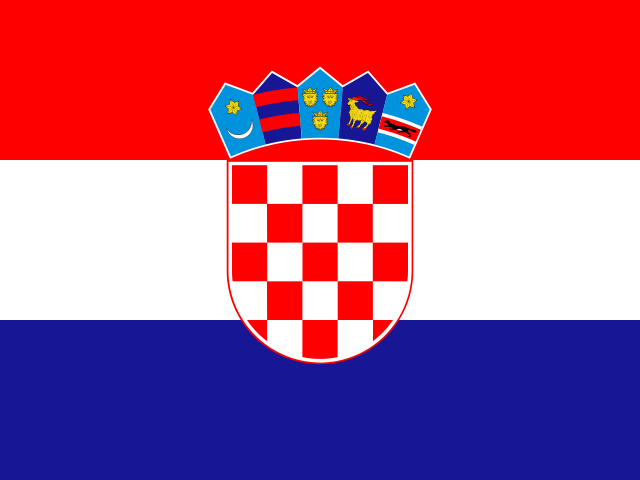
Zagreb — Capital of Croatia
Zagreb grew from two adjacent medieval hilltop settlements that long rivaled each other before merging: Kaptol, the ecclesiastical seat centered on Zagreb Cathedral and governed by the local bishop, and Gradec, a separately chartered royal free town on the neighboring hill, granted its charter by King Béla IV of Hungary in 1242 partly as thanks for the town's role sheltering him during a Mongol invasion. The two settlements, separated by a stream later paved over as the street now called Tkalčićeva, feuded and even fought each other periodically for centuries before formally uniting into a single city in 1850.
Zagreb's rise to prominence tracks the broader history of Croatia's relationship with Hungary and later the Habsburg monarchy, of which Croatian lands were a part for centuries; it became the seat of Croatia's ban (viceroy) and functioned as an effective regional capital long before Croatia was ever independent, hosting the Sabor (Croatian parliament) whose institutional roots go back to medieval assemblies of Croatian nobility. The 19th-century Croatian National Revival, a cultural and political movement asserting Croatian identity within the Austro-Hungarian Empire, was substantially centered in Zagreb and helped cement the city's role as the focal point of Croatian national life well before statehood.
Zagreb became capital of the Socialist Republic of Croatia within Yugoslavia after 1945 and automatically continued as capital when Croatia declared independence in 1991 — though independence did not come without direct danger to the city itself: Zagreb came under rocket attack in May 1995 during Operation Flash, part of the wider Croatian War of Independence, when Serb forces launched cluster munitions that killed several civilians in the city center, a reminder that Croatia's path to full sovereignty involved real combat reaching its own capital, not only its border regions.
The city's Upper Town (Gornji Grad, encompassing the old Kaptol and Gradec districts) retains much of its historic character, including the neo-Gothic twin spires of Zagreb Cathedral (largely rebuilt after a 1880 earthquake) and St. Mark's Church, whose colorfully tiled roof depicting the medieval coats of arms of Zagreb and the Triune Kingdom of Croatia, Slavonia, and Dalmatia is one of the city's most photographed landmarks, while the Lower Town, developed mainly in the 19th and early 20th centuries, holds Zagreb's museums, theaters, and the horseshoe-shaped series of parks and squares known as Lenuci's Horseshoe.
The centuries-long rivalry between Kaptol and Gradec occasionally turned genuinely violent, most notably in repeated medieval and early-modern conflicts over trade rights and jurisdiction between the bishop's clerical authority on one hill and the free town's merchant-citizen government on the other, a local rivalry distinct from but often intertwined with the larger political struggles between church and crown playing out across the wider Kingdom of Hungary-Croatia during the same centuries.
Zagreb's more recent 21st-century identity has been shaped partly by its annual Advent Christmas market, which won 'Best European Christmas Market' in successive years in the mid-2010s in an online public poll, a recognition the city has actively promoted as part of a broader tourism push distinct from Croatia's much better internationally known Adriatic coastal destinations like Dubrovnik and Split.
North of the Upper Town, Mirogoj Cemetery — designed by the Zagreb Cathedral architect Hermann Bollé and opened in 1876 — is laid out beneath a long arcaded wall of domed brick pavilions rather than as an open lawn cemetery, and it serves as shared burial ground for the city's Catholic, Orthodox, Muslim, Jewish, and Protestant communities alike. That multi-faith arrangement was unusual for a 19th-century European cemetery and is still visible today in the range of religious symbols and inscriptions carved along its arcades.
Dolac, the open-air market perched on a raised terrace just above Ban Jelačić Square, has operated since the 1930s and remains the city's principal fresh-produce market, its rows of red umbrellas forming one of the most recognizable everyday scenes in central Zagreb; farmers from the surrounding Zagorje hills still bring produce into the market most mornings much as they did when it first opened.
Quick facts
- Zagreb's population of roughly 800,000 as of 2024 makes it home to nearly a fifth of all Croatians, a concentration built up over decades of internal migration from smaller towns and the coast.
- The city formed from the 1850 merger of two long-rival medieval settlements, Kaptol and Gradec, still visible as distinct districts in the Upper Town today.
- St. Mark's Church's tiled roof displays the historic coats of arms of Zagreb and of Croatia, Dalmatia, and Slavonia.
- Dolac open-air market, above Ban Jelačić Square since the 1930s, is still supplied each morning by farmers driving in from the Zagorje hills north of the city.
- The Zagreb Funicular, connecting the Lower and Upper Towns, opened in 1890 and remains one of the shortest and oldest public funiculars still operating in the world.