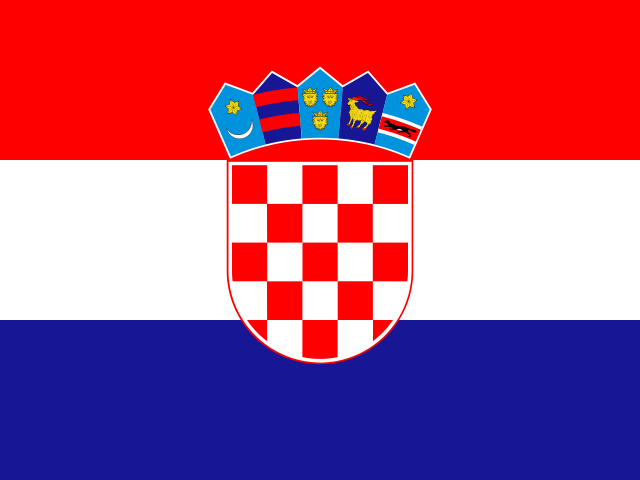
The Flag of Croatia
Europe · Adopted 21 December 1990
Croatia's flag pairs a red-white-blue horizontal tricolor with a distinctive centered coat of arms — the šahovnica, a red-and-white checkerboard shield — and it was formally adopted on 21 December 1990 as part of the new Croatian constitution passed as the country moved toward independence from a disintegrating Yugoslavia, a process it completed the following year. The tricolor itself echoes the Pan-Slavic color scheme also seen in Slovenia's and Russia's flags, reflecting a mid-19th-century tradition among Slavic national movements of adopting red-white-blue banners as an expression of shared Slavic identity even as each country's specific arrangement and emblem differ.
The checkerboard shield is far older than the modern flag and is generally traced back to medieval heraldic tradition associated with the Kingdom of Croatia, with red-and-white checkered shields appearing in Croatian heraldic contexts from at least the 15th century onward; a persistent, though historically unverifiable, popular legend holds that a Croatian ban (viceroy) won a chess match against a Venetian doge and was rewarded with control over the Dalmatian coast, explaining the checkerboard's origin — a colorful story Croatian sources themselves generally treat as folklore rather than documented history.
One detail Croatians take seriously about the šahovnica is which corner square is red versus white: the modern flag's shield begins with a red square in the top-left corner, a specific arrangement that distinguishes it from the checkerboard used during the WWII-era fascist Ustaše puppet state, which began with a white square in that position — a difference of a single square's color that carries real historical weight in Croatia given the Ustaše regime's association with wartime atrocities, and one the post-1990 government was careful to get right when finalizing the modern design.
Above the checkerboard sits a row of five smaller crowns, or crownlets, representing Croatia's historical constituent regions: the oldest Croatian crown (from the medieval Croatian Kingdom), and the arms of the Republic of Dubrovnik, Dalmatia, Istria, and Slavonia — a design choice that visually asserts Croatian sovereignty over territories with distinct historical identities, uniting them under a single national emblem in a way that was politically significant during the early-1990s push for full independence and territorial integrity amid the Yugoslav wars.
Croatia's flag replaced the socialist-era flag of the Socialist Republic of Croatia within Yugoslavia, which had used a red star in place of the checkerboard shield; removing the star and reinstating the historic šahovnica was one of the most visible symbolic breaks Croatia made with its Yugoslav communist past as it moved toward the 1991 declaration of independence and the war that followed with Yugoslav federal and Serb forces.
The šahovnica's earliest confirmed documented appearance is generally dated to 1495, on the coat of arms of Croatian-Hungarian King Vladislaus II, and it recurs steadily through subsequent centuries of Croatian heraldry under Habsburg rule, including on 19th-century Croatian regimental flags used within the Austro-Hungarian military — giving the checkerboard a documented pedigree stretching back over five centuries even though the number of squares and exact coloring were not fully standardized until the modern 1990 flag law fixed them precisely at 25 squares in a 5-by-5 grid.
Croatia's coat of arms question became a live political issue again well beyond the initial 1990 design, since Bosnian Croat and Herzegovinian political factions during and after the 1990s Yugoslav wars also adopted checkerboard-based symbols in territory outside Croatia's own borders, and the shared šahovnica has occasionally functioned as a marker of ethnic Croat identity across the wider former-Yugoslav region in much the way Albania's eagle functions for ethnic Albanians beyond Albania's own state boundaries.
Because a red-and-white checkerboard pattern is visually distinctive, Croatia's coat of arms itself has few flag lookalikes internationally, though the broader red-white-blue tricolor format is shared, in different arrangements, with several other Slavic-heritage flags including Slovakia's and the Netherlands' (unrelated to the Slavic tradition but visually similar in raw color palette) — Croatia's is set apart clearly, however, by the checkerboard shield present on no other national flag.
Croatia's own Pan-Slavic red-white-blue tricolor traces to the 1848 Croatian national revival movement, when Croatian political leader Josip Jelačić and allied intellectuals promoted the same tricolor scheme other Slavic nationalist movements across the Austrian Empire were adopting that year as part of a wider wave of 1848 revolutions, giving Croatia's flag colors roots in a specific mid-19th-century political moment distinct from, though contemporary with, the much older heraldic history of the checkerboard shield itself.
Croatia's brief period as part of the Kingdom of Serbs, Croats and Slovenes and then interwar Yugoslavia between the world wars saw the checkerboard largely folded into a shared Yugoslav royal coat of arms rather than flown independently, and it was only with the establishment of the Socialist Republic of Croatia after 1945 that a distinctly Croatian version of the tricolor, initially bearing a red star rather than the šahovnica, reemerged as the flag of a formally recognized, if not independent, Croatian political entity within federal Yugoslavia.
Which corner square is red
- Detail-accurate printed flag — The checkerboard starts with a red square at the top left, and a flag that starts on white is a different arrangement entirely. It is a single square to check in the listing photograph.
As an Amazon Associate we earn from qualifying purchases made through these links, at no extra cost to you.
Often confused with
- Slovenia — shares the same Pan-Slavic red-white-blue tricolor base and even a similar coat of arms placement, but Slovenia's emblem shows Triglav mountain and wavy blue lines rather than Croatia's red-and-white checkerboard shield. Compare side by side →
Croatia at a glance
- Capital
- Zagreb
- Population
- 3.8 million (2024)
- Currency
- Euro (EUR)
- Language(s)
- Croatian (official)
Population figure as of 2024, source: UN World Population Prospects (2024 revision). See methodology for how facts are sourced and kept current.