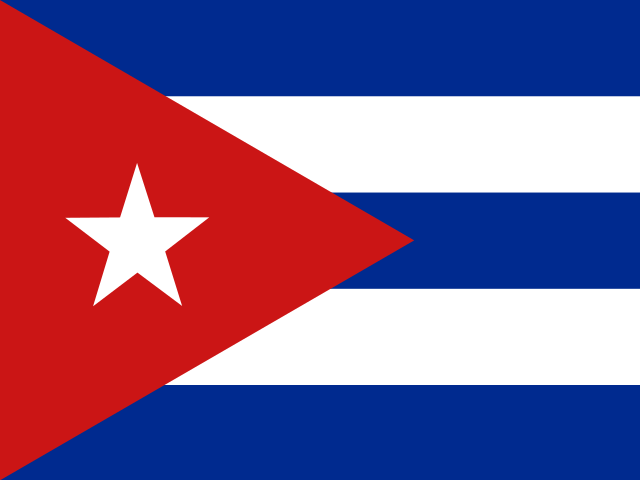
Havana — Capital of Cuba
Havana was founded by Spanish colonizers in 1519, one of the original seven villas established on Cuba by conquistador Diego Velázquez de Cuéllar, and its location on a deep, well-protected natural harbor on Cuba's northern coast quickly made it the most strategically important port in the Spanish Caribbean — by the mid-16th century, Havana had become the mustering point where Spanish treasure fleets gathered before sailing together back to Spain, a role that shaped the city's fortifications and defenses for the next two centuries.
That treasure-fleet role made Havana a repeated target for pirates and rival European powers, prompting Spain to build an extensive ring of fortifications, including the Castillo de los Tres Reyes Magos del Morro, completed in 1630 to guard the harbor entrance, and the massive Castillo de San Carlos de la Cabaña, finished in 1774 after Britain briefly captured Havana in 1762 during the Seven Years' War — an occupation that lasted less than a year but convinced Spain to invest heavily in the city's defenses afterward.
UNESCO placed Havana's Old Town, Habana Vieja, on its World Heritage List in 1982, citing one of the most extensive collections of Spanish colonial architecture in the Americas, much of it preserved — critics and supporters both note — precisely because Cuba's post-1959 economic isolation and limited development funding left large portions of the old city relatively unchanged for decades compared with colonial districts in cities that saw heavier mid-20th-century redevelopment.
The city became the capital of Spanish colonial Cuba formally in 1607, when Spain officially designated Havana the seat of colonial government over the earlier capital of Santiago de Cuba on the island's eastern end, cementing a west-east divide in Cuban political and cultural weight that has persisted in various forms ever since — Santiago retains a strong regional identity as Cuba's 'other' historic center even though it never regained capital status.
Havana has remained the capital through every subsequent change of government: Spanish colonial rule, brief U.S. military occupation after 1898, the pre-1959 republic, and the socialist government under Fidel Castro and his successors since 1959, giving the city an unbroken four-century run as Cuba's political center that few Caribbean capitals can match.
Pre-revolutionary Havana in the 1950s developed a reputation as a glamorous, casino-driven playground for American tourists under the Fulgencio Batista government, with mob-linked hotels and nightclubs lining the Malecón and Vedado districts — an era that ended abruptly after the 1959 revolution, when the incoming government nationalized the casinos and hotels and redirected the city's economy away from American tourism entirely for decades.
Havana's Malecón, a roughly eight-kilometer seaside esplanade and seawall built in stages beginning in 1901 during the U.S. occupation period, remains one of the city's most iconic public spaces, doubling as a promenade, informal social gathering spot, and flood barrier against the storm surges that periodically batter the low-lying waterfront during hurricane season.
Havana's population declined and its building stock deteriorated markedly during the economic crisis of the 1990s known in Cuba as the Special Period, triggered by the collapse of Soviet subsidies that had propped up the Cuban economy for decades, and while parts of the historic center have since been restored using tourism revenue, many residential neighborhoods outside the protected Habana Vieja zone still show the visible strain of decades of limited maintenance investment.
Quick facts
- Havana's roughly 2.1 million residents make it by a wide margin Cuba's largest city, dwarfing Santiago de Cuba, the country's historic second city, in both population and economic weight.
- Havana's Cathedral Square is anchored by the Baroque Havana Cathedral, completed in 1777 and built from coral-fossil limestone quarried from the seabed just offshore.
- Thousands of pre-1960 American cars, kept running for decades because the US trade embargo restricted new vehicle imports, remain a familiar sight on Havana's streets today.
- The Hotel Nacional de Cuba, opened in 1930 on a bluff above the Malecón, hosted a notorious 1946 mob summit organized by Lucky Luciano and later held Cuban anti-aircraft positions in its gardens during the 1962 missile crisis.
- Spain built a massive ring of harbor fortifications after Britain's brief 1762–63 occupation of Havana during the Seven Years' War exposed how vulnerable the port's defenses had been.