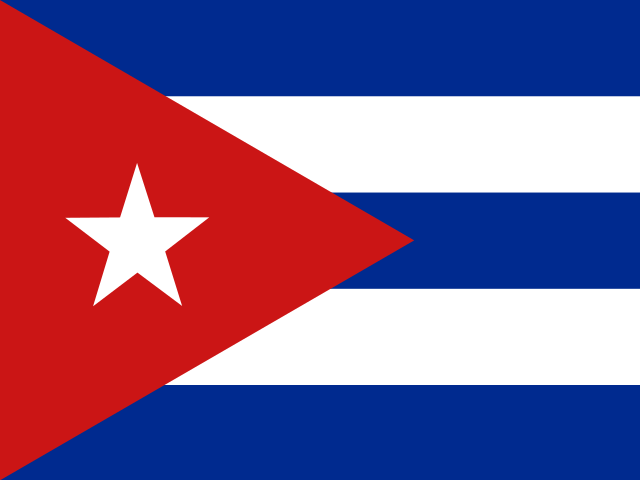
The Flag of Cuba
North America · Adopted 20 May 1902 (first flown 1850)
Cuba's flag was designed in 1849 by Narciso López, a Venezuelan-born general who led several failed military expeditions to try to wrest Cuba from Spanish colonial rule, working with exiled Cuban revolutionary Miguel Teurbe Tolón in New York, where much of the era's Cuban independence organizing took place among expatriates. López first flew the flag in Cuba itself during a brief, unsuccessful invasion at Cárdenas in May 1850, making the design a banner of armed rebellion against Spain for over half a century before it ever became an official state flag — Cuba did not actually win independence until 1898, and the flag was not formally adopted as the national flag until 20 May 1902, the day the Republic of Cuba was established after a brief period of U.S. military occupation following the Spanish-American War.
The design's three blue stripes represent the three military departments Spain divided colonial Cuba into administratively, while the two white stripes stand for the purity of the independence cause; the red triangle at the hoist, a Masonic-influenced symbol reflecting López and Tolón's own membership in Freemasonry and the movement's role in early Cuban independence organizing, represents equality, fraternity, and the blood spilled in the fight for freedom from Spain, with the white five-pointed star at its center — the 'Lone Star' — symbolizing Cuban independence and sovereignty as a single, unified nation among others.
That Lone Star had a direct and lasting influence beyond Cuba's own borders: because López's flag was designed and first sewn largely by Cuban exiles working in the United States during a period of intense American interest in annexing Cuba, its lone-star motif fed into a symbolic tradition that later carried over to Puerto Rico, whose own flag — designed by Puerto Rican revolutionaries in New York in 1895, explicitly modeled on Cuba's, simply reversing the blue and red — was created as a sister banner for a parallel independence movement against Spain, even though Puerto Rico's political path afterward diverged sharply from Cuba's under subsequent U.S. control.
Cuba's flag briefly went out of official use twice — once during the early years of U.S. military occupation after 1898, when American administrators controlled Cuban governance before the 1902 republic was established, and again in symbolic terms after the 1959 revolution, when Fidel Castro's government retained the same pre-revolutionary flag design rather than replacing it, a deliberate choice to frame the revolution as fulfilling, rather than rejecting, the 19th-century independence struggle the flag had always represented.
The flag has not been redesigned since 1902, giving it unusual continuity across sharply different political eras — Spanish colonial rule, U.S. occupation, the pre-1959 republic, and the socialist government since 1959 have all flown the same design without alteration, an ideological throughline Cuban state messaging has actively emphasized rather than glossed over.
Because Cuba's blue-white-red-star pattern directly inspired Puerto Rico's flag, the two are frequently confused by color alone; the quickest distinction is that Cuba's triangle and stripes are the reverse arrangement of Puerto Rico's blue triangle and red-and-white stripes — a genuine, historically documented case of one flag's design deliberately spawning another, rather than a coincidental resemblance.
Cuban law treats the flag with particular formality, and it is flown prominently on national holidays including 20 May, marking the 1902 declaration of the republic, and 10 October, Grito de Yara, commemorating the start of Cuba's first war of independence against Spain in 1868 — decades before López's flag design would finally become the country's own.
Narciso López's own political motives were more complicated than a simple independence narrative suggests: several of his invasion attempts, including the 1850 Cárdenas expedition where the flag was first flown on Cuban soil, were financed in part by American annexationists who hoped an independent Cuba might eventually join the United States as a slave state, a historical wrinkle that complicates the flag's popular framing as a purely anti-colonial symbol and one that Cuban state historiography, both pre- and post-1959, has generally downplayed in favor of emphasizing López's role as an independence pioneer.
López was captured and publicly executed by Spanish authorities in Havana in 1851 after a later invasion attempt failed, making him a martyr figure for the independence cause decades before Cuba actually achieved it, and his flag continued to be flown clandestinely by independence sympathizers through the Ten Years' War (1868–1878) and the final war of independence beginning in 1895, led by figures including José Martí, before Spain's defeat in the 1898 Spanish-American War finally opened the path to the 1902 republic.
Puerto Rico's own flag went through a long period of official suppression under U.S. rule after 1898 precisely because of its close visual and historical association with Cuban independence sentiment, and it was not formally adopted as Puerto Rico's official flag until 1952, decades after Cuban exiles in New York had first designed it in 1895 as a deliberate sister banner to López's Cuban original.
Cuba's flag briefly flew alongside the flag of the United States during the 1898–1902 U.S. military occupation that followed the Spanish-American War, a period Cuban nationalists later criticized as an incomplete independence given the restrictions the Platt Amendment placed on Cuban sovereignty even after the 1902 republic was formally established, restrictions that were not fully repealed until 1934 — meaning the flag's raising in 1902 marked a real but partial sovereignty rather than the clean break from foreign control its symbolism suggested.
Which colour is the triangle
- Colour-order accurate flag — This design and Puerto Rico's use the same parts with the colours swapped, so the check is simply which colour fills the hoist triangle and which the stripes.
As an Amazon Associate we earn from qualifying purchases made through these links, at no extra cost to you.
Cuba at a glance
- Capital
- Havana
- Population
- 11.2 million (2024)
- Currency
- Cuban Peso (CUP)
- Language(s)
- Spanish (official)
Population figure as of 2024, source: UN World Population Prospects (2024 revision). See methodology for how facts are sourced and kept current.