Prague — Capital of Czech Republic
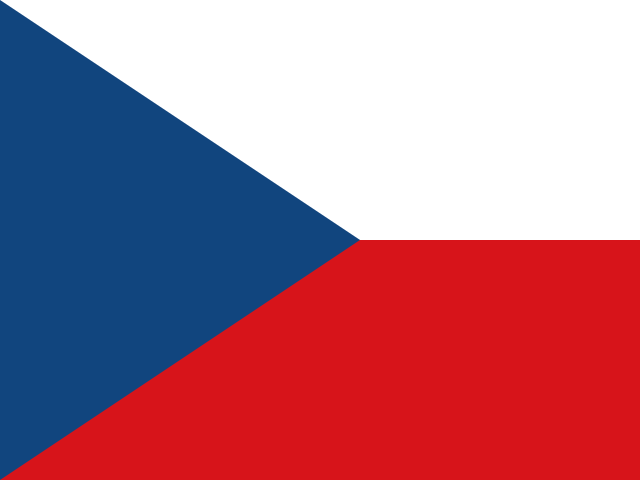
See the flag of Czech Republic →
Prague's origins trace to a fortified settlement established on a bend of the Vltava River, with Prague Castle's foundation traditionally dated to around 880 CE under Prince Bořivoj I of the Přemyslid dynasty, making the castle complex one of the oldest continuously significant seats of power in Central Europe. The city grew into a major medieval center, and its most transformative period came under Charles IV in the 14th century, who as both King of Bohemia and Holy Roman Emperor made Prague his imperial capital, founded Charles University in 1348 (the oldest university in Central Europe), and commissioned the Charles Bridge and much of the Gothic core of the city that still defines Prague's historic center today.
Prague's status fluctuated over the following centuries as Bohemia's political fortunes shifted: it remained a major Habsburg city even after the imperial capital moved to Vienna, and it was the site of the 1618 Defenestration of Prague, in which Protestant nobles threw Catholic officials from a castle window, an incident that helped trigger the Thirty Years' War, one of the most devastating conflicts in early modern European history. The subsequent Battle of White Mountain in 1620 ended in Habsburg victory and a long period of Counter-Reformation Catholic and German cultural dominance over the city, during which Czech language and culture were pushed to the margins for roughly two centuries.
The 19th-century Czech National Revival gradually restored Czech as a language of literature, scholarship, and public life, and when Czechoslovakia declared independence in 1918, Prague — already the largest and most developed city in the Czech lands — became the new state's capital without serious rival contenders, cementing a role it had informally held for centuries. The interwar First Czechoslovak Republic period made Prague a notably cosmopolitan Central European capital before the Nazi occupation from 1939 to 1945 devastated the country's Jewish community and suppressed Czech institutions.
Prague largely escaped the physical destruction that leveled many other Central European capitals during World War II, leaving its medieval and Baroque architecture remarkably intact — a major reason the historic center is now a UNESCO World Heritage Site and one of Europe's most visited cities. The 1968 Prague Spring, a brief period of political liberalization under communist leader Alexander Dubček, was crushed by a Soviet-led invasion that August, and the 1989 Velvet Revolution that peacefully ended communist rule was centered on mass demonstrations in Prague's Wenceslas Square, led in part by playwright and later president Václav Havel.
Prague's Jewish Quarter, Josefov, preserves one of the most complete surviving ensembles of historic Jewish architecture in Europe, including the Old-New Synagogue, built in the 1270s and among the oldest active synagogues in Europe, and the Old Jewish Cemetery, in use from the 15th to 18th centuries — the quarter survived Nazi occupation intact in part because occupying authorities reportedly intended it as a future 'museum of an extinct race,' a grim historical irony that left the physical buildings standing even as the vast majority of Prague's Jewish population was murdered in the Holocaust.
When Czechoslovakia split into the Czech Republic and Slovakia in 1993, Prague's continued role as Czech capital was never seriously in question given its centuries-long status as the political, cultural, and economic center of the Czech lands specifically, in contrast to Slovakia, which had to establish Bratislava — historically a secondary regional city — as capital of an entirely new state structure for the first time.
Quick facts
- Prague's population reached approximately 1.4 million within city limits as of 2024, though unofficial estimates that count the wider metropolitan area and long-term foreign residents put the real figure meaningfully higher.
- The Prague Astronomical Clock, mounted on the Old Town Hall tower in 1410, is the oldest astronomical clock still operating in its original location anywhere in the world, and its hourly parade of mechanical apostle figures remains a fixture of daily life in the Old Town Square.
- UNESCO placed Prague's historic center on its World Heritage list in 1992, pointing to an unbroken run of Romanesque, Gothic, Renaissance, and Baroque building fabric spanning nearly a thousand years with few comparable rivals in Europe.
- Prague is nicknamed the 'City of a Hundred Spires' for its dense skyline of church towers, though various counts of the city's actual spires have put the true figure closer to five hundred.
- Franz Kafka was born in Prague in 1883 and lived almost his entire life there, setting much of his fiction in the city's streets even though most of his major works were published only after his death in 1924.