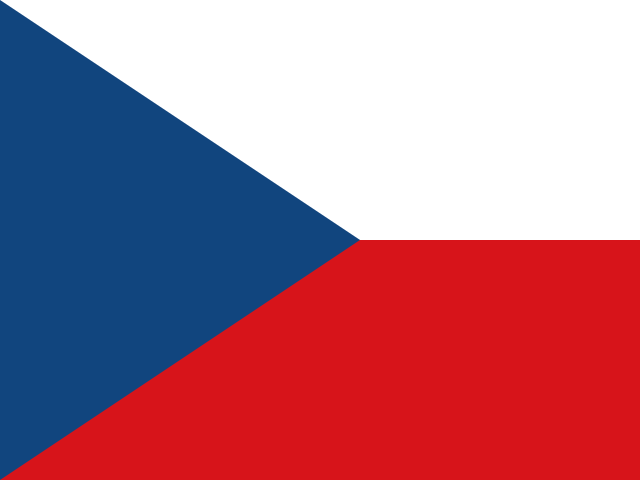
The Flag of Czech Republic
Europe · Adopted 30 March 1920 (retained by Czech Republic in 1993)
The Czech flag exists in its current form specifically because of a heraldic problem: when Czechoslovakia became independent in 1918 after the collapse of Austria-Hungary, its first proposed flag was a simple white-over-red horizontal bicolor, drawn from the traditional colors of Bohemia. That design, however, was immediately recognized as visually near-identical to Poland's flag, also white over red, which was a serious enough problem for a brand-new state trying to establish a distinct international identity that a design competition was held to fix it, and the winning solution, adopted 30 March 1920, added a blue triangular wedge from the hoist, extending to the flag's midpoint — a shape officially explained as representing Moravia and Slovakia, the eastern regions joined with Bohemia in the new Czechoslovak state, but which also, not incidentally, solved the Poland lookalike problem definitively.
That triangle addition is the single detail that makes the Czech flag work as a design: without it, the flag is simply Poland's colors reversed in emphasis (a bicolor), but with the wedge, it becomes something visually distinct at a glance even from a distance, a practical vexillological solution to a genuine diplomatic and identification concern for the newly formed country.
The flag survived Czechoslovakia's entire turbulent 20th century intact — Nazi occupation from 1939 (though the puppet Protectorate of Bohemia and Moravia used its own separate flag during the occupation itself), postwar restoration, four decades of communist rule after 1948, and the 1989 Velvet Revolution — without being formally redesigned, a stability distinct from many of Czechoslovakia's neighbors whose communist governments added stars, emblems, or other socialist iconography to their flags. The flag as used today is essentially unchanged from its 1920 form.
When Czechoslovakia peacefully split into the Czech Republic and Slovakia on 1 January 1993 — the 'Velvet Divorce' — the flag became a genuine point of contention: the 1992 agreement dividing Czechoslovak assets stipulated that neither successor state would keep the joint Czechoslovak flag, but the Czech Republic kept it anyway, a decision Slovakia formally protested as a violation of the dissolution agreement, though the protest went nowhere in practice and the Czech Republic has used the former Czechoslovak flag, unaltered, as its national flag ever since — making it one of very few cases where a 'new' state's official flag is, legally speaking, the recycled flag of a state that no longer exists.
Blue, white, and red are officially explained in Czech sources as drawing on both the historic colors of Bohemia (white and red, from the medieval Bohemian coat of arms' silver lion on red) and a broader association with liberty, equality, and fraternity common to several European tricolor traditions, though unlike France's flag the Czech colors are not usually given individually assigned civic virtues in the same explicit way — the color story rests more on Bohemian heraldic heritage than on abstract symbolic assignment.
The 1920 competition that produced the winning wedge design was overseen in part by Jaroslav Kursa, an archivist credited with proposing the triangular addition, and the choice of blue specifically is generally explained as representing Slovakia (whose own traditional heraldic colors include blue) as well as, more loosely, evoking the historic Moravian margravial colors — though unlike Bohemia's white-and-red, which rests on centuries of unambiguous heraldic use, the blue wedge's symbolic assignment was very much a 1920 invention crafted to solve the day's practical design problem rather than a revival of any specific older regional banner.
The flag's survival through the 1993 dissolution stands in contrast to Slovakia's experience: Slovakia, lacking a legal claim to the shared Czechoslovak banner, adopted its own new flag using a similar white-blue-red Pan-Slavic tricolor base topped with its own double cross coat of arms, meaning that of the two successor states, only the Czech Republic ended up flying, essentially unaltered, the exact flag both countries had shared for the preceding seven decades — a genuinely unusual outcome for a state dissolution and one still occasionally noted in Czech-Slovak discussions of the split.
Poland remains the flag Czech's is most often confused with by people unfamiliar with the blue wedge, given the shared white-and-red base; beyond that, the Czech flag's triangular wedge design is otherwise fairly distinctive internationally, sharing its general silhouette structure loosely with a small number of other triangle-and-stripe flags like Cuba's, though the color schemes are unrelated.
The white-over-red bicolor that gave the Czech flag its base predates even the 1918 Czechoslovak state by centuries, drawn from the Bohemian coat of arms — a silver, two-tailed lion rampant on a red shield — that had represented the Kingdom of Bohemia since at least the 13th century under the Přemyslid dynasty, giving the modern flag's underlying color pairing a heraldic pedigree considerably older than the 1920 wedge design that ultimately distinguished it from Poland's.
During the Nazi occupation period, the German-controlled Protectorate of Bohemia and Moravia used its own separate emblem incorporating both Czech and German symbolism rather than continuing to fly the interwar Czechoslovak tricolor, while the Czechoslovak government-in-exile based in London under Edvard Beneš continued to treat the blue-white-red flag as the legitimate national symbol throughout the war — a split that made the flag itself, quite apart from any territory, one of the contested markers of legitimate Czechoslovak statehood during the occupation years.
How far the blue wedge reaches
- Geometry-accurate flag — Without the wedge this is Poland's flag, so the wedge is the design; the usual fault is one that stops well short of the halfway point and reads as a corner triangle instead.
As an Amazon Associate we earn from qualifying purchases made through these links, at no extra cost to you.
Often confused with
- Poland — the Czech flag's white and red bands directly echo Poland's white-over-red bicolor, a resemblance so close that a distinguishing blue triangle was added to the Czech design specifically to avoid confusion after Czechoslovak independence in 1918. Compare side by side →
Czech Republic at a glance
- Capital
- Prague
- Population
- 10.9 million (2024)
- Currency
- Czech Koruna (CZK)
- Language(s)
- Czech (official)
Population figure as of 2024, source: UN World Population Prospects (2024 revision). See methodology for how facts are sourced and kept current.