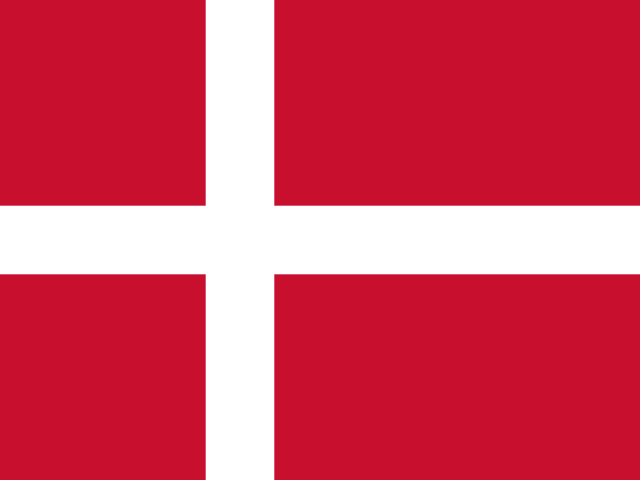
Copenhagen — Capital of Denmark
Copenhagen's name derives from the Old Norse Køpmannæhafn, meaning 'merchants' harbor,' reflecting its origin as a trading settlement that grew up around a natural harbor on the Øresund strait separating Denmark from what is now Sweden. The city's recorded history as a fortified town dates to around 1167, when Bishop Absalon, a powerful advisor to the Danish crown, built a castle on the site to protect the harbor from raiders — the remains of that original castle are still visible in the basement of Christiansborg Palace, the current seat of the Danish parliament, on the same spot roughly 850 years later.
Copenhagen became Denmark's official capital in 1443 under King Christopher of Bavaria, replacing Roskilde, the older ecclesiastical and royal center located a short distance away; the shift reflected Copenhagen's growing importance as a trading and naval hub controlling access to the Baltic Sea through the Øresund strait, a strategically vital chokepoint that Denmark would control and tax shipping through (the Sound Dues) for centuries afterward, a major source of royal revenue until the tolls were abolished in 1857.
The city has weathered repeated catastrophe and rebuilt each time: a devastating fire in 1728 destroyed roughly a third of the city, another major fire in 1795 burned much of what had been rebuilt, and British naval bombardment in 1807 — during the Napoleonic Wars, when Britain attacked to prevent the Danish fleet from falling into French hands — destroyed large parts of the city and killed hundreds of civilians in one of the earliest deliberate bombing campaigns targeting a civilian population center. Much of Copenhagen's surviving historic architecture consequently dates from the 18th and 19th-century rebuilding periods rather than earlier centuries.
Copenhagen's modern identity rests heavily on its reputation for livability, cycling infrastructure, and design: the city has invested for decades in extensive bicycle lane networks that now carry a large share of daily commuter traffic, and its harbor, once dominated by industry, has been substantially redeveloped since the 1990s for public swimming, housing, and cultural buildings including the Royal Danish Opera House and the black-diamond-shaped Royal Library extension. The Little Mermaid statue, unveiled in 1913 and inspired by Hans Christian Andersen's fairy tale, remains the city's best-known tourist landmark despite its modest size.
As seat of the Danish monarchy — one of the oldest continuous monarchies in the world, with the current royal family's lineage traced back over a thousand years — Copenhagen hosts Amalienborg Palace, the royal family's official winter residence, where a changing-of-the-guard ceremony has continued as a public daily event for generations, alongside Christiansborg Palace, uniquely housing all three branches of Danish government (executive, legislative, and judicial) in a single building.
The city's Tivoli Gardens, opened in 1843 as one of the world's oldest still-operating amusement parks, is often cited as a direct inspiration for Walt Disney's later theme parks, with Disney reportedly visiting Tivoli before designing Disneyland — a piece of design lineage Copenhagen residents and tourism promoters still point to as evidence of the city's outsized influence on global popular culture relative to its modest size.
Copenhagen's Carlsberg Breweries, founded in 1847 by J.C. Jacobsen just outside the city's then-boundaries, grew into one of the world's largest brewing groups and funded the Ny Carlsberg Glyptotek art museum along with much of the Carlsberg Foundation-backed cultural infrastructure still visible around the city today; the original brewery site in the Vesterbro district has since been redeveloped into a mixed residential and cultural quarter after production moved elsewhere in the 2000s. Freetown Christiania, a self-governing enclave established by squatters in a former military barracks in the Christianshavn district in 1971, has operated for more than five decades under its own informal rules distinct from the surrounding city, becoming both a tourist draw and a recurring point of friction with Danish authorities over its semi-legal cannabis trade.
Quick facts
- Greater Copenhagen's population reached roughly 1.4 million by 2024 estimates, with a metropolitan area that spans the Øresund strait to take in parts of southern Sweden as well.
- Copenhagen became Denmark's capital in 1443, replacing the earlier royal and ecclesiastical center at Roskilde.
- The city was heavily bombarded by the British Royal Navy in 1807 during the Napoleonic Wars, destroying much of its historic core.
- Copenhagen is connected to Malmö, Sweden, by the Øresund Bridge, an 8-kilometer combined bridge-and-tunnel link opened in 2000.
- The Little Mermaid statue, based on Hans Christian Andersen's 1837 fairy tale, has stood on the Copenhagen waterfront since 1913 and remains a major tourist draw despite its small size.