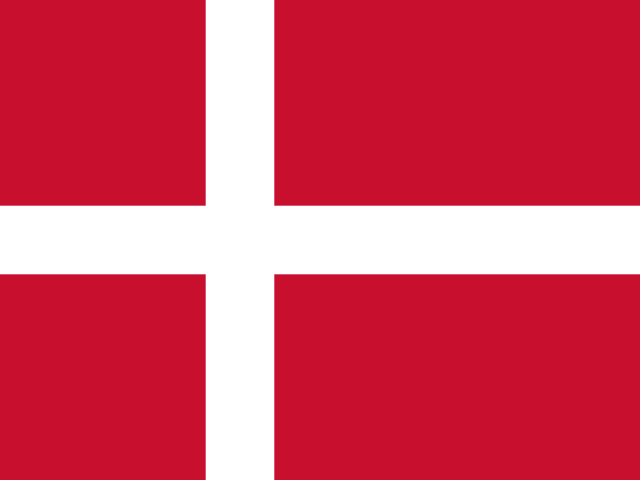
The Flag of Denmark
Europe · Adopted recorded in use by 1370s; still official today
The Dannebrog — Denmark's red field with an off-center white Nordic cross — has the strongest claim of any national flag still in use to being the oldest continuously used national flag in the world, with documented use going back to at least the 14th century and a founding legend placed even earlier, in 1219. That legend holds that during the Battle of Lyndanisse in present-day Tallinn, Estonia, fought as part of a Danish crusade against pagan Estonians, a red flag with a white cross fell from the sky as Danish forces were on the verge of defeat, and its appearance turned the battle in Denmark's favor and was taken as a sign of divine favor — a story first recorded in writing only in the 16th century, centuries after the supposed event, which historians treat as later myth-making rather than a contemporary account, even though the Dannebrog Order (a Danish chivalric order) and the country's national self-image still lean heavily on the 1219 date.
What can be documented with more confidence is that a red flag bearing a white cross was in use by Danish forces by the 1370s, appearing in period seals and records, making it, at minimum, one of the oldest verified national flag designs in continuous use in Europe regardless of how the earlier legendary origin is treated. The name Dannebrog itself is generally translated as 'Danes' cloth' or 'red cloth of the Danes,' and it has never been formally replaced or redesigned in the sense that many other European flags have been — its basic red field and off-center white cross remain essentially what they were centuries ago.
The cross's off-center position — shifted toward the hoist rather than centered — is itself historically significant beyond Denmark: it became the template for what vexillologists call the Nordic cross, and every other Nordic country's flag (Norway, Sweden, Finland, Iceland) directly imitates this same asymmetric cross layout, adapted with each country's own colors, when they adopted or redesigned their own national flags in the 19th and 20th centuries — making the Dannebrog not just Denmark's flag but the structural ancestor of an entire regional flag family used across Scandinavia and the North Atlantic.
Denmark's flag law is unusually informal by European standards for such an old and symbolically weighted flag: there is no single comprehensive law fixing every detail of the Dannebrog's proportions the way some other countries codify their flags, and the civil version (called the splitflag when it has a swallow-tailed fly end, versus the plain rectangular stutflag used by private citizens) has coexisted with regulated state and naval versions for centuries, a patchwork of custom and partial regulation rather than a single unifying statute.
Danes fly the Dannebrog with an everyday informality that many visitors find striking for a flag with such deep historical and religious symbolism attached: it is flown on birthdays, at private celebrations, on Christmas trees, and outside homes for personal occasions in a way that goes well beyond the strictly official, government-building use more typical of national flags elsewhere in Europe — a genuinely distinctive feature of Danish flag culture rather than a formality observed only by the state.
Denmark's flag also occupies a distinctive legal middle ground unusual for a national flag: private Danish citizens and companies are broadly free to fly the plain rectangular stutflag on their own property without special permission, but flying the swallow-tailed splitflag has historically been reserved for the state, the military, and certain privileged institutions such as churches and specific royally chartered organizations — a two-tier system rooted in centuries-old custom about who could claim the more elaborate, ceremonially weighted version, and one that still shapes which shape of Dannebrog Danes choose for a given occasion.
The 1219 Battle of Lyndanisse legend has a curious afterlife beyond Denmark itself: because the battle took place on the site of what became Tallinn, Estonia, the same founding story is occasionally invoked in both Danish and Estonian retellings of their respective national histories, and Tallinn's own name is popularly explained as deriving from the Estonian for 'Danish town,' a linguistic echo of the very conquest to which Denmark's flag legend is attached — one of relatively few cases in Europe where two different countries' founding national narratives are set at literally the same historical event.
Because the Nordic cross layout is now shared by five national flags, casual visual confusion is common among people less familiar with the region, though Denmark's specific red-and-white combination is not duplicated by any of its Nordic neighbors — Iceland and Norway both use blue and red with white, Sweden uses blue and yellow, and Finland uses blue and white, leaving Denmark's plain red-and-white pairing as visually distinct once the shared cross shape is accounted for.
The two Danish autonomous territories, Greenland and the Faroe Islands, each fly their own distinct flags alongside the Dannebrog rather than in place of it — Greenland's uses a red-and-white circle-and-bar design adopted in 1985, while the Faroe Islands' Merkið, a blue-fringed Nordic cross adopted in 1919, follows the same cross template Denmark itself originated, giving the Kingdom of Denmark a genuinely three-flag internal structure that reflects its status as a unitary state incorporating two self-governing territories with distinct identities.
The cross sits off centre
- Geometry-accurate flag — The upright of the cross is set toward the pole rather than centred, and a flag that centres it is not this design. The offset is measurable against the flag's own length.
As an Amazon Associate we earn from qualifying purchases made through these links, at no extra cost to you.
Often confused with
- Norway — shares the same off-center Nordic cross structure pioneered by Denmark's flag, but Norway's uses a blue cross outlined in white on a red field, a three-color combination rather than Denmark's simple red-and-white. Compare side by side →
Denmark at a glance
- Capital
- Copenhagen
- Population
- 6.0 million (2024)
- Currency
- Danish Krone (DKK)
- Language(s)
- Danish (official)
Population figure as of 2024, source: UN World Population Prospects (2024 revision). See methodology for how facts are sourced and kept current.