Santo Domingo — Capital of Dominican Republic
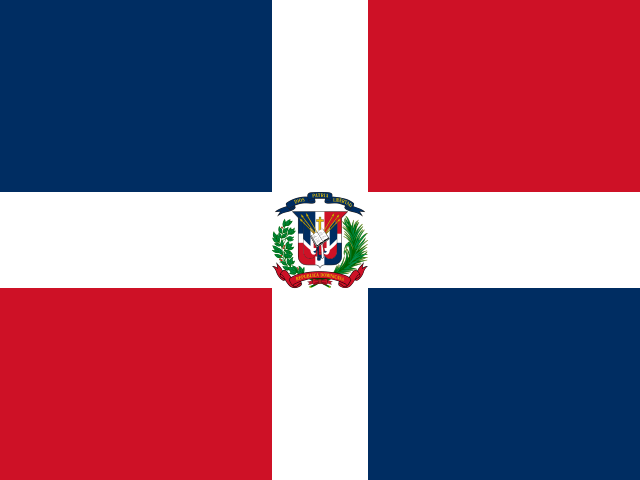
See the flag of Dominican Republic →
Santo Domingo holds a claim few other cities in the Western Hemisphere can make: founded in 1496 by Bartholomew Columbus, brother of Christopher Columbus, it predates every other surviving European colonial settlement on the American continent, and it served as the base from which Spain organized much of its early conquest and colonization of the wider Caribbean and mainland Americas in the early 1500s.
The Colonial City of Santo Domingo has held UNESCO World Heritage status since 1990 and contains the oldest cathedral in the Americas — the Catedral Primada de América, completed in 1540 — as well as the ruins of the Hospital San Nicolás de Bari, the first hospital built in the New World, and the Alcázar de Colón, a fortress-palace built for Diego Columbus, Christopher Columbus's son, who served as governor of the colony in the early 16th century.
The city's name and colonial history are entangled with the same Haitian occupation that produced the Dominican flag: Santo Domingo was the capital of the entire Spanish colony of Santo Domingo (covering all of Hispaniola) for centuries, then endured Haitian rule and unification of the island from 1822 to 1844, before serving as the base from which Juan Pablo Duarte's independence movement organized the 1844 uprising that made it the capital of the newly sovereign Dominican Republic rather than of a Spanish or Haitian-controlled territory.
Santo Domingo briefly bore a different name for political reasons under the Trujillo dictatorship: from 1936 to 1961, the city was officially renamed Ciudad Trujillo in honor of the ruling dictator, Rafael Trujillo, and only reverted to Santo Domingo after his assassination in 1961 ended more than three decades of authoritarian rule — a naming episode still remembered as one of the more extreme examples of a Latin American strongman renaming a national capital after himself.
Modern Santo Domingo is the Dominican Republic's largest city and its political and economic hub, home to the national government, the country's main port on the Ozama River, and a rapidly grown skyline that now sits directly alongside the 16th-century Colonial Zone — a juxtaposition of the oldest and newest urban Americas within blocks of each other that is unusual even among historic Latin American capitals.
The Alcázar de Colón, completed around 1512 for Diego Columbus, remained in use by Columbus family descendants as governors of the colony for several generations before falling into disrepair; it was extensively restored in the 1950s and now functions as a museum displaying period furnishings and artifacts connected to the early Spanish colonial administration of Hispaniola.
Santo Domingo's Ozama Fortress, construction of which began in 1502, is considered the oldest surviving military structure built by Europeans in the Americas, predating comparable fortifications in Mexico, Peru, and elsewhere on the mainland by years, since Spain used Hispaniola as its initial staging ground before later conquests pushed colonial administration westward and southward across the wider Americas.
Calle Las Damas, a cobblestone street running through the Colonial Zone, is often cited as the oldest paved street laid out by Europeans in the Americas, dating to the earliest years of the city's founding and named for the noblewomen who reportedly strolled along it in the 16th century — a claim to firsts that recurs repeatedly through Santo Domingo's historic core, reflecting the city's genuinely singular status as the launching point for Spain's broader colonization of the hemisphere.
Quick facts
- Close to 3.8 million people live in greater Santo Domingo, comfortably the largest urban concentration anywhere in the Dominican Republic and one of the largest metropolitan areas in the Caribbean overall.
- Metro Santo Domingo, opened in 2009, was the first rapid-transit rail system built anywhere in the Caribbean.
- The Universidad Autónoma de Santo Domingo, founded in 1538, claims to be the oldest university in the Americas, predating Harvard by nearly a century.
- The Faro a Colón (Columbus Lighthouse mausoleum), completed in 1992 for the 500th anniversary of Columbus's arrival, remains one of the city's most debated modern landmarks over its cost and design.
- UNESCO's 1990 listing of the Colonial City singled out its grid of early 16th-century civic and religious buildings as a template Spain later followed across its American colonies.