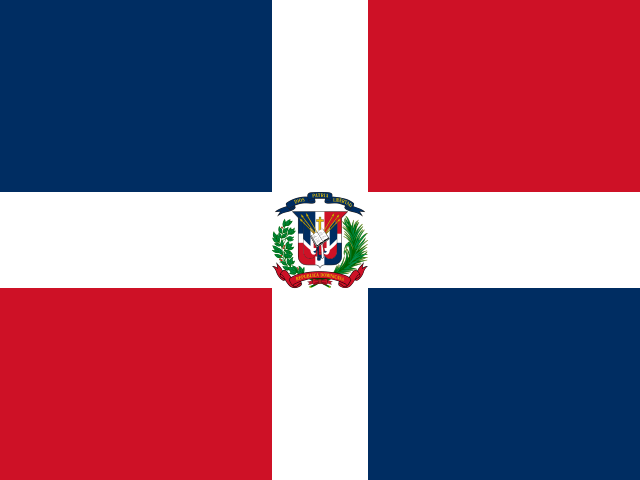
The Flag of Dominican Republic
North America · Adopted 6 November 1844 (current proportions and coat of arms detail refined 1913 and 1934)
The Dominican Republic's flag dates to 1844, designed by Juan Pablo Duarte, the country's founding independence leader, and first raised during the 27 February 1844 uprising that secured independence not from a European colonial power but from neighboring Haiti, which had occupied and unified the entire island of Hispaniola under Haitian rule since 1822. Duarte based the design on Haiti's own blue-and-red flag but split it with a white cross reaching to all four edges, dividing the field into four quarters — a deliberate visual statement that the new Dominican nation was breaking from Haitian rule while still emerging from the same shared island history.
The white cross is explicitly Christian in origin, reflecting the strongly Catholic identity of the newly independent Dominican state, and it divides the flag into two blue and two red quarters: blue is read as representing liberty, red for the blood shed by those who fought in the 1844 War of Independence against Haitian rule, and the white cross itself for peace and the sacrifices made to achieve it, though Dominican civic education also emphasizes the cross as marking the country's identity as a Catholic nation distinct from the vodou-influenced religious traditions more prominent across the border in Haiti at the time.
At the center of the cross sits the Dominican coat of arms — a small national flag flanked by a laurel branch and a palm branch, with a Bible open to the Gospel of John above a shield, and the national motto 'Dios, Patria, Libertad' ('God, Fatherland, Liberty') arranged around it. This makes the Dominican Republic the only country in the world whose national flag depicts a Bible, a distinction repeatedly cited by vexillologists as unique among all sovereign states' flags, and it reflects the explicitly religious framing Duarte and his fellow independence leaders gave to the 1844 break from Haiti.
Because the coat of arms is considered a sacred element tied to national sovereignty, Dominican law forbids private citizens from flying the state flag bearing the full coat of arms in most everyday contexts — ordinary use is meant to be the plain cross-and-quarters version without the emblem, a civil-versus-state flag distinction the Dominican Republic shares in principle with several other Latin American nations, even though in practice the full coat-of-arms version is very widely flown regardless.
The flag's design and coat of arms were refined several times after 1844 without altering the core cross-and-four-quarters layout — most notably in 1913, when the coat of arms's laurel-and-palm arrangement was formalized, and again in 1934 under President Rafael Trujillo's government, which added the current, more elaborate ribbon and motto placement still used today, alongside broader efforts by the Trujillo regime to standardize and promote national symbols as part of its long dictatorship.
Because Haiti's flag was the direct visual starting point for the Dominican design, the two nations' flags share an obvious historical relationship despite representing countries that fought a war against each other in 1844 and have had a fraught, often tense relationship ever since — Haiti's flag uses the same blue and red without the white cross, a visual echo of a shared island history that neither side's flag can fully escape.
The Dominican Republic celebrates Independence Day on 27 February, marking the 1844 uprising against Haitian rule, and Duarte, Sánchez, and Mella — the three principal independence leaders — are honored nationally as the country's founding fathers, with the flag central to virtually every civic and school ceremony tied to that history.
Juan Pablo Duarte founded La Trinitaria, a secret nine-member independence society, in 1838 specifically to organize resistance to Haitian rule, and the group's name — a reference to the Christian Holy Trinity — is sometimes cited alongside the later Bible-bearing coat of arms as part of a broader pattern in which Dominican independence organizing leaned explicitly on Catholic religious symbolism to distinguish the movement, and the nation it sought to build, from Haiti's different religious and cultural traditions.
The Dominican Republic's 22-year period of Haitian rule (1822–1844) followed a still earlier and separate period of Haitian invasion and brief unification attempts in the early 1800s, and Dominican national memory treats the 1844 break as resolving a genuinely contested question about the island's political future — whether Hispaniola would remain one unified state or split into two — a question that, unlike the flag's design itself, has never fully gone away in Dominican-Haitian relations, given the two countries' continuing disputes over migration and the shared land border in the 21st century.
Beyond the 1913 and 1934 refinements to the coat of arms, the Dominican flag briefly took on additional political weight during the Trujillo dictatorship (1930–1961), when state messaging tied the flag closely to the regime's own nationalist rhetoric; the flag's design itself survived Trujillo's 1961 assassination and the political instability that followed unchanged, distinguishing the flag's continuity from the country's turbulent 20th-century political history more broadly.
Duarte himself did not live to see his flag design achieve lasting political stability — he was pushed into exile within months of the 1844 independence he had helped engineer, amid factional infighting among the new republic's leadership, and he died in Venezuela in 1876 without ever holding significant power in the country he helped found, a detail Dominican civic education presents as part of the broader sacrifice narrative attached to the flag and the independence movement it represents.
An emblem with a book in it
- High-resolution printed flag — The central device packs a shield, two branches and an open book into a few inches of cloth, which is more structure than the white cross around it can hide if the print is coarse.
As an Amazon Associate we earn from qualifying purchases made through these links, at no extra cost to you.
Often confused with
- Haiti — the Dominican flag's blue and red are drawn directly from Haiti's own flag, since the Dominican Republic broke away from Haitian rule in 1844 — Haiti's flag lacks the white cross and Bible-bearing coat of arms entirely. Compare side by side →
Dominican Republic at a glance
- Capital
- Santo Domingo
- Population
- 11.3 million (2024)
- Currency
- Dominican Peso (DOP)
- Language(s)
- Spanish (official)
Population figure as of 2024, source: UN World Population Prospects (2024 revision). See methodology for how facts are sourced and kept current.