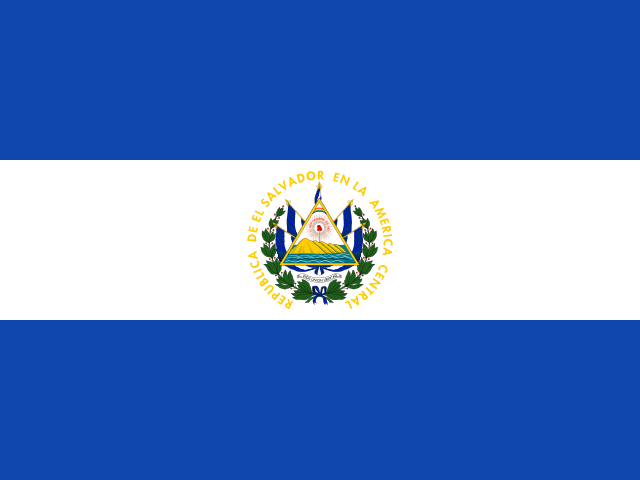
San Salvador — Capital of El Salvador
San Salvador was founded by Spanish conquistadors in 1525 under Pedro de Alvarado's lieutenant Diego de Alvarado, though the settlement had to be relocated within a few years after conflict with the local Indigenous Pipil population, resettling at its present site in the Valley of the Hammocks in 1545 — a name (Valle de las Hamacas) that refers to the valley's frequent earthquakes, which have shaped the city's history perhaps more than any other single factor, including several that leveled large portions of the capital in the 16th, 19th, and 20th centuries.
The city became the capital of the newly independent United Provinces of Central America for a period in the 1830s under the federation's president, Francisco Morazán, who favored San Salvador over rival claims from Guatemala City, though the federation's collapse by 1840 ended that brief chapter; San Salvador became the established capital of the fully independent Republic of El Salvador afterward and has held that role continuously since.
El Salvador's 20th-century capital was shaped severely by conflict as well as earthquakes: San Salvador sat at the center of the country's 1980–1992 civil war, a brutal conflict between the U.S.-backed government and FMLN guerrillas that killed an estimated 75,000 people nationwide, and the war's legacy — along with subsequent gang violence in the decades that followed — dominated the city's international reputation for years before a sweeping, internationally controversial security crackdown launched under President Nayib Bukele beginning in 2022 dramatically reduced homicide rates in the capital and across the country.
A major earthquake in 1986 and another pair of quakes in January and February 2001 each caused significant damage and loss of life in San Salvador, reinforcing the seismic vulnerability built into the very name of the valley the city occupies — earthquake-resistant building codes and reconstruction efforts have repeatedly reshaped the capital's built environment across multiple generations as a result.
Modern San Salvador is El Salvador's political, financial, and cultural center, home to the National Palace, the Metropolitan Cathedral, and the country's main university, and the metropolitan area has grown to include a ring of surrounding municipalities that together form by far the largest urban concentration in the country, a densely built valley setting between two active volcanoes, San Salvador and Boquerón.
Archbishop Óscar Romero, assassinated while celebrating Mass in San Salvador in March 1980 by a right-wing death squad just as the civil war was intensifying, remains one of the most internationally recognized figures associated with the capital's modern history; he was canonized as a Catholic saint in 2018, and the chapel where he was killed, at the Hospital de la Divina Providencia, is now a pilgrimage site within the city.
The National Palace, completed in 1911 in a neoclassical style after an earlier building on the site burned down, served as the seat of El Salvador's government for much of the 20th century before newer government buildings took over most administrative functions, and it now operates primarily as a museum and ceremonial space in the heart of San Salvador's historic downtown.
San Salvador's Monument to the Divine Savior of the World, known locally as El Salvador del Mundo, depicting Christ standing atop the globe, sits at a major roundabout that has become the de facto symbolic center of the capital, used as a gathering point for major public celebrations and, at times, political demonstrations throughout the city's modern history.
Quick facts
- Close to a third of El Salvador's entire population, an estimated 2.1 million people, lives within greater San Salvador's metropolitan area, the dominant urban center in one of Central America's smallest and most densely populated countries.
- The University of El Salvador, founded in San Salvador in 1841, is Central America's oldest public university still operating under its original name, and its main campus remains one of the capital's largest educational complexes.
- San Salvador briefly served as capital of the United Provinces of Central America in the 1830s under federation president Francisco Morazán.
- Earthquakes in 1986 and twice in 2001 caused major damage and loss of life in the capital, reflecting the region's high seismic activity.
- El Salvador's 1980–1992 civil war was centered heavily on San Salvador, killing an estimated 75,000 people nationwide before a 1992 peace accord ended the conflict.