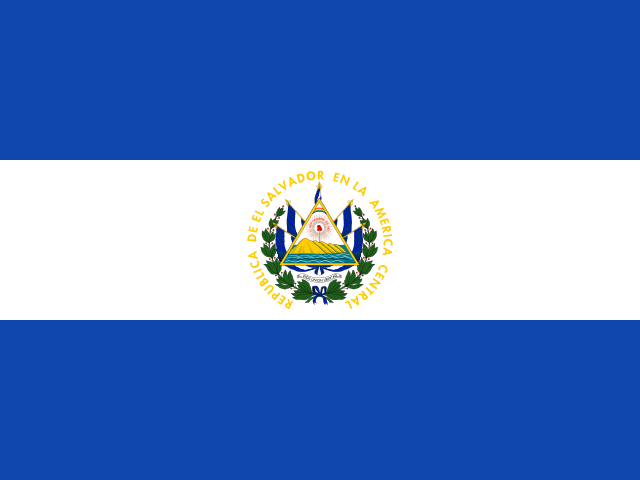
The Flag of El Salvador
North America · Adopted 17 May 1912
El Salvador's current flag was adopted on 17 May 1912, restoring the blue-white-blue pattern originally used by the United Provinces of Central America, the federation that briefly bound together Guatemala, Honduras, El Salvador, Nicaragua, and Costa Rica after their shared 1821 independence from Spain and brief absorption into the Mexican Empire. El Salvador had actually abandoned that federal-era design decades earlier, flying a red-blue-red flag through much of the second half of the 19th century, before a 1912 decree under President Manuel Enrique Araujo reversed course and readopted the blue-white-blue layout specifically to reassert El Salvador's historical claim to the old federation's legacy and, at the time, to signal support for renewed Central American unification efforts, which recurred periodically through the 19th and early 20th centuries without ever succeeding permanently.
The blue stripes represent the Pacific Ocean and Caribbean Sea framing the former federation's territory, and white for peace, while the central coat of arms — a triangle enclosing five volcanoes rising from the sea beneath a rainbow, with a Phrygian cap radiating light above and the words 'Dios, Union, Libertad' ('God, Union, Liberty') on a ribbon below — directly commemorates the five founding states of the 1823 federation, the five volcanoes standing for Guatemala, Honduras, El Salvador, Nicaragua, and Costa Rica united as one body, a symbolic aspiration toward Central American unity that El Salvador's flag holds onto more explicitly than most of its neighbors' current designs do.
That shared federal-era ancestry means El Salvador's flag is genuinely part of a family with Guatemala, Honduras, and Nicaragua's flags, all of which trace back to the same original 1823 federation banner — but the five countries diverged distinctly afterward: Guatemala moved to a light-blue-white-light-blue vertical layout with its own quetzal-and-rifles emblem, Honduras kept horizontal blue-white-blue with five stars replacing a coat of arms, Nicaragua kept a design close to the federal original with its own triangle-and-volcanoes emblem, and Costa Rica broke furthest from the pattern by adding a central red stripe in 1848 that none of the others adopted.
El Salvador's flag was not always in continuous use in this exact form — the 1865 to 1912 period of red-blue-red use represented an entire generation flying a genuinely different national flag, making the 1912 return to blue-white-blue a deliberate historical restoration rather than simple continuity, and the Phrygian cap radiating light above the coat of arms was carried over specifically from the earlier federal emblem as an explicit link back to the 1820s revolutionary period.
The flag has not been redesigned since 1912, and Salvadoran law today specifies both a state flag bearing the coat of arms and a plainer civil flag without it, similar to the two-tier system used by several neighboring Central American republics, with the state version reserved chiefly for government buildings and official functions.
Because the blue-white-blue pattern with a central coat of arms is shared closely with Nicaragua's flag in particular, the two are the most frequently confused pairing among the former federation's successor states — El Salvador's emblem uses a triangle-framed volcano scene with a rainbow and radiating Phrygian cap, while Nicaragua's places its own triangle-and-volcano emblem directly on the white stripe without the rainbow and cap arrangement, giving a careful viewer a clear way to tell them apart.
El Salvador marks Independence Day on 15 September, shared with Guatemala, Honduras, Nicaragua, and Costa Rica as the common anniversary of the 1821 declaration from Spain, and the flag features prominently in that joint regional commemoration even though each of the five nations has followed a distinct, separately governed path for nearly two centuries since.
President Manuel Enrique Araujo, who signed the 1912 decree restoring the blue-white-blue design, was assassinated the following year, in 1913, cutting short a presidency that had also pursued renewed talks toward Central American federal unity — talks that never resulted in a lasting political union but that give the 1912 flag decision an added layer of unrealized ambition, since the design change was explicitly meant to gesture toward a reunification that El Salvador's government of the time still hoped might eventually happen.
The red-blue-red flag El Salvador flew for roughly five decades before 1912 is largely absent from popular memory today, rarely depicted in Salvadoran textbooks or civic materials compared with the blue-white-blue design that both preceded and succeeded it, an unusual gap in a country that otherwise takes flag history seriously — historians attribute this partly to the 1912 government's own framing of the change as a restoration rather than a genuine redesign, which downplayed the intervening decades' different flag by treating it as an aberration rather than a legitimate chapter of Salvadoran flag history in its own right.
El Salvador's coat of arms scroll reading 'Dios, Union, Libertad' places 'Union' as the middle term deliberately, reflecting how central the aspiration toward a reunified Central America remained to Salvadoran official symbolism well into the 20th century, even as practical political union among the five former federation states never came close to being reestablished after its 1840s collapse.
The emblem is what tells it apart
- Flag with the emblem — The page places this in a family of near-identical blue-white-blue flags, and without the central device it is indistinguishable from two of its neighbours', so a plain version is not this flag.
As an Amazon Associate we earn from qualifying purchases made through these links, at no extra cost to you.
Often confused with
- Nicaragua — descends from the same 1820s Central American Federation flag, so both use blue-white-blue with a central volcano emblem — El Salvador's coat of arms adds a rainbow and radiating Phrygian cap that Nicaragua's simpler triangle-and-volcano design lacks. Compare side by side →
- Honduras — shares the same federal-era blue-white-blue stripe pattern, but Honduras replaced the central coat of arms with five blue five-pointed stars, one for each founding state of the old federation. Compare side by side →
El Salvador at a glance
- Capital
- San Salvador
- Population
- 6.3 million (2024)
- Currency
- US Dollar (USD); Bitcoin also legal tender since 2021
- Language(s)
- Spanish (official)
Population figure as of 2024, source: UN World Population Prospects (2024 revision). See methodology for how facts are sourced and kept current.