Malabo — Capital of Equatorial Guinea
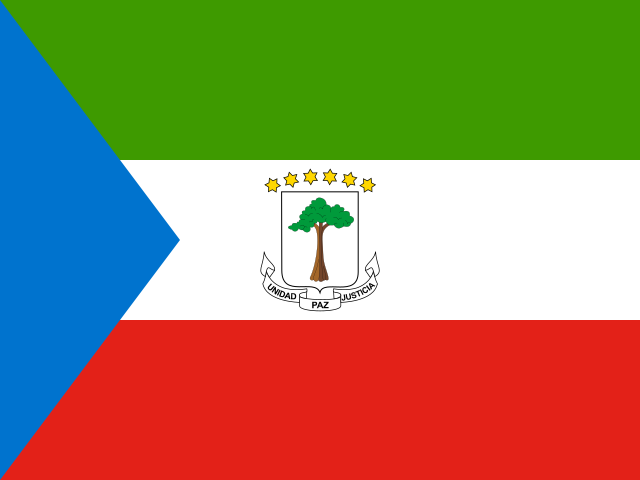
See the flag of Equatorial Guinea →
Malabo sits not on Equatorial Guinea's continental mainland at all, but on the island of Bioko, roughly 250 kilometers off the coast of Cameroon in the Gulf of Guinea — an unusual arrangement in which the capital of a mostly mainland country occupies an offshore island, a legacy of the island's earlier importance to British and Spanish colonial trade networks that predated the mainland territory's full incorporation.
The city was founded by British settlers in 1827 as Port Clarence (later Clarence Town), established as a base for suppressing the transatlantic slave trade after Britain leased the site from Spain, which held nominal sovereignty over the island but had not yet effectively colonized it. Spain reasserted direct control in the 1850s and renamed the settlement Santa Isabel, the name it carried through most of the Spanish colonial period.
The city took its current name, Malabo, only in 1973 under Francisco Macías Nguema, as part of his campaign to strip colonial-era Spanish names from the country's cities and landmarks — Malabo honors Bioko's pre-colonial Bubi king, Malabo Lopelo Melaka, who had resisted Spanish encroachment in the 19th century, giving the renamed capital an indigenous rather than colonial namesake.
Malabo was retained as national capital at independence in 1968 largely because it had been the seat of Spanish colonial administration and had better port and urban infrastructure than any settlement on the mainland Río Muni territory at the time — but its position, isolated on an island far from the mainland where the large majority of the country's population and its oil and gas reserves are actually located, has long been considered impractical.
That impracticality is why Equatorial Guinea began constructing an entirely new capital, Ciudad de la Paz (also called Oyala), on the mainland starting in the 2010s, funded by the country's substantial oil wealth discovered in the 1990s — the government has periodically announced plans to relocate the seat of government there, though Malabo, as of 2024, was still functioning as the country's actual seat of government and remained its largest city.
Malabo's economy and skyline have been reshaped since the 1990s by Equatorial Guinea's emergence as a significant oil and gas producer, with the country's substantial hydrocarbon wealth funding new government buildings and infrastructure even as most of the country's population has seen relatively little benefit, a disparity widely documented by international human rights and transparency organizations.
Malabo sits in the caldera of an extinct volcano forming Bioko's northern coast, giving the city a naturally sheltered harbor ringed by steep, forested hills — a dramatic setting that has drawn comparisons in travel writing to other volcanic-caldera ports, though Malabo's international profile remains modest compared with its geographic counterparts elsewhere in the world.
The Catholic cathedral at the heart of old Malabo, Santa Isabel Cathedral, completed in the early 20th century under Spanish rule in a neo-Gothic style unusual for a tropical West-Central African city, remains one of the clearest surviving markers of the Spanish colonial period, standing alongside a scattering of colonial-era wooden buildings that have survived in the older parts of the city center.
Malabo International Airport, upgraded substantially during the country's oil-boom years, has hosted several African Union summits and other continental diplomatic gatherings since the 2000s, part of a deliberate government push to raise Equatorial Guinea's international profile despite the country's small population and its government's poor human-rights record, which has limited its diplomatic standing with Western governments even as summit hosting has continued.
Quick facts
- Malabo's population has grown rapidly on the back of the country's oil wealth, reaching roughly 300,000 residents as of 2024, up sharply from the modest colonial-era town of just a few decades earlier.
- Equatorial Guinea is the only country in Africa where Spanish is an official language, and Malabo's government and schooling still operate primarily in Spanish alongside French and Portuguese.
- Bioko Island's rainforest, reached from Malabo, is home to seven primate species, one of the richest concentrations of primate diversity anywhere in Africa, studied through a long-running conservation program with Drexel University.
- Estadio de Malabo hosted matches during the 2012 and 2015 Africa Cup of Nations tournaments, both co-hosted by Equatorial Guinea.
- Malabo's setting inside a volcanic caldera makes it one of the wettest capital cities in Africa, with heavy year-round rainfall driven by moist air trapped against the surrounding crater walls.