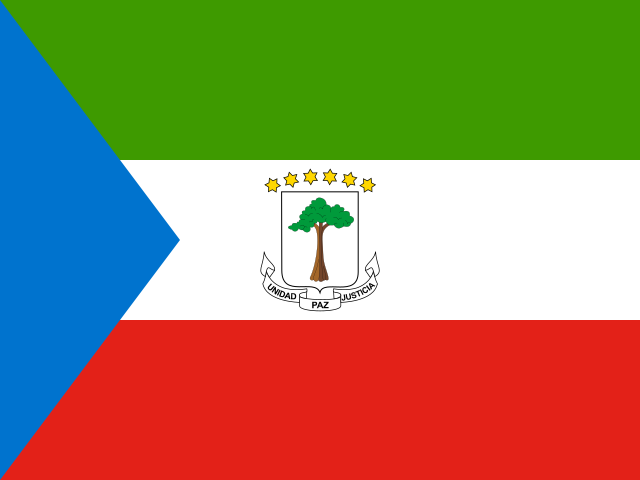
The Flag of Equatorial Guinea
Africa · Adopted 21 August 1979 (originally 1968, coat of arms altered under Obiang)
Equatorial Guinea's flag was first adopted on 12 October 1968, the day the small Central African nation gained independence from Spain, and consists of three horizontal bands — green, white, and red, top to bottom — with a blue triangle at the hoist and the national coat of arms centered on the white stripe. The current version of the coat of arms dates to 21 August 1979, following the coup that brought Teodoro Obiang Nguema Mbasogo to power, and it is Obiang's version that remains on the flag today, making him one of the longest-serving heads of state in the world to still have personally overseen a change to his country's flag.
The coat of arms centers on a silk-cotton tree (a ceiba, known locally as the 'God Tree'), depicted because, according to national tradition, the first treaty between Spanish colonizers and local leaders on the island of Bioko was signed beneath just such a tree — a specific, place-based origin story rather than a generic botanical symbol. Six yellow six-pointed stars arc above the tree, representing the mainland region (Río Muni) and the five main islands that make up the country: Bioko, Annobón, Corisco, and the Elobey islands.
Below the tree, a ribbon carries the national motto in Spanish: 'Unidad, Paz, Justicia' ('Unity, Peace, Justice') — a motto that reads with some irony given Equatorial Guinea's actual post-independence history, since founding president Francisco Macías Nguema's 1968–1979 rule is remembered as one of the most brutally repressive regimes in modern African history, responsible for an estimated tens of thousands of deaths and the flight of roughly a third of the population before his own nephew, Obiang, overthrew and executed him in 1979.
The green band represents the country's dense forests and natural vegetation, spanning both the mainland Río Muni territory and the forested islands; white stands for peace; red for the sacrifice made in throwing off Spanish colonial control; and the blue triangle at the hoist represents the sea connecting Equatorial Guinea's mainland and island territories, a symbolically appropriate detail for a country that is unusually split between a continental mainland and a scattered island archipelago.
Under Macías Nguema's rule, the flag's coat of arms was replaced entirely in 1973 with a plainer emblem stripped of the ceiba tree — part of Macías' broader campaign to erase colonial-era and traditional symbols — before Obiang restored a version of the original ceiba-tree design in 1979 after Macías' overthrow, making the current emblem in effect a return to the country's founding 1968 symbolism rather than a wholly new creation.
Equatorial Guinea remains the only sovereign nation in Africa with Spanish as an official language, a legacy of nearly two centuries of Spanish colonial administration beginning in 1778 (after Portugal ceded the territory to Spain), and this Hispanic colonial heritage — unique on a continent otherwise divided among French, British, Portuguese, Belgian, Italian, and German former colonial powers — is part of what makes the country's flag stand apart stylistically from most of its immediate Central African neighbors, none of which use a Spanish-language motto.
Visually, the closest relative to Equatorial Guinea's flag within the region is Guinea-Bissau's, which uses an overlapping palette of red, yellow, and green with a black star — but the resemblance stops at a shared use of green and a general West-Central African tricolor format; Equatorial Guinea's white middle band, blue hoist triangle, and elaborate ceiba-tree coat of arms have no direct equivalent on Guinea-Bissau's flag or on any other national flag in the region.
Equatorial Guinea's national day, 12 October, marking both the 1968 independence date and the day the current flag was first raised, is marked with military parades in Malabo that prominently display the coat of arms' ceiba tree and six stars alongside portraits of President Obiang, whose government has controlled the country continuously since the 1979 coup.
The country's post-1990s oil boom, driven by major offshore discoveries developed with American energy companies from the mid-1990s onward, transformed Equatorial Guinea into one of the highest GDP-per-capita nations in Africa on paper, even as most of that wealth remained concentrated around the ruling family — a disparity that international observers have repeatedly documented, and one that sits uneasily against the flag's own 'Unity, Peace, Justice' motto.
Because the flag's coat of arms was altered twice within its first eleven years of independence — first stripped down under Macías in 1973, then restored and formalized under Obiang in 1979 — Equatorial Guinea offers a compact example of how quickly a newly independent African state's national symbols could be pulled into the personal political projects of successive rulers, even while the underlying green-white-red-and-blue field beneath the emblem stayed constant throughout.
The six stars on the coat of arms are arranged specifically to distinguish the country's continental and island components at a glance: Río Muni's mainland territory and Bioko, Annobón, Corisco, and the two Elobey islets each get equal representation despite Río Muni holding the overwhelming majority of the country's land area and population, a deliberate equal-billing choice similar in spirit to how Comoros' flag gives Mayotte a star despite not controlling it, though for the opposite reason — here all islands depicted are genuinely governed by the state.
Government specification requires the coat of arms to be rendered in full color even on otherwise monochrome official reproductions of the flag, on a 2:3 field — a level of detail typical of the elaborate heraldic emblems many former Spanish and Portuguese colonies retained on their flags, in contrast to the plainer geometric symbols favored by many former French and British colonies in the same region.
An arms device that must stay in colour
- Full-colour printed flag — This is one of the more elaborate heraldic devices on any flag, with a tree, six stars and a lettered ribbon; a monochrome or simplified rendering is a different flag, so check the listing shows the arms in full.
As an Amazon Associate we earn from qualifying purchases made through these links, at no extra cost to you.
Often confused with
- Guinea-Bissau — carries the same PAIGC-derived black star seen on Ghana's flag rather than any heraldic emblem, a Pan-African liberation-movement symbol with no equivalent among Equatorial Guinea's Hispanic-heritage regalia. Compare side by side →
Equatorial Guinea at a glance
- Capital
- Malabo
- Population
- 1.9 million (2024)
- Currency
- Central African CFA Franc (XAF)
- Language(s)
- Spanish, French, and Portuguese (all official); Fang and Bubi widely spoken
Population figure as of 2024, source: UN World Population Prospects (2024 revision). See methodology for how facts are sourced and kept current.