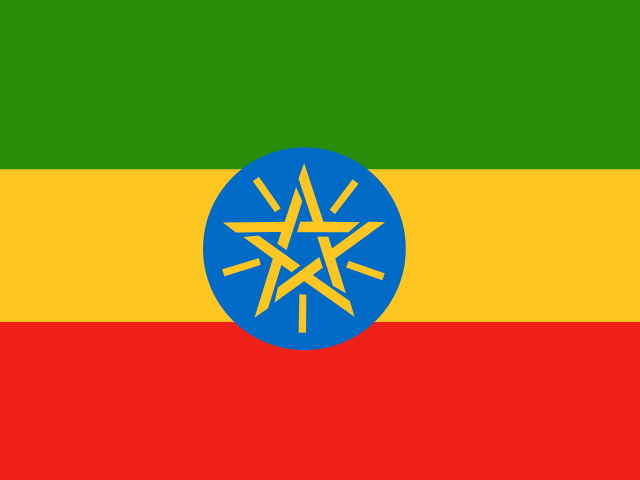
Addis Ababa — Capital of Ethiopia
Addis Ababa — the name means 'new flower' in Amharic — was founded in 1886 by Empress Taytu Betul, wife of Emperor Menelik II, who established a settlement around the site's natural hot springs at Filwoha; Menelik formally moved the imperial capital there the following year, ending a centuries-long Ethiopian tradition of peripatetic, moving royal camps that had never settled permanently in one city for long stretches at a time.
The choice nearly didn't stick: the surrounding highlands were rapidly deforested to supply firewood for the growing city in its first years, and Menelik seriously considered relocating the capital elsewhere in the 1890s before the introduction of fast-growing eucalyptus trees, imported from Australia starting around 1894–1895, solved the fuel-wood crisis and allowed the city to keep growing on the same site — meaning the eucalyptus tree, now ubiquitous across the Ethiopian highlands, is directly tied to Addis Ababa's survival as a capital.
Addis Ababa became the symbolic seat of the wider Pan-African movement in the 20th century, a role that culminated in the Organisation of African Unity choosing the city as its headquarters in 1963 — a choice made explicitly because Ethiopia was the one African nation that had never been colonized, giving Addis Ababa a legitimacy no other candidate capital could claim at the time. The African Union, the OAU's successor organization since 2002, still headquarters there today, and the city is sometimes informally called 'the political capital of Africa' as a result.
The city was briefly occupied and renamed by Fascist Italy during the 1936–1941 occupation of Ethiopia, but Ethiopian and British Commonwealth forces liberated it in 1941, restoring Haile Selassie to his throne after his years of exile — one of the relatively few instances of an occupied African capital being liberated by a coalition that included the country's own returning imperial government rather than remaining permanently altered by colonial rule.
Addis Ababa sits at an elevation of roughly 2,355 meters, making it one of the highest-altitude national capitals in the world, and the city has grown enormously since the Derg-era and post-1991 periods to become East Africa's largest metropolitan area and a major diplomatic hub, hosting not only the African Union but also the UN Economic Commission for Africa and a dense concentration of foreign embassies.
The city's Merkato district is widely described as the largest open-air market in Africa, a sprawling commercial district that developed under Italian occupation in the late 1930s (when colonial authorities relocated Ethiopian traders out of the city center) and has since grown into a vast, largely informal trading hub handling goods from across Ethiopia and the wider Horn of Africa region.
Addis Ababa's Corridor Development Project, a major urban redevelopment initiative launched under Prime Minister Abiy Ahmed's government in the early 2020s, has reshaped large sections of the city center with new roads, parks, and pedestrian corridors, part of a broader push to modernize the capital's infrastructure even as the wider country has faced significant internal conflict, including the 2020–2022 Tigray war centered far to the north of the capital itself.
Addis Ababa Bole International Airport has grown into one of Africa's busiest aviation hubs, serving as the primary hub for Ethiopian Airlines, Africa's largest carrier by several measures and a state-owned airline whose extensive continental and intercontinental route network has made Addis Ababa a genuine gateway city for air travel across Africa, well beyond its role as a diplomatic and political capital.
Quick facts
- Addis Ababa's city-limits population passed an estimated 5.2 million in 2024 UN data, and the wider metropolitan area sprawling into surrounding Oromia towns pushes the real figure considerably higher still.
- The city's name, meaning 'new flower' in Amharic, was chosen by Empress Taytu Betul at its founding in 1886.
- Addis Ababa hosts the headquarters of the African Union, chosen in 1963 because Ethiopia was the one African state that had never been colonized.
- At roughly 2,355 meters elevation, it is among the highest-altitude capital cities in the world.
- The National Museum of Ethiopia in Addis Ababa houses the fossilized remains of 'Lucy' (Dinkinesh), the roughly 3.2-million-year-old Australopithecus afarensis skeleton discovered in Ethiopia's Afar region in 1974, with replicas on public display while the original bones are kept in a climate-controlled vault.