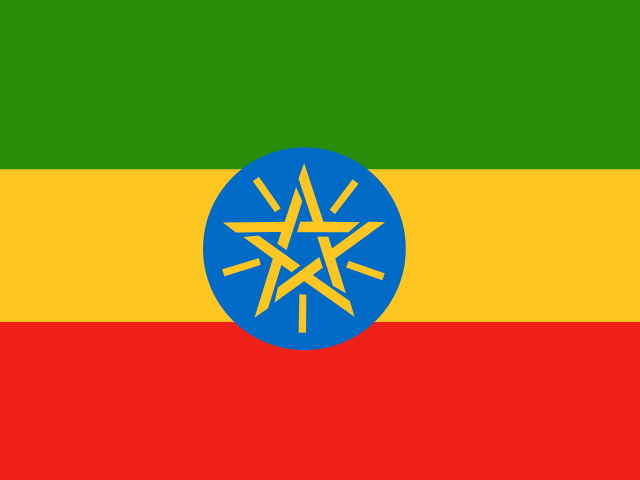
The Flag of Ethiopia
Africa · Adopted 6 February 1996 (tricolor itself dates to 1897; central emblem added 1996)
Ethiopia's green-yellow-red horizontal tricolor is the historical wellspring of the entire pan-African color tradition, not a borrower of it — the sequence dates to at least 1897 under Emperor Menelik II, decades before any other African nation gained independence and adopted the same palette in tribute. Because Ethiopia was never colonized (aside from a brief 1936–1941 Italian occupation under Mussolini that Ethiopian forces, with British support, ultimately reversed), its flag stood for generations as the rare visible symbol of African sovereignty on a continent otherwise carved up by European powers, which is precisely why so many later independence movements across Africa deliberately echoed its colors when designing their own flags — Ghana in 1957, Guinea in 1958, and dozens more after them, explicitly citing Ethiopia's example.
The current flag, with a blue disc bearing a yellow five-pointed star and radiating light rays centered on the tricolor, dates specifically to 6 February 1996, adopted under the government that took power after the fall of the Marxist Derg regime in 1991 and the subsequent adoption of a new federal constitution. The star represents the unity and equality of Ethiopia's diverse ethnic nations and peoples under that federal system, while the rays are generally read as representing a prosperous future.
Before 1996, Ethiopia's flag underwent several changes tied directly to its turbulent 20th-century politics: the plain green-yellow-red tricolor without any central emblem flew for decades; Haile Selassie's imperial government added the Lion of Judah emblem (referencing the Solomonic dynasty's traditional claim of descent from King Solomon and the Queen of Sheba) to the flag in the mid-20th century; the Derg military government that overthrew Haile Selassie in 1974 replaced the lion with a Marxist-style emblem featuring a star and other socialist iconography after 1975; and only after the Derg's 1991 fall did the current blue-disc-and-star design replace that Marxist emblem.
Green is generally explained as representing the land and its fertility, yellow as representing hope, justice, and equality (also linked to the country's historic Orthodox Christian faith, in which yellow carries strong religious association), and red as representing the strength and sacrifice of those who defended Ethiopia's independence, particularly during the resistance to Italian invasion.
The order of the stripes — green, yellow, red from top to bottom — is specifically Ethiopian and is not universal even among flags that borrow the same three colors: several other pan-African-palette flags, including Ghana's and Senegal's, sequence the colors differently or arrange them vertically rather than horizontally, meaning 'pan-African colors' describes a shared palette rather than a single copied layout.
Ethiopia's status as the origin point of the pan-African palette is a matter of near-universal agreement among vexillologists and African historians alike, tied concretely to Ethiopia's 1896 victory over Italy at the Battle of Adwa — the first decisive defeat of a European colonial power by an African state in the scramble-for-Africa era — which cemented the flag's colors as a symbol of Black African sovereignty and resistance well before those colors spread across the rest of the continent's own independence-era flags.
Because so many African nations' flags share this green-yellow-red palette, Ethiopia's is sometimes casually grouped with Ghana's, Senegal's, or Mali's — but Ethiopia's is the only one among them carrying a blue disc and star, and its historical priority as the source rather than an adopter of the palette is the detail most worth knowing about it.
Ethiopia's federal constitution, adopted in 1995 alongside the flag redesign that followed a year later, organized the country into ethnically based regional states for the first time in its history, a restructuring the flag's central star was specifically designed to represent — unity among distinct 'nations, nationalities, and peoples,' the constitution's own phrase, rather than a single homogeneous Ethiopian identity as earlier imperial-era flags had implicitly assumed.
That federal settlement has itself come under severe strain: the 2020–2022 Tigray war, fought between the federal government and forces from the northern Tigray region, killed an estimated several hundred thousand people by various international estimates and raised sharp questions about the durability of the unity the post-1996 flag's star was meant to symbolize, though the flag itself was not altered or contested by any of the parties to that conflict.
Ethiopia's Adwa Victory Day, 2 March, commemorating the 1896 battle that cemented the pan-African significance of the flag's colors, and the country's own National Flag Day, observed on 6 February to mark the 1996 adoption of the current star-and-disc emblem, are both occasions of formal flag ceremony — giving Ethiopia two distinct annual observances tied to different chapters of the same flag's long history.
Ethiopia's flag construction ratio is fixed at 1:2, notably wider and more elongated than the 2:3 ratio common among most other African states, and the blue disc at the center is specified to occupy a precise proportion of the flag's height — a detail Ethiopian government style guides describe in some technical depth, consistent with the flag's status as a symbol whose exact form the state has codified and defended since well before most other African nations had flags of their own to compare it against.
Ethiopia's population, now the second largest in Africa after Nigeria, is spread across more than 80 distinct ethnic groups speaking dozens of languages from at least four major language families — a diversity the current federal constitution and its flag's central star were both designed around, even as the country's ethnic federalism model has come under increasing strain in the years since the 2018 political transition that brought Abiy Ahmed to power.
An elongated 1:2 cut
- Flag cut to 1:2 — At 1:2 this flag is longer for its height than the 3:5 most stock sizes use, and the central disc is specified as a fraction of that longer field, so a mis-cut flag puts the disc off- centre as well as changing the shape.
As an Amazon Associate we earn from qualifying purchases made through these links, at no extra cost to you.
Often confused with
- Ghana — uses the same green-yellow-red pan-African palette explicitly in homage to Ethiopia, but stacks the colors in a different order and centers a black star rather than a blue disc. Compare side by side →
Ethiopia at a glance
- Capital
- Addis Ababa
- Population
- 132.1 million (2024)
- Currency
- Ethiopian Birr (ETB)
- Language(s)
- Amharic (federal working language); Oromo, Somali, Tigrinya, and Afar also official at regional level
Population figure as of 2024, source: UN World Population Prospects (2024 revision). See methodology for how facts are sourced and kept current.