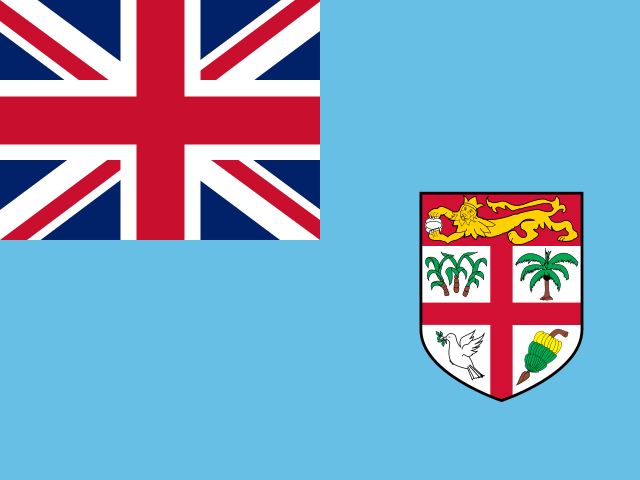
Suva — Capital of Fiji
Suva was not Fiji's first colonial capital — that was Levuka, on the island of Ovalau, the rough-and-tumble port town where Fiji's chiefs signed the 1874 Deed of Cession to Britain. The colonial government moved the capital to Suva in 1882, largely because Levuka's cramped harbor and narrow coastal strip left no room for a growing administrative center, while Suva's deep, well-sheltered harbor on the larger island of Viti Levu offered far more space to build a proper colonial port city.
The site had been the location of a failed 1870 Australian settlement scheme before the colonial government took it over, and Suva was laid out through the late 19th and early 20th centuries in a fairly conventional British colonial pattern — a grid of streets near the harbor, government buildings modeled on contemporary British colonial architecture, and a botanical reserve (Thurston Gardens, opened 1913) named for one of Fiji's early colonial governors.
Suva's high, consistent rainfall — among the wettest capital cities in the Pacific, driven by its position on Viti Levu's windward southeastern coast — shaped its early reputation among colonial administrators as a demanding posting compared with drier parts of Fiji, and the climate remains a defining feature of the city today, with tropical downpours a near-daily feature for much of the year.
As Fiji's population diversified through the indentured labor system that brought tens of thousands of Indian workers to the sugar plantations from 1879 onward, Suva grew into the country's most ethnically mixed city, home today to significant Indo-Fijian, iTaukei, and Pacific Islander communities living alongside one another, a demographic pattern quite different from Fiji's more rural, iTaukei-majority outer islands.
The city now hosts the University of the South Pacific, a regional university jointly owned by twelve Pacific Island nations and founded in 1968, making Suva a genuine hub of higher education and diplomacy for the wider Pacific region rather than only a national capital — it also hosts diplomatic missions and regional offices, including for several Pacific-focused UN agencies, that serve neighboring island states without their own resources for full missions.
Suva has also been the stage for Fiji's turbulent modern political history: the country has experienced four coups since 1987, each centered on seizing control of government institutions concentrated in the capital, including the 1987 coups led by Sitiveni Rabuka and the 2000 coup in which businessman George Speight and armed supporters stormed Fiji's parliament building in Suva and held then-prime minister Mahendra Chaudhry and other MPs hostage for weeks.
The Grand Pacific Hotel, opened in 1914 to serve passengers arriving by ocean liner en route to Australia and New Zealand, was for decades Suva's most prominent building and a symbol of the colonial-era port city's aspirations to genteel respectability; closed for years, it was extensively restored and reopened in 2014 on its hundredth anniversary.
The Fiji Museum, located within Suva's Thurston Gardens, holds one of the Pacific's most significant collections of Fijian artifacts, including war clubs and tabua (whale's-tooth ornaments central to Fijian ceremonial exchange), and it addresses Fiji's pre-colonial history of cannibalism directly as part of the historical record rather than omitting it from the display.
As a low-lying Pacific port city, Suva also sits within Fiji's cyclone belt, and the government has invested in cyclone-resistant infrastructure and early-warning systems following storms such as Cyclone Winston in 2016, one of the most powerful cyclones ever recorded in the Southern Hemisphere, which caused extensive damage across Fiji even though Suva itself was comparatively spared the worst of the direct hit.
Quick facts
- Suva's urban area has a population of roughly 195,000 as of 2024 estimates, making it Fiji's largest city and the biggest urban center in the South Pacific outside Australia and New Zealand.
- Levuka, the town Suva replaced as capital in 1882, still exists today and was itself named a UNESCO World Heritage Site in 2013 as the Pacific's best-preserved 19th-century colonial port settlement.
- USP is governed by a council drawn from all twelve member countries, and its largest single campus, Laucala, sits on Suva's outskirts rather than in the city center itself.
- Suva's Government Buildings, completed in 1939 in a Colonial Renaissance style overlooking the harbor, still house Fiji's parliament and remain one of the capital's most recognizable landmarks.
- The Fiji Museum's holdings include a shoe reputedly belonging to missionary Thomas Baker, killed and eaten in Fiji's highlands in 1867, one of the last documented cases of cannibalism in the islands.