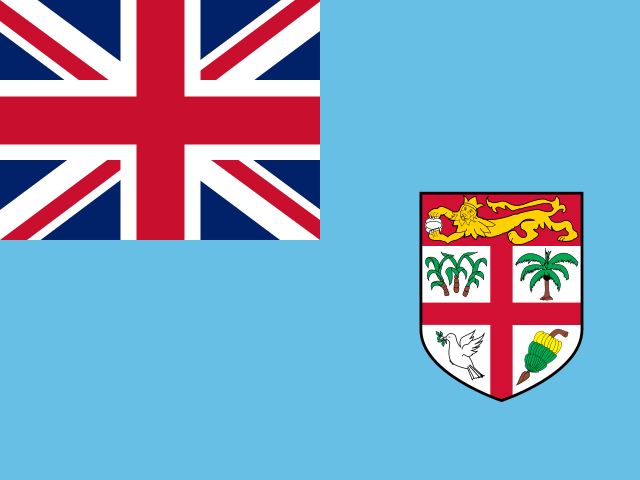
The Flag of Fiji
Oceania · Adopted 10 October 1970 (independence day)
Fiji's flag became official on 10 October 1970, the day Britain granted independence, and it is unusual among former colonies for keeping the Union Jack in its canton without ever formally dropping it since. The light blue field represents the Pacific Ocean surrounding the islands, a deliberate departure from the dark navy blue of most British colonial ensigns and one of the few genuinely original elements added at independence rather than inherited wholesale from the colonial flag that preceded it.
The shield on the fly is lifted directly from Fiji's coat of arms, which itself dates to 1908 and was granted by the British College of Arms during the colonial period. It carries a red cross on a white field (echoing the flag of St George), and quarters showing a coconut palm, a bunch of bananas, a dove of peace holding an olive branch, and stalks of sugar cane — a direct reference to the sugar industry that colonial administrators built Fiji's economy around, worked historically by indentured laborers brought from India starting in 1879, a labor migration whose descendants make up a large share of Fiji's population today. A British lion holding a cocoa pod sits above the shield, another leftover from the colonial coat of arms with no equivalent significance in independent Fiji's own economy.
Fiji came closer than almost any other former British Pacific colony to actually replacing its flag. Prime Minister Frank Bainimarama's government launched a formal redesign process in 2013, arguing that the Union Jack and colonial-era shield no longer suited an independent republic — Fiji had already left the Commonwealth once, from 1987 to 1997, following a series of coups, and rejoined only after adopting a republican constitution. A public design competition ran through 2015, drawing thousands of submissions built around Fijian motifs like the tanoa (kava bowl), masi cloth patterns, and local flora.
The redesign was shelved in 2016. The government cited the cost of replacing flags, uniforms, and signage nationwide, along with what it described as insufficient public enthusiasm for change, and no shortlisted design was ever put to a public vote. The original 1970 flag has flown unmodified ever since, making Fiji a case where a serious, government-led redesign effort was actually attempted and then abandoned rather than never seriously considered.
Some of the 2015 shortlisted entries drew on the tanoa, the large wooden bowl used in yaqona (kava) ceremonies central to Fijian custom and diplomacy, and on masi, the hand-printed barkcloth used in ceremonial dress across Fiji and much of the wider Pacific — motifs organizers felt would replace the borrowed British and colonial-era heraldic imagery with symbols drawn directly from everyday Fijian cultural practice, in contrast to a shield granted by a London-based heraldic authority in 1908.
Fiji's national rugby sevens team, Olympic gold medalists at the 2016 and 2020 Games, plays and travels under the same 1970 flag design, and rugby has arguably done more than any government campaign to cement the current flag's popular association with national pride, since the sport carries an outsized cultural weight in Fiji relative to the country's small population.
Independence in 1970 followed nearly a century of British colonial rule that began in 1874, when Fiji's paramount chiefs ceded the islands to Queen Victoria — the Deed of Cession is still commemorated and taught as a founding document of the modern Fijian state, distinct from the war-of-independence narratives that shaped the flags of many other post-colonial nations.
The flag's continued use of the Union Jack has drawn periodic criticism from republican and indigenous-rights advocates inside Fiji, but it has also been defended by others as part of Fiji's actual documented history rather than a purely imposed colonial symbol, given that cession in 1874 was a negotiated act by Fijian chiefs rather than a straightforward conquest — a nuance that makes Fiji's flag debate different in character from equivalent arguments in some other former colonies.
Fiji Day, marking both independence in 1970 and the 1874 Deed of Cession, remains the flag's central annual occasion, and the flag continues to fly over Fiji's Great Council of Chiefs meetings and government buildings in its unaltered 1970 form.
Before 1970, Fiji flew a colonial Blue Ensign defaced with the same 1908 shield, a common pattern across the British Empire in which each colony's badge was simply added to a standard ensign template rather than designed as a genuinely national flag; independence in 1970 kept the shield but swapped the colonial dark-blue field for the lighter Pacific blue and dropped the 'Colony of Fiji' framing, making the 1970 flag a modification of decades of prior colonial practice rather than an entirely new creation.
Fiji's government specifications set the flag's shape at 1:2 and define the light-blue field's shade precisely enough to distinguish it, on paper, from the darker ensign blues still used by Australia, New Zealand, and several other former British territories, even though the difference is subtle enough that casual observers rarely notice it. The Royal Fiji Navy flies its own separate white ensign, defaced with the national shield in the fly, a distinct maritime flag from the civil and state flag used on land and by government agencies.
Fiji's 2013 constitution, adopted after the Bainimarama government's return to civilian rule, left the flag's legal description untouched even while rewriting most of the country's governing framework, meaning the same 1970 design that survived four coups — in 1987 (twice), 2000, and 2006 — has now also outlasted the specific constitutional order each of those coups was fought over, a continuity Fijian officials have cited as one practical argument for leaving the design alone despite the shelved 2015 redesign effort.
A lighter blue than the neighbours'
- Dyed-through flag — The page says the field's shade is defined precisely enough to separate it from the darker blues used on similar designs nearby, which only holds if the colour is dyed rather than printed on.
As an Amazon Associate we earn from qualifying purchases made through these links, at no extra cost to you.
Often confused with
- Tuvalu — both use a light-blue field with a Union Jack canton, a format shared by several former British Pacific colonies — but Tuvalu's fly carries nine yellow stars in the geographic layout of its islands, while Fiji's carries a colonial-era shield with a red St George's cross and sugar-cane and coconut-palm quarters. Compare side by side →
Fiji at a glance
- Capital
- Suva
- Population
- 930,000 (2024)
- Currency
- Fijian Dollar (FJD)
- Language(s)
- English, Fijian (iTaukei), and Fiji Hindi (all three official)
Population figure as of 2024, source: UN World Population Prospects (2024 revision). See methodology for how facts are sourced and kept current.