Paris — Capital of France
Paris grew from Lutetia, a settlement of the Parisii, a Celtic tribe who occupied the Île de la Cité, the small island in the Seine that still sits at the geographic heart of the city today, before the Romans conquered the area in 52 BCE and built their own town on the same site. The location was never accidental — the Seine narrows and is easiest to bridge exactly there, making the island a natural crossing point on north-south trade routes long before anyone thought of it as a future national capital.
The city's status as a political capital solidified gradually rather than by a single founding decree. Clovis I, king of the Franks, made Paris his capital around 508 CE, but the title moved around considerably in the centuries that followed as Merovingian and Carolingian rulers favored other seats of power; it was really under the Capetian dynasty, beginning with Hugh Capet's coronation in 987, that Paris became fixed as the permanent royal and later national capital, a status it has held essentially without interruption for over a thousand years since — one of the longest unbroken capital tenures of any major world city.
Paris's built environment carries the marks of two transformative eras layered on top of the medieval city: the grand royal and Napoleonic-era monuments like the Louvre (originally a 12th-century fortress before its later conversion to a royal palace and, after the Revolution, a public museum) and the Arc de Triomphe, and then the sweeping mid-19th-century reconstruction under Baron Haussmann, commissioned by Napoleon III starting in 1853, which demolished much of the cramped medieval street pattern in favor of the wide, uniform boulevards and consistent building facades that give central Paris its recognizable look today.
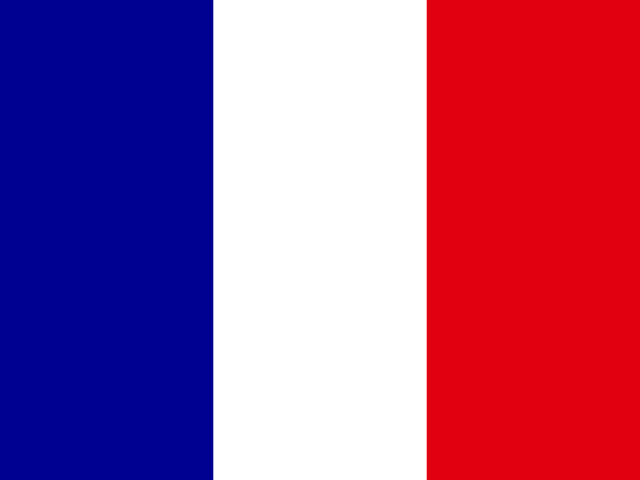
The city's association with revolution runs directly through its status as capital: the storming of the Bastille on 14 July 1789 happened in Paris specifically because that was where royal authority, and the resentment against it, was concentrated, and the tricolor flag itself was assembled from Parisian municipal colors combined with the royal white in the same summer, tying the flag's origin story to the city in a way most national flags' origin stories are not tied to their capitals.
Modern Paris remains France's political, economic, and cultural center in a way few other European capitals dominate their countries so completely — home to the National Assembly, the Senate, the Élysée Palace (the president's residence), and roughly a fifth of France's entire population within its wider metropolitan area, a level of primacy that has occasionally driven French governments to deliberately decentralize government agencies and universities to other regions to counterbalance it.
During the Nazi occupation of France from 1940 to 1944, Paris was declared an open city and largely spared the destruction inflicted on many other European capitals, though it endured harsh German administration and, on Hitler's direct order, was slated for demolition in August 1944 — an order the German military governor of Paris, Dietrich von Choltitz, ultimately refused to carry out as Allied and Free French forces approached, a decision widely credited with preserving the city's historic core intact through the war's end.
Quick facts
- Paris proper has a population of roughly 2.1 million, but its metropolitan area (Île-de-France) holds close to 12.9 million people as of 2024 estimates, making it one of the largest urban areas in Europe.
- The Eiffel Tower, completed in 1889 as a temporary entrance arch for that year's World's Fair, was originally criticized by many Parisian artists and intellectuals as an eyesore and was nearly dismantled in 1909 before its usefulness as a radio transmission tower saved it.
- Notre-Dame Cathedral, begun in 1163, suffered a major fire in April 2019 that destroyed its spire and much of the roof; a large-scale restoration reopened the cathedral to the public in December 2024.
- Paris hosted the Summer Olympics three times — 1900, 1924, and again in 2024 — making it one of only a handful of cities to host the Games three or more times.
- The city is divided into 20 numbered arrondissements spiraling outward clockwise from the Louvre, a system introduced in 1860 that Parisians still use as shorthand for neighborhood identity today.