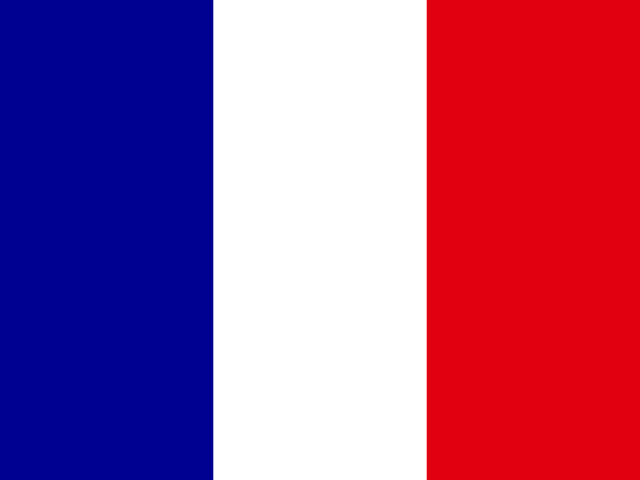
The Flag of France
Europe · Adopted 15 February 1794 (current proportions fixed 1976 for the Marine version; civil/state flag unchanged since 1830)
The French tricolore is usually dated to the summer of 1789, when the Marquis de Lafayette, then commander of the newly formed Paris National Guard, is credited with combining the red and blue of the city of Paris — colors that had already appeared on the cockades worn by revolutionaries storming the Bastille that July — with the white of the Bourbon monarchy. The idea, at least as Lafayette and his contemporaries described it, was reconciliation rather than replacement: a red-and-blue Parisian rebellion literally wrapped around a white royal center, a flag meant to hold the king and the revolution together rather than announce that one had defeated the other.
That reconciliation did not last. Louis XVI was executed in January 1793, and the following year, on 15 February 1794, the National Convention formally adopted the tricolor — by then already flying over French ships and armies for several years — as the flag of the Republic, with the current vertical blue-white-red arrangement (hoist to fly) fixed into law. The design has been suspended twice since: the restored Bourbon monarchy brought back the plain white royal flag from 1814 to 1830, and briefly again during the Hundred Days, before the July Revolution of 1830 permanently restored the tricolor, which has flown continuously as France's flag through the Second Republic, two empires, and five republics since.
Unlike many national flags where the colors carry an official symbolic reading fixed by statute, France has never legislated a single meaning for blue, white, and red. The most common civic gloss — liberty, equality, fraternity, echoing the republican motto — is a later attachment rather than the colors' original justification, which was simply Paris (blue and red) plus the crown (white). White in particular carries a genuine double history: it was the Bourbon royal color for centuries before 1789, which is exactly why keeping it in the new flag mattered symbolically in 1789 as a gesture of unity, even though the monarchy it represented was gone within a few years.
France's tricolor became the direct template for a striking number of other national flags, a fact vexillologists treat as one of the tricolore's most significant global legacies. Revolutionary and independence movements across 19th- and 20th-century Europe and Latin America — from Italy's and Romania's flags to several of the tricolor designs adopted across former French colonial Africa — borrowed the vertical- or horizontal-tricolor structure directly from the French example, sometimes substituting national colors into the same three-band format Paris had popularized.
The exact proportions of the three stripes were not perfectly even for a long stretch of the 19th century — early tricolors were sometimes woven with the blue slightly narrower than the white and red, an artifact of how the bolts of dyed cloth were originally proportioned — before a 1976 government decree standardized the naval and state version to equal thirds and specified the exact shades (a deeper 'Marine blue' and a fuller red than the pastel tones sometimes seen on cheaply printed flags) intended to be worn better and read more sharply at a distance and on television than the lighter shades used since the 1970s' rise of mass-produced flags.
The tricolor is one of France's most tightly protected national symbols: French law criminalizes public desecration of the flag, and the flag is one of the five official symbols of the Republic named directly in Article 2 of the 1958 Constitution, alongside the national anthem, the motto, the national language, and the principle of national sovereignty — a level of constitutional entrenchment that goes beyond how most countries formally treat their flag.
France's flag is genuinely rare among tricolors in having virtually no close look-alikes despite its enormous global design influence — the specific blue-white-red vertical arrangement is distinctive enough, and few other nations reuse that exact color trio in that exact order, that confusion cases are uncommon compared to, say, the many red-white-and-star or green-white-orange tricolors elsewhere in the world.
France also maintains a naval-specific version, sometimes called the Marine flag, which uses slightly different, deeper shades of blue and red than the civil land flag — a distinction that traces to a 19th-century observation that lighter dye shades faded and washed out visually at sea and in strong sunlight faster than the deeper tones the navy preferred, so French naval vessels have long flown a version subtly but deliberately different from the flag flown over town halls and government buildings on land, even though both share the same official name and legal status.
During the German occupation of France from 1940 to 1944, the tricolor itself was not banned outright, but the collaborationist Vichy regime added the francisque, a double-headed axe emblem associated with Marshal Pétain's authoritarian 'National Revolution,' to many official uses of the flag, while Free French forces under Charles de Gaulle continued flying the plain, unmarked tricolor abroad as the flag of legitimate French resistance — meaning for several years two rival versions of French authority each claimed the same base flag, a split resolved only with Liberation in 1944 when the plain tricolor was restored as the sole legitimate national flag.
Three stripes of equal width
- Stitched equal-panel flag — The page records that nineteenth-century versions were often woven with the blue narrower than the other two, and an unequal blue is still the commonest fault in a loosely made tricolour.
As an Amazon Associate we earn from qualifying purchases made through these links, at no extra cost to you.
Often confused with
- Netherlands — shares no colors with France directly, but is the flag most often cited alongside France's as the two oldest tricolor traditions in Europe, since the Dutch horizontal red-white-blue predates the French vertical version by over two centuries. Compare side by side →
- Italy — uses the exact same vertical tricolor layout France pioneered, substituting green for blue — a design choice the Cispadane Republic made in 1797 in direct imitation of the French tricolor it had adopted under French Revolutionary influence. Compare side by side →
France at a glance
- Capital
- Paris
- Population
- 66.6 million (2024)
- Currency
- Euro (EUR)
- Language(s)
- French (official)
Population figure as of 2024, source: UN World Population Prospects (2024 revision). See methodology for how facts are sourced and kept current.