Tbilisi — Capital of Georgia
Tbilisi's founding is traditionally dated to the 5th century, credited by legend to King Vakhtang I Gorgasali, who is said to have discovered the site's hot sulfur springs while hunting and named the settlement after them — 'Tbilisi' derives from the Georgian word 'tbili,' meaning warm, referring to those springs, which still feed the bathhouses of the city's historic Abanotubani district today. Whatever the legend's precise accuracy, the sulfur springs are real and remain a functioning part of the old town's identity.
The city became the capital of the Kingdom of Iberia (eastern Georgia) in the late 5th or early 6th century and has remained Georgia's political center, in one form or another, ever since — through periods of Arab, Mongol, Persian, and Ottoman domination, the medieval Georgian Golden Age under Queen Tamar in the 12th–13th centuries, absorption into the Russian Empire in 1801, a brief independence from 1918 to 1921, seven decades as capital of Soviet Georgia, and full independence again from 1991.
Persian and Russian forces both sacked Tbilisi at different points in its history — most devastatingly a Persian army under Agha Mohammad Khan in 1795, an event still referenced in Georgian national memory as one of the city's darkest episodes — and the city has been substantially rebuilt more than once as a result, which is part of why Tbilisi's architecture today mixes medieval, Persian-influenced, Russian imperial, Soviet, and post-independence styles more visibly layered than in cities with less interrupted histories.
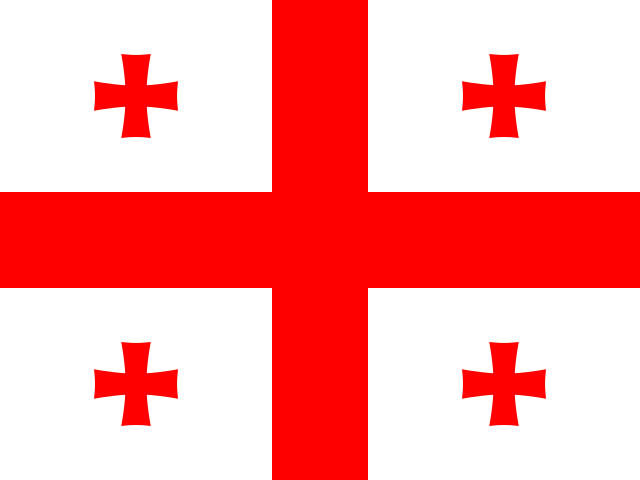
Tbilisi was the site of major pro-independence demonstrations in April 1989 that were violently suppressed by Soviet troops, an event that significantly accelerated the push toward Georgian independence achieved two years later in 1991, and the city later served as the epicenter of the 2003 Rose Revolution, the protest movement that led directly to the adoption of Georgia's current five-cross flag weeks afterward.
The Narikala Fortress, overlooking the old town from a hillside above the sulfur baths and dating in its earliest form to the 4th century with major rebuilding under various later rulers, remains Tbilisi's most prominent historic landmark and a physical symbol of the city's long defensive history at a crossroads fought over by Persian, Ottoman, Russian, and Mongol powers over the centuries.
Tbilisi's position on trade routes linking the Caucasus, Persia, and the Black Sea made it a genuine caravan city for centuries, with merchants from Armenia, Persia, and later Russia settling in distinct quarters of the old town; the Sioni Cathedral, seat of the Georgian Orthodox Church's patriarch for centuries and rebuilt multiple times after various sackings, still stands near the old caravanserai district as a marker of that layered mercantile and religious history.
Above the old town, the Kartlis Deda ('Mother of Georgia') statue, erected in 1958 on a hill overlooking the city, depicts a woman holding a sword in one hand and a bowl of wine in the other — greeting friends with wine and enemies with the sword — a piece of civic symbolism that doubles as a nod to Georgia's long winemaking tradition, one of the oldest in the world, with archaeological evidence of grape fermentation in the region dating back roughly 8,000 years.
Russia's brief war with Georgia in August 2008, fought primarily over the breakaway region of South Ossetia, brought Russian bombing within reach of Tbilisi's outskirts and prompted an exodus of displaced people into the capital from the conflict zones, an episode that hardened Georgian public opinion against Russia and accelerated the country's pursuit of closer ties with the European Union and NATO in the years since.
Quick facts
- Tbilisi's population sits around 1.2 million by recent counts — close to a third of all Georgians live in the capital, an unusually high share for a country this size.
- The city's name derives from the Georgian word for 'warm,' referring to the sulfur hot springs still in use in the old town's bathhouses today.
- The Tbilisi Funicular, opened in 1905 and later rebuilt after decades of disuse, carries passengers up Mtatsminda Mountain to a hilltop park and the Pantheon burial ground for notable Georgian writers and artists.
- Rustaveli Avenue, Tbilisi's principal thoroughfare, is lined with the Georgian National Museum, the Opera and Ballet Theatre, and the parliament building, and takes its name from the medieval poet Shota Rustaveli.
- The Bridge of Peace, a glass-and-steel pedestrian bridge over the Mtkvari River opened in 2010, was designed by Italian architect Michele De Lucchi and lights up at night with a pattern of LED sensors.