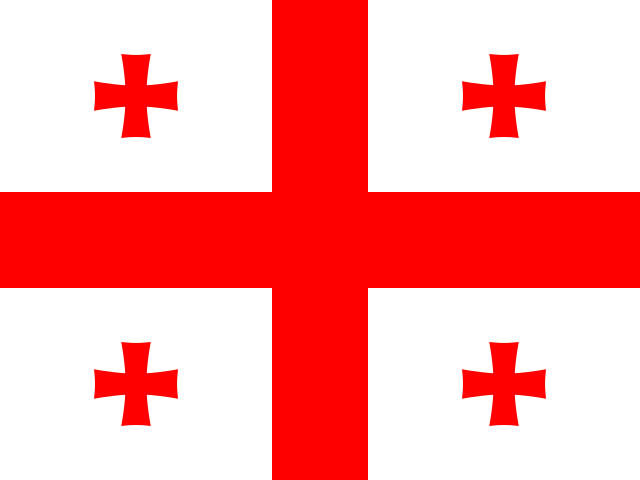
The Flag of Georgia
Asia · Adopted 14 January 2004
Georgia's current flag — a white field bearing a large red St. George's Cross that divides it into quadrants, each holding a smaller red bolnur-katskhuri cross — was adopted on 14 January 2004, just weeks after the Rose Revolution that swept Mikheil Saakashvili to power following disputed 2003 parliamentary elections. The new government's very first legislative act, fittingly given the circumstances, was to restore this medieval-derived design as the national flag, replacing the maroon flag with a small canton that independent Georgia had used since 1990.
The five-cross design is known historically as the 'Five Cross Flag' and has genuine medieval roots: variants of it appear in Georgian historical sources and church art associated with the medieval Kingdom of Georgia, and specifically with the 13th-to-14th-century reign, and it was also used as a naval and merchant flag by Georgian principalities at various points before Georgia was absorbed into the Russian Empire in the early 19th century. Rather than being invented from scratch in 2004, the design was a deliberate revival, chosen by a movement that wanted a symbol connecting the newly reformist government to Georgia's pre-Russian, pre-Soviet medieval statehood.
The main cross is popularly identified as St. George's Cross, referencing Saint George, Georgia's patron saint (the country's Georgian-language name, Sakartvelo, is unrelated etymologically to 'George,' but the English name 'Georgia' itself is linked in popular tradition, if not conclusively in scholarship, to the saint's cult, which has been central to Georgian Christian identity since at least the medieval period). The four smaller crosses in each quadrant are called bolnur-katskhuri crosses, a distinctive Georgian cross form with flared, bud-like arm ends named after the Bolnisi Sioni and Katskhi church sites where similar cross carvings have been found dating back over a millennium.
Between 1921 and 1990, Soviet Georgia's official banner followed the standard republican template — red field, gold hammer and sickle, a star near the hoist — and, briefly, from 1918 to 1921, the short-lived Democratic Republic of Georgia used an entirely different maroon flag with a black-and-white canton — the same maroon design independent Georgia readopted in 1990 after the Soviet collapse, before the 2004 switch to the medieval five-cross pattern replaced it. That means Georgia has used three genuinely distinct flag families across roughly a century: the 1918–1921 maroon flag, the Soviet hammer-and-sickle banner, and the current five-cross design, each tied to a different phase of the country's turbulent modern political history.
Georgia's 2004 flag law fixes the flag's 2:3 ratio and the precise geometry and placement of all five crosses, along with the required deep red (sometimes described as a shade close to true red rather than maroon) used throughout — a level of technical precision consistent with a flag that was deliberately restored, and legally re-codified, rather than left as an informally revived historical symbol.
Because the St. George's Cross device also appears, in a different color arrangement, on England's flag, Georgia's design is occasionally compared to England's at a glance, but the resemblance ends there — England's flag is simply a red cross on white with no additional smaller crosses, while Georgia's four bolnur-katskhuri crosses in the quadrants make its flag visually much busier and are absent from England's design entirely.
The 2004 adoption was pushed through parliament with unusual speed even by the standards of a revolutionary government eager to signal a break with the past: Saakashvili's allies argued the case directly by displaying the five-cross flag at Rose Revolution rallies in November 2003, weeks before Saakashvili had even been formally elected president, so that by the time the law reached parliament in January 2004 the flag had already become the de facto symbol of the protest movement itself rather than something parliament was choosing cold.
The bolnur-katskhuri cross form takes its name specifically from two archaeological sites: the Bolnisi Sioni Basilica, a 5th-century church in southern Georgia whose stone carvings include some of the earliest dated examples of Georgian script anywhere, and the Katskhi Pillar region in western Georgia, both places where stonework bearing this same flared-arm cross pattern has been documented by Georgian archaeologists, giving the flag's smaller crosses a traceable link to specific, datable historical sites rather than a generic medieval motif invented for the 2004 redesign.
Georgia's 20% of internationally recognized territory — the breakaway regions of Abkhazia and South Ossetia — has remained outside the control of the Tbilisi government since wars in the early 1990s and a further conflict with Russia in August 2008, and both breakaway territories fly their own separate flags rather than Georgia's five-cross design, meaning the national flag itself is a visible marker of the same territorial division that affects the country's politics and international relations more broadly.
Flag Day in Georgia is observed on 14 January to mark the 2004 law's anniversary, distinct from Independence Day on 26 May, which commemorates the 1918 declaration of the short-lived first republic — giving Georgia, like several of its post-Soviet neighbors, two separate nationally significant dates tied to two different phases of its modern statehood rather than a single founding anniversary.
Some Georgian vexillological and historical sources trace the five-cross pattern's most direct documented antecedent to a seal and banner associated with Queen Tamar's late-12th and early-13th-century reign, a period Georgians generally regard as the medieval kingdom's political and cultural peak, when Georgian territory and influence reached their greatest historical extent before Mongol invasions in the 13th century began a long decline — meaning the 2004 flag deliberately reaches back past the era of Russian and Soviet rule to reconnect with the specific high-water mark of independent Georgian statehood rather than to a more general or vaguely defined medieval past.
Five crosses in fixed positions
- Geometry-accurate flag — The four small crosses and the large one all have specified proportions and placements; the common fault is small crosses drawn too large, which closes the white gaps the design depends on.
As an Amazon Associate we earn from qualifying purchases made through these links, at no extra cost to you.
Georgia at a glance
- Capital
- Tbilisi
- Population
- 3.7 million (2024)
- Currency
- Georgian Lari (GEL)
- Language(s)
- Georgian (official)
Population figure as of 2024, source: UN World Population Prospects (2024 revision). See methodology for how facts are sourced and kept current.