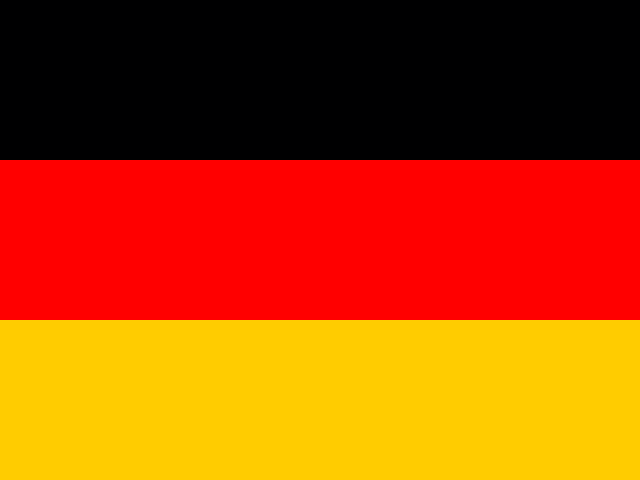
Berlin — Capital of Germany
Berlin's origins trace to twin medieval trading settlements, Berlin and Cölln, established on opposite banks of the Spree River in the 13th century and formally merged in 1307; it grew steadily as a regional trading town before becoming the seat of the Margraviate of Brandenburg and, from 1701, capital of the newly proclaimed Kingdom of Prussia — the political base from which Prussia would eventually unify Germany by force under Bismarck in 1871, at which point Berlin became capital of the new German Empire.
Berlin's 20th century was uniquely turbulent even by the standard of European capitals: capital of the Weimar Republic after 1919, capital of Nazi Germany from 1933, reduced substantially to rubble by Allied bombing and the 1945 Battle of Berlin, then divided among the four occupying Allied powers after the war. When West Germany was founded in 1949, it deliberately chose Bonn, a modest city on the Rhine, as a 'provisional' capital rather than West Berlin, both because West Berlin was a politically vulnerable enclave deep inside East German territory and as a symbolic statement that reunification, and a return to Berlin, was still the ultimate goal.
The Berlin Wall, built by East Germany in August 1961 to stop the flow of East Germans fleeing to the West through Berlin, physically split the city for 28 years, running for roughly 155 kilometers around West Berlin and becoming the single most recognizable symbol of the Cold War's division of Europe until its fall on 9 November 1989, an event that directly preceded German reunification less than a year later.
After reunification in 1990, the German parliament voted in 1991 — by a narrow margin — to move the seat of government back from Bonn to Berlin, a transition that took most of the 1990s to complete; the rebuilt Reichstag building, topped with Norman Foster's glass dome completed in 1999, symbolically reopened as the seat of the Bundestag that same year, marking Berlin's full restoration as national capital after a half-century interruption.
Today Berlin functions as Germany's political capital and a major cultural and technology hub, though — unlike Paris or London within their own countries — it does not dominate Germany economically the way those capitals dominate France and the UK, a legacy of Germany's historically federal structure, in which cities like Munich, Frankfurt, and Hamburg retain substantial independent economic weight rather than being eclipsed by the capital.
Berlin is also, unusually among national capitals, one of Germany's sixteen federal states in its own right (a 'city-state' alongside Hamburg and Bremen), meaning its mayor governs with powers roughly equivalent to a state premier — a structural leftover of its Cold War-era division and special four-power status that was preserved rather than dissolved when the city rejoined a unified German federal system in 1990.
Berlin's postwar division also produced two entirely separate zoos, two separate opera houses, and duplicate sets of major civic infrastructure that the reunified city was left to either merge or maintain side by side through the 1990s — an unusually literal, physical legacy of 45 years of political division that shaped Berlin's urban planning debates for years after the Wall itself came down.
Quick facts
- Berlin's population is approximately 3.7 million as of 2024, making it Germany's largest city and one of the most populous urban areas in the European Union.
- The city has been capital of four distinct German states in its history: the Kingdom of Prussia, the German Empire, the Weimar Republic, and (after a Bonn interlude for West Germany) the reunified Federal Republic since 1990/91.
- Checkpoint Charlie, the best-known Berlin Wall crossing point between the American and Soviet sectors, is now a museum and open-air memorial rather than a functioning border post.
- Berlin is home to three separate opera houses and dozens of museums, including the UNESCO-listed Museum Island in the Spree, a concentration of cultural institutions unusually dense even among European capitals.
- The city remained legally under joint Allied occupation status until German reunification formally ended it in 1990, an arrangement that had lasted 45 years.