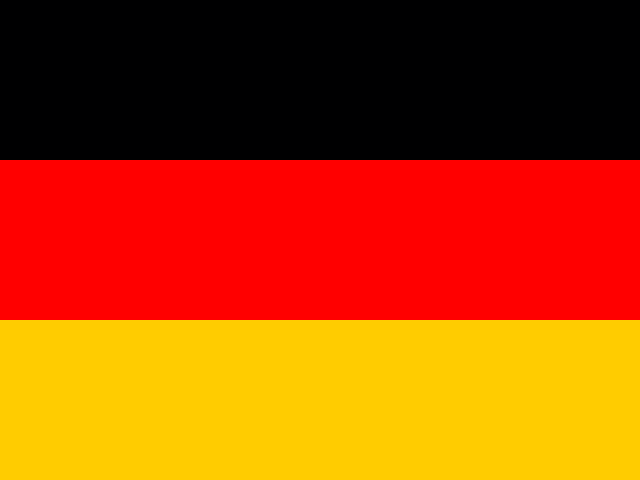
The Flag of Germany
Europe · Adopted 23 May 1949 (West Germany, reaffirmed for the reunified state 3 October 1990)
Germany's black-red-gold tricolor has a genuinely contested 19th-century origin story that the flag itself is still read through today. The most durable account traces it to the volunteer Lützow Free Corps, a Prussian militia that fought against Napoleon in 1813 wearing black uniforms with red trim and gold-colored buttons — a scrappy, improvised look rather than a designed color scheme — which student fraternities (the Burschenschaften) later adopted as a banner of German liberal nationalism at the 1817 Wartburg Festival and again at the 1832 Hambach Festival, events widely regarded as early expressions of a unified, constitutional Germany that did not yet exist as a state.
Those colors became the flag of the short-lived, revolutionary Frankfurt Parliament in 1848, the first attempt at a unified, liberal, democratic German state — an effort that ultimately collapsed without achieving unification. When Germany was finally unified in 1871, it was Prussia, not the liberal 1848 movement, that had done the unifying by force under Bismarck, and the new German Empire deliberately rejected black-red-gold in favor of black-white-red, combining Prussia's black-and-white with the red-and-white of the Hanseatic trading cities — a flag that stood for conservative, monarchical unification rather than the liberal, popular unification the 1848 tricolor had represented.
That tension — liberal black-red-gold versus imperial/conservative black-white-red — did not disappear after 1871; it resurfaced explicitly when the Weimar Republic, Germany's first genuine democracy, restored black-red-gold as the national flag in 1919, a deliberate political statement tying the new republic to the liberal 1848 tradition rather than the defeated Kaiserreich. Nationalist and monarchist factions never fully accepted this, continued flying black-white-red unofficially throughout the Weimar years, and the swastika flag replaced both in 1933 when the Nazi regime imposed its own symbol.
After the Second World War and Germany's division, both the newly founded West Germany (Federal Republic, 1949) and East Germany (German Democratic Republic, also 1949) adopted the same black-red-gold tricolor, explicitly reaching back to the Weimar and 1848 liberal tradition rather than either wartime flag. East Germany's version diverged in 1959 when it added its own state coat of arms — a hammer, compass, and ring of grain — to the center, a distinguishing addition that visually separated the two Germanys' flags for three decades and became, especially by the 1980s, a flashpoint: West German protesters and later East German pro-democracy demonstrators in 1989 were photographed cutting the emblem out of the flag entirely, flying the plain tricolor as a specifically anti-regime gesture.
When Germany reunified on 3 October 1990, the plain black-red-gold tricolor — without any emblem — became the flag of the unified country, resolving in practice the argument the two German states' competing versions had visually represented since 1959.
Officially, black-red-gold has no single legislated meaning the way some national flags do; the most common informal reading ties the colors to the historic 'Lützow black' uniforms with red facings and gold buttons, though popular explanations sometimes retroactively attach meanings like unity, justice, and freedom (echoing the words of the German national anthem's third verse, 'Einigkeit und Recht und Freiheit') to the colors after the fact rather than as their founding rationale.
The flag's construction is precisely codified: German law fixes the ratio at 3:5 and the exact shades of black, red, and gold, and the state (government) version adds the federal eagle emblem in the center, distinct from the plain civil tricolor flown by ordinary citizens and businesses — a two-tier system (plain civil flag versus emblem-bearing state flag) shared with several other European republics.
German public display of the flag itself has carried a distinct social history since reunification. For much of the postwar period, ordinary West Germans displayed the national flag comparatively rarely in everyday life outside official buildings, a restraint widely understood as a reaction against the intense, state-compelled flag nationalism of the Nazi era; that reticence visibly loosened during the 2006 FIFA World Cup, hosted in Germany, when large numbers of ordinary citizens flew or wore the tricolor at public viewing events in a wave of what German media at the time called unusually relaxed, celebratory patriotism, a moment widely discussed afterward as a genuine shift in how comfortable postwar Germans had become displaying their own flag.
Germany's federal states (Länder) each also fly their own regional flags alongside the national tricolor, several of which — Bavaria's white-and-blue lozenge pattern, for instance — carry far older regional identities that predate German unification altogether, a reminder that the national black-red-gold flag sits atop a federal structure of considerably older individual state traditions rather than having erased them.
The black-white-red imperial tricolor did not vanish from German public life after 1919 or even after 1945: far-right and nationalist groups have periodically revived it as a deliberately anti-republican countersymbol, and German authorities have at various points debated restricting its public display at demonstrations specifically because of that association — a live example of how a retired national flag can continue to carry political weight, and controversy, long after being formally replaced.
A 3:5 cut of three equal bands
- Flag cut to 3:5 — The ratio and the three shades are both fixed in law, and at 3:5 each band is exactly a third of the height, which is a proportion you can check by folding the flag in three.
As an Amazon Associate we earn from qualifying purchases made through these links, at no extra cost to you.
Often confused with
- Belgium — uses the same three colors — black, red (technically yellow/gold for Germany, gold for Belgium too) — but Belgium's are arranged as vertical bands rather than Germany's horizontal ones, and in a different color order (black, yellow, red). Compare side by side →
- Romania — no colors in common, but is frequently confused with the vertical tricolors that trace their design lineage to the same 19th-century liberal-nationalist tricolor tradition Germany's own flag emerged from, even though Romania's blue-yellow-red comes from a separate origin. Compare side by side →
Germany at a glance
- Capital
- Berlin
- Population
- 84.5 million (2024)
- Currency
- Euro (EUR)
- Language(s)
- German (official)
Population figure as of 2024, source: UN World Population Prospects (2024 revision). See methodology for how facts are sourced and kept current.