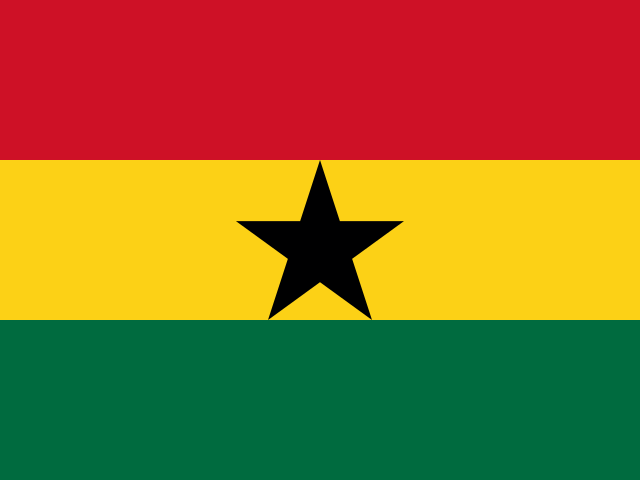
Accra — Capital of Ghana
Accra grew from a cluster of Ga fishing and trading villages along the Gulf of Guinea coast, and its name is generally traced to the Akan word nkran, meaning 'ants,' a reference either to the numerous anthills once found in the area or, in another common explanation, to the density of the local Ga settlements themselves — sources differ on which reading is more original, and both explanations circulate in Ghanaian accounts of the city's naming.
By the 17th century, Accra had become a competitive trading post for three separate European powers simultaneously: the Dutch built Fort Crèvecœur, the British built Fort James, and the Danish built Christiansborg Castle, all within a few kilometers of each other along the same short stretch of coastline — an unusually concentrated multi-power colonial presence that reflected Accra's importance to the Atlantic trade, including, for well over a century, the transatlantic slave trade that moved through these same coastal forts.
The British eventually consolidated control of the Gold Coast and made Accra the colonial capital in 1877, replacing Cape Coast, which had served as the earlier British administrative center further west — the move to Accra was driven partly by Accra's healthier climate and partly by its more central position for administering the growing colonial territory.
Accra's Christiansborg Castle, the old Danish fort, later became Osu Castle and served for decades after independence as the seat of the Ghanaian presidency, continuing a direct architectural throughline from 17th-century Danish colonial trade fort to modern seat of government until the presidency relocated to the newly built Jubilee House in 2013.
As the base from which Kwame Nkrumah organized the Gold Coast's independence movement through the 1950s, Accra carries particular significance in African decolonization history — it was in Accra that Nkrumah declared independence on 6 March 1957, and the city subsequently hosted several major pan-African conferences in the late 1950s and 1960s that Nkrumah used to position Ghana, and Accra specifically, as a symbolic capital for African liberation movements well beyond Ghana's own borders.
Today Accra is West Africa's fastest-growing major metropolitan area by some measures, its skyline transformed since the 2000s by a construction boom tied to Ghana's relatively stable democratic governance and its oil discoveries from 2007 onward, even as its historic coastal forts remain preserved as UNESCO World Heritage Sites documenting the city's earlier, harsher colonial-era trading history.
Independence Square (also known as Black Star Square), built specifically to host the 1961 visit of Queen Elizabeth II and subsequent independence commemorations, remains the site of Ghana's largest state ceremonies, anchored by the Independence Arch and a large freestanding Black Star monument that gives the square its popular name.
Accra's Jamestown neighborhood, one of the city's oldest districts and home to the old British Fort James lighthouse, has become known internationally in recent decades for its annual Chale Wote street art festival, launched in 2011, which has helped draw global attention to Accra's contemporary art and music scene well beyond the city's historical colonial-era landmarks.
Kwame Nkrumah's mausoleum, built on the site of the Old Polo Grounds where he declared independence in 1957, anchors a dedicated memorial park in central Accra that draws both domestic visitors and the wider African and Caribbean diaspora, cementing the capital's status as a pilgrimage site for pan-Africanist history well beyond Ghana's own borders.
Quick facts
- Greater Accra's metro area has swelled past 5.5 million residents, a scale that puts it among West Africa's largest urban regions and reflects decades of rapid rural-to-city migration since independence.
- Three separate European colonial powers — the Netherlands, Britain, and Denmark — each built competing forts in Accra within a few kilometers of one another in the 17th century.
- Accra replaced Cape Coast as the Gold Coast's colonial capital in 1877.
- Kwame Nkrumah declared Ghana's independence from Accra on 6 March 1957, making it the first sub-Saharan African capital of an independent, formerly colonized state.
- The W.E.B. Du Bois Memorial Centre for Pan-African Culture in Accra preserves the home where the American scholar and civil-rights leader spent his final years after moving to Ghana at Nkrumah's invitation in 1961, and includes his grave alongside that of his wife, Shirley Graham Du Bois.