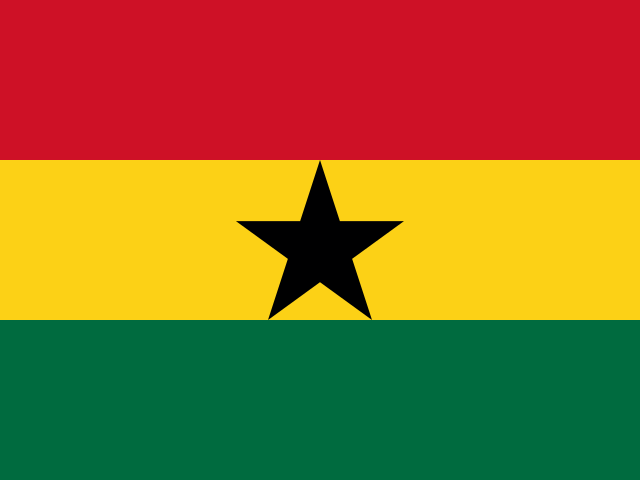
The Flag of Ghana
Africa · Adopted 6 March 1957 (readopted 1966 after a 1964–1966 one-party-state variant)
Ghana's flag, adopted on 6 March 1957 the moment the country became the first sub-Saharan African colony to gain independence from European rule, was designed by Theodosia Okoh and became an instant template for the wave of African independence movements that followed over the next decade — Ghana's leader Kwame Nkrumah explicitly framed the new nation's flag colors as a deliberate homage to Ethiopia, the one African country never colonized, and urged other soon-to-be-independent African states to adopt similar palettes as a visible marker of pan-African solidarity.
Red, gold, and green run horizontally, with a large black five-pointed star centered on the gold band. Red stands for the lives lost in the fight to end British colonial rule (as well as in the broader African liberation struggle Nkrumah championed continent-wide); gold represents the mineral wealth of the country, formerly named the Gold Coast under British rule specifically because of its historic gold trade; and green represents the country's rich forests and agricultural land, including the cocoa industry that dominated its colonial-era export economy.
The black star at the center, sometimes called the 'lodestar of African freedom' in Ghanaian political rhetoric of the era, is Ghana's own original contribution to the pan-African flag tradition rather than a borrowing from Ethiopia's design — it was inspired by the Black Star Line, the shipping company founded by Jamaican Pan-Africanist Marcus Garvey in 1919 as part of his 'Back to Africa' movement, and Nkrumah deliberately adopted the symbol to link Ghana's independence to that earlier diaspora-driven Pan-Africanist tradition.
Ghana briefly modified its flag between 1964 and 1966: after Nkrumah's government formally declared Ghana a one-party state under the Convention People's Party in a 1964 referendum, the white band replacing gold in one version and other adjustments were tied to CPP symbolism, but the 1966 military coup that overthrew Nkrumah restored the original 1957 red-gold-green-with-black-star design, and that restored version has remained unchanged since.
Because red-gold-green (or red-yellow-green) with a black star or similar central emblem became such a widely copied combination after Ghana's 1957 independence — directly influencing the flag choices of Guinea (1958), Mali, Senegal, and numerous other newly independent African states over the following years — Ghana's flag is sometimes described as the design that turned Ethiopia's originally singular pan-African palette into a genuinely continent-wide visual movement.
Set next to Ethiopia's own flag, the family resemblance is obvious at a glance — same three base colors — but the two center pieces have nothing in common: Ethiopia's is a blue disc radiating light around a star, Ghana's a single solid black star with no disc at all, and even the stripe order runs in opposite directions, Ghana's red-gold-green against Ethiopia's green-yellow-red.
Ghana's black star also appears, distinct from the flag itself, on the country's coat of arms and on the crest of the national football team, nicknamed the Black Stars, one of the more visible everyday reminders of the flag's central symbol beyond formal government use.
Theodosia Okoh, the flag's designer, was a schoolteacher and artist rather than a professional heraldic designer, and her winning design was selected through a national competition Nkrumah's government held ahead of the 1957 independence ceremony — she remains one of relatively few women credited by name as the principal designer of an African national flag, a detail Ghanaian civic and educational material has increasingly highlighted in recent decades.
Ghana's flag was lowered from the Gold Coast's colonial governor's residence and the Union Jack raised in its place one final time at midnight on 5–6 March 1957, in a ceremony at Accra's Old Polo Grounds where Nkrumah delivered his famous declaration that Ghana's independence was 'meaningless unless it is linked up with the total liberation of the African continent' — a speech now closely associated with the flag's own pan-African symbolism and frequently quoted alongside descriptions of the black star's Marcus Garvey lineage.
The 1966 coup that restored the original flag design also ended Nkrumah's presidency for good; he was overthrown while on a state visit to China and never returned to Ghana, living the rest of his life in exile in Guinea, whose own president, Sékou Touré, granted him honorary co-presidency in a gesture of pan-African solidarity that echoed the very ideals the black star had been chosen to represent.
Ghana's Independence Day, 6 March, remains the flag's most significant annual occasion nationwide, marked with parades at Independence Square in Accra — built specifically to host large-scale independence commemorations — where the flag's red-gold-green bands and central black star are displayed at a scale matching the day's status as one of the most celebrated anniversaries on the West African calendar.
Ghanaian government style guides call specifically for a warm, saturated gold rather than a duller plain yellow on the central band of the standard 2:3 flag, distinguishing it from several other pan-African tricolors that opt for plain yellow — a detail tied directly to the Gold Coast's own historical gold trade rather than a generic color choice.
Ghana's transition from British colony to independent republic proceeded in two stages, first as a self-governing dominion within the Commonwealth from 1957 to 1960, then as a full republic under Nkrumah as president from 1960 onward — the flag itself was unaffected by that second-stage transition, having already been fixed in its final red-gold-green-and-star form since the original 1957 independence ceremony, well before the republic status vote of that later year.
Warm gold, not plain yellow
- Colourfast outdoor flag — The page is explicit that the middle band should be a warm saturated gold rather than a flat yellow, and that is the first colour to wash out on a surface-printed flag left in the sun.
As an Amazon Associate we earn from qualifying purchases made through these links, at no extra cost to you.
Often confused with
- Ethiopia — shares the same green-yellow/gold-red pan-African palette that Ghana deliberately borrowed in tribute, but Ethiopia centers a blue disc and star rather than a solid black star, and reverses the stripe order. Compare side by side →
Ghana at a glance
- Capital
- Accra
- Population
- 34.1 million (2024)
- Currency
- Ghanaian Cedi (GHS)
- Language(s)
- English (official); Akan (Twi), Ewe, Ga, and other languages widely spoken
Population figure as of 2024, source: UN World Population Prospects (2024 revision). See methodology for how facts are sourced and kept current.