St. George's — Capital of Grenada
St. George's was founded by French colonists in 1650 around a natural horseshoe-shaped harbor on Grenada's southwestern coast, originally under the name Fort Royal, before the island passed to British control in 1763 under the Treaty of Paris that ended the Seven Years' War, at which point the town was renamed St. George's; the harbor's shape and depth made it one of the best natural anchorages in the Eastern Caribbean, a geographic advantage that secured the town's status as Grenada's capital through both French and British colonial periods and into independence.
The city is frequently described as one of the most picturesque capitals in the Caribbean, with pastel-colored buildings and red-tiled roofs rising up the hillside around the Carenage — the inner harbor, whose name directly echoes the same careening function (ships tipped on their sides for cleaning) that gave Bridgetown, Barbados its own harbor name, reflecting a shared vocabulary of colonial-era Caribbean shipping terminology used across multiple British island possessions.
St. George's was the epicenter of Grenada's most turbulent modern political period: the 1979 revolution that brought Maurice Bishop's People's Revolutionary Government to power was centered in the capital, and the internal party conflict that led to Bishop's house arrest and execution in October 1983 unfolded largely in and around Fort Rupert (formerly Fort George), overlooking the city — the crisis that followed triggered the U.S.-led Operation Urgent Fury days later, with American forces landing near the capital and effectively ending the revolutionary government within days.
Hurricane Ivan struck Grenada directly in September 2004, one of the most destructive storms in the island's modern history, damaging an estimated 90 percent of buildings on the island including much of St. George's historic housing stock and its landmark St. George's Anglican and Catholic cathedrals, both of which required extensive reconstruction in the years that followed.
St. George's University, founded in 1976 on the edge of the capital, has grown into one of the largest medical and veterinary schools in the Caribbean, drawing thousands of international students, particularly from the United States, and has become a significant part of the capital's economy and international profile alongside its traditional roles as Grenada's seat of government, main port, and spice-export hub.
St. George's University itself was directly caught up in the 1983 crisis, since a substantial number of American medical students were enrolled on the campus at the time of Operation Urgent Fury, and the U.S. government cited their safety as one of its stated justifications for the intervention — a detail that ties the university, otherwise known today mainly for its academics, directly into the most consequential political event in the capital's modern history.
Fort George, built by the French in the 1700s and later renamed Fort Rupert after Prince Rupert of the Rhine before reverting informally to its earlier name in some local usage, sits on a promontory overlooking the Carenage and remains one of the best-preserved 18th-century fortifications in the Eastern Caribbean, offering panoramic views of the harbor that made St. George's such a strategically valuable port for both French and British colonial powers.
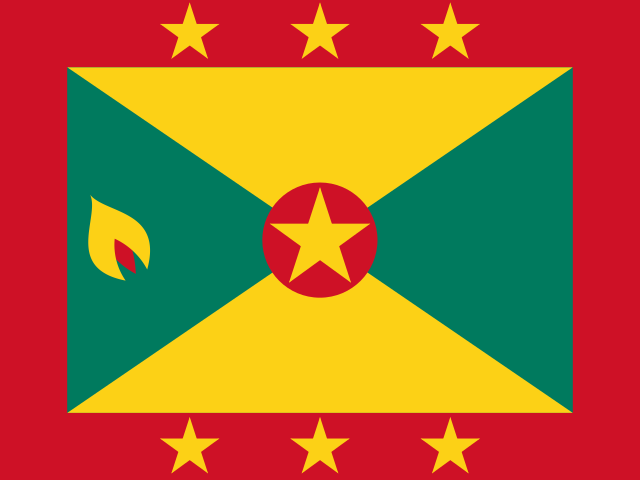
St. George's Market Square, a short walk from the Carenage, has operated as a produce and craft market for generations and remains one of the best places in the capital to see the nutmeg, cinnamon, cocoa, and other spices that give Grenada its 'Isle of Spice' identity sold directly by local growers, a living continuation of the same agricultural economy referenced on the national flag.
Quick facts
- Around 33,000 people live in St. George's and its wider urban fringe, out of a national population of roughly 126,000 spread across Grenada, Carriacou, and Petite Martinique.
- The Sendall Tunnel, cut through the ridge separating the Carenage from the Esplanade in 1895, still carries daily traffic and is named for a 19th-century British colonial governor of the island.
- York House, an 18th-century Georgian building in the capital, has served since independence as the seat of both Grenada's Parliament and its Supreme Court under a single roof.
- Grenada's national museum occupies a building that began as an 18th-century French army barracks and later operated as a hotel where a young Josephine Bonaparte reportedly once stayed.
- St. George's University's main campus sits on a peninsula at True Blue, separate from its original Grand Anse site, and today enrolls students from well over 140 countries.