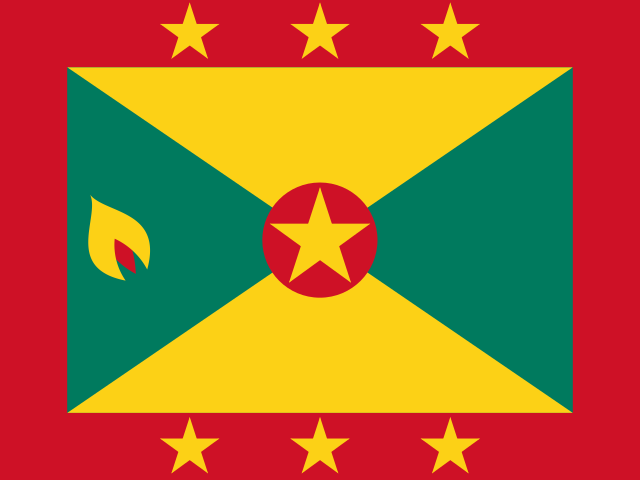
The Flag of Grenada
North America · Adopted 7 February 1974
Grenada adopted its flag on 7 February 1974, the day it became independent from Britain, in a design credited to Anthony C. George, a Grenadian artist whose concept was chosen from a national competition ahead of independence. The design replaced the colonial Blue Ensign and settled on a red border enclosing triangular fields of yellow and green arranged in an X, or saltire, pattern — a distinctive layout among Caribbean flags, most of which favor horizontal or vertical stripes rather than a bordered diagonal-triangle arrangement.
Green represents Grenada's vegetation and agriculture, particularly the nutmeg and spice cultivation the island has long been known for internationally — Grenada is sometimes called the 'Isle of Spice' and was, for much of the 20th century, one of the world's leading nutmeg producers. Yellow stands for the sun and the warmth of the Grenadian people, and red for the unity, courage, and vitality of the nation, with red also framing the entire flag as a border, a distinctive choice that sets Grenada's design apart from flags that use red only as one stripe among several.
Seven yellow five-pointed stars are arranged around the flag's red border — six along the top and bottom edges plus one larger star centered in the red triangle at the hoist — representing Grenada's six parishes plus Carriacou and Petite Martinique, the two smaller inhabited islands that form part of the same nation, giving the star count a specific administrative meaning tied to Grenada's exact territorial divisions rather than a round or symbolic number.
A stylized nutmeg pod appears on the green triangle at the hoist side, a direct and literal reference to the crop most associated with Grenada's economy and identity — few national flags anywhere in the world depict a specific agricultural product this explicitly, and the nutmeg's inclusion reflects how central spice cultivation has been to Grenada's economic self-image since the crop was introduced in the 1840s and grew into the island's dominant export by the 20th century.
Grenada's flag survived one of the more turbulent periods of any Caribbean nation's post-independence history without being altered: the 1979 Grenadian Revolution brought the People's Revolutionary Government to power under Maurice Bishop, followed by internal factional violence in October 1983 that led to Bishop's execution and, days later, a U.S.-led military intervention, Operation Urgent Fury, that removed the revolutionary government — through all of it, the 1974 flag design remained the national flag, never replaced by any revolutionary government banner despite the scale of the political upheaval.
The flag has not been redesigned since 1974, and its specifications, including the exact proportions of the red border and the star placement, are set by Grenadian law; the flag is flown prominently on Independence Day, 7 February, and on Thanksgiving Day, 25 October, commemorating the end of the 1983 U.S.-led intervention, a date whose very existence reflects how directly that crisis shaped modern Grenadian national memory.
Because the red-bordered X-pattern with corner stars is a genuinely uncommon flag layout worldwide, Grenada's flag has few close look-alikes among sovereign states, making it one of the more visually distinctive flags in the Eastern Caribbean despite the region's shared British colonial background.
Anthony George's original competition entry is preserved in Grenadian government archives, and the seven-star arrangement he chose deliberately mirrors Grenada's exact administrative geography rather than using a rounder, more symbolic number the way some other Caribbean flags do — Grenada's six parishes (Saint George, Saint John, Saint Mark, Saint Patrick, Saint Andrew, and Saint David) plus the dependencies of Carriacou and Petite Martinique together account for all seven points, a level of specific administrative correspondence uncommon among Caribbean independence-era flags.
The 1979 revolution briefly considered adopting new revolutionary symbols more broadly — the People's Revolutionary Government under Maurice Bishop introduced new currency and state emblems in some contexts — but the national flag itself was never formally targeted for replacement even during the most ideologically assertive period of the revolutionary government, and after the 1983 U.S.-led intervention restored constitutional government, the same 1974 flag simply continued in use without any need for a post-crisis redesign.
Nutmeg cultivation, referenced directly on the flag, was devastated in Grenada by Hurricane Ivan in 2004 and again by Hurricane Emily in 2005, destroying the large majority of the island's nutmeg trees, which take years to mature; the industry has only partially recovered in the two decades since, giving the flag's literal nutmeg pod emblem a bittersweet resonance for an economic sector that has never fully returned to its earlier prominence in the Grenadian economy.
Grenada gained independence later than several of its Eastern Caribbean neighbors, in 1974, under Prime Minister Eric Gairy, whose increasingly authoritarian rule in the years that followed helped set the stage for the 1979 revolution that eventually overthrew him — meaning the flag's adoption predates by five years the political upheaval that would go on to define much of the country's international reputation through the 1980s, even though the design itself was never altered by any of the governments that came after Gairy.
Seven stars, six in the border
- Placement-accurate flag — Six stars sit in the red border and one in a central disc, and both the border's width and where those stars fall along it are specified, so a crowded or uneven border is a redraw.
As an Amazon Associate we earn from qualifying purchases made through these links, at no extra cost to you.
Grenada at a glance
- Capital
- St. George's
- Population
- 126,000 (2024)
- Currency
- Eastern Caribbean Dollar (XCD)
- Language(s)
- English (official); Grenadian Creole widely spoken
Population figure as of 2024, source: UN World Population Prospects (2024 revision). See methodology for how facts are sourced and kept current.