Bissau — Capital of Guinea-Bissau
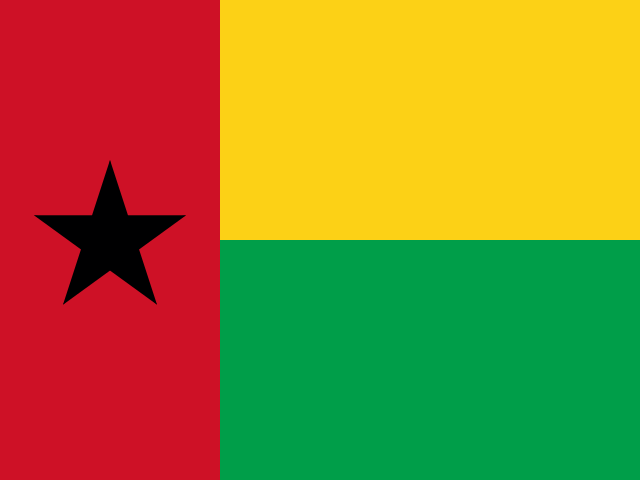
See the flag of Guinea-Bissau →
Bissau began as a Portuguese fortified trading post established in 1687 at the mouth of the Geba River, built primarily to service the transatlantic slave trade along this stretch of the West African coast — a grim origin the city shares with several other former colonial ports in the region. It grew slowly under Portuguese control for centuries before being formally made the capital of Portuguese Guinea in 1941, replacing the earlier colonial seat at Bolama.
The city became the focal point of the PAIGC's independence struggle in the 1960s and 1970s, and its outskirts saw fighting during the guerrilla war Portugal fought to hold onto the colony; Bissau became capital of the newly declared republic in 1973 and remained so after Portugal's formal recognition of independence in 1974.
Bissau's old colonial quarter, known as the Praça, retains much of its Portuguese-era architecture, including the Bissau Cathedral, built in the 1930s-40s, and a scatter of crumbling colonial buildings that reflect both the city's age and decades of limited investment since independence.
The city has repeatedly been the epicenter of Guinea-Bissau's political instability: it was the site of the 1980 coup that brought João Bernardo Vieira to power, heavy urban fighting during the 1998–1999 civil war that devastated parts of the city, and numerous subsequent coups and attempted coups into the 2000s and 2010s — a record that has left Bissau with some of the most fragile state institutions in West Africa.
Despite this turbulence, Bissau remains the country's only major urban center and its economic hub, anchored by a port that handles the country's modest cashew-nut exports — cashews are Guinea-Bissau's dominant cash crop and export earner, a reliance that makes the capital's port activity closely tied to a single commodity's global price swings.
The independence movement Bissau ultimately inherited was led for most of its duration by Amílcar Cabral, the PAIGC's founder and chief strategist, who was assassinated in Conakry in January 1973, just months before the PAIGC unilaterally declared independence from a rebel-held base rather than from Bissau itself, which remained under Portuguese control until the following year — meaning the man most closely associated with founding the nation never saw its capital under the flag he had fought for.
Bandim, one of Bissau's oldest and most densely populated neighborhoods, grew up around a large open-air market that remains one of West Africa's notable informal trading hubs, and the district has also been the subject of one of the longest-running demographic health surveillance studies in Africa, tracking births, deaths, and disease in the community continuously since 1978.
In the 2000s and 2010s, Bissau's weak state institutions and porous port made the country, and the capital in particular, a well-documented transit point for South American cocaine moving toward European markets, a problem serious enough that international observers and Guinea-Bissau's own officials at times described the country as at risk of becoming a 'narco-state' — a label that has complicated the capital's efforts to attract foreign investment even as its underlying economic base remains cashews.
Quick facts
- Around 500,000 people live in Bissau by 2024 estimates — a figure so far ahead of any other Guinea-Bissau town that the country effectively has just one real city.
- The city's name gave the country half of its own — 'Guinea-Bissau' distinguishes it from neighboring Guinea (capital Conakry), a naming convention adopted specifically to avoid confusion between the two Guineas.
- Bissau replaced Bolama as colonial capital in 1941 and has held the role continuously since, through independence and every subsequent government.
- The Fortaleza d'Amura, a Portuguese-built fortress in the city, still functions as a military installation and is one of Bissau's oldest surviving colonial structures.
- Guinea-Bissau is among the world's top cashew-nut exporters relative to its size, and Bissau's port is the near-exclusive channel through which that crop reaches international markets.
- Guinea-Bissau has cycled through more than a dozen changes of head of state or government since 1980, a pace of political turnover among the highest of any country in the world over that period.
- Bissau's Bandim neighborhood has hosted a continuous public-health demographic surveillance study since 1978, among the longest-running of its kind in Africa.